
Estimated reading time: 6 minutes
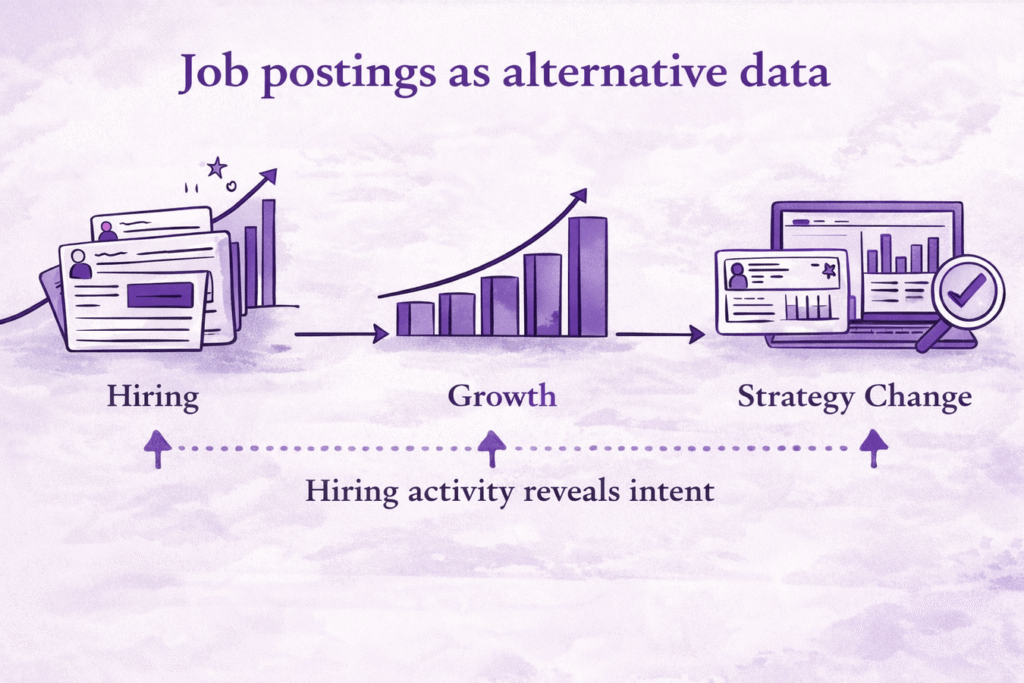
Job postings data is one of the clearest forms of alternative data because it shows what companies are doing before they announce it publicly. When a company starts hiring for sales, data engineering, security, operations, or market expansion roles, it is often revealing budget, strategy, and operational intent in real time.
Traditional company profiles describe what a business is. Hiring activity shows what a business is becoming.
That is why job postings data is useful for sales prospecting, account scoring, market intelligence, investment research, and alternative data workflows. It helps teams identify companies that are growing, changing priorities, entering new markets, or preparing for major operational work.
What is job postings data?
Job postings data is structured information collected from company career pages, job boards, applicant tracking systems, and other public sources where companies publish open roles. Instead of treating job listings as recruiting content, analysts use them as signals of company behavior.
A single job post can be noisy. A pattern of hiring activity across teams, locations, seniority levels, and time periods can reveal much more.
- Which departments are expanding
- Where budget is being allocated
- Which markets or regions a company is entering
- What technologies, functions, or capabilities the company is investing in
- Whether growth is consistent, slowing, or accelerating
In short: job postings data helps turn hiring activity into a measurable business signal.
Why job postings work as alternative data
Alternative data is valuable when it reveals movement that traditional datasets miss. Firmographic data can tell you a company’s industry, location, or estimated size. Job postings data can show what the company is actively preparing to do next.
Hiring is especially useful because opening a role usually requires internal approval. Someone agreed there is a need, a budget, and a plan. That makes hiring activity a stronger signal than passive interest or static profile data.
| Hiring signal | What it may indicate | How teams can use it |
|---|---|---|
| Sales and RevOps roles increasing | Go-to-market expansion | Prioritize accounts for outbound or partner outreach |
| Data engineering and analytics roles | Investment in data infrastructure | Identify companies likely to need data tools, APIs, or enrichment |
| Security and compliance roles | Risk, audit, or enterprise readiness pressure | Target companies with relevant security, legal, or compliance solutions |
| Regional sales or operations roles | Market expansion | Find companies entering new geographies |
| Product and engineering hiring spikes | Product investment or roadmap acceleration | Monitor competitors, emerging categories, or growth-stage companies |
Job postings data vs firmographic data
Firmographic data is useful for defining a market. Job postings data is useful for understanding timing.
A company can match your ideal customer profile for years without showing any buying readiness. Hiring activity adds a layer of urgency. It helps answer questions like:
- Is this company investing in a relevant team right now?
- Has hiring accelerated or slowed over the last few months?
- Are they building internally or likely to buy external tools?
- Which business function is under pressure?
This is why hiring data often works best when combined with firmographic, technographic, funding, and company news data. The firmographics define who the company is. The hiring activity helps explain what is changing.
How to use job postings data for sales prospecting
For sales and GTM teams, job postings data can turn generic prospecting into signal-based outreach. Instead of contacting every account in a static list, teams can prioritize companies showing current movement.
Examples:
- A company hiring multiple data engineers may be investing in analytics infrastructure.
- A company adding customer success roles may be scaling revenue operations.
- A company opening sales roles in a new region may be expanding into that market.
- A company hiring security roles may be preparing for enterprise customers, compliance reviews, or audits.
These signals make outreach more specific. They also help sales teams avoid accounts that look good on paper but show no current momentum.
Related guide: How to Use Job Openings Data for Sales Prospecting.
How to use job postings data for account scoring
Hiring activity can also improve lead scoring and account prioritization. Instead of scoring only by company size, industry, or funding, teams can include current hiring patterns.
- Hiring volume: how many roles are currently open?
- Hiring recency: did the company start hiring recently?
- Role mix: which functions are growing?
- Location pattern: where is the company expanding?
- Trend direction: is hiring increasing, stable, or declining?
This turns job postings data into a practical input for sales operations, RevOps, partner teams, investors, and market researchers.
Why historical job postings data matters
Current job postings show what a company is hiring for today. Historical job postings data shows how company priorities change over time.
That history is useful because a single open role can be random. A three-month or twelve-month trend is much more meaningful.
- Steady growth can indicate durable expansion.
- Sudden hiring spikes can indicate new initiatives or urgent needs.
- Hiring pauses can indicate uncertainty or shifting priorities.
- Department-level changes can reveal strategy before public announcements.
For investors and researchers, historical hiring data can support market mapping, competitor monitoring, and early growth detection. For sales teams, it can help separate temporary noise from real buying intent.
What to look for in a job postings data provider
If you are evaluating job postings data providers, look beyond raw job count. The value comes from structure, freshness, history, and how easily the data fits into your workflow.
- Coverage: How many companies and sources are tracked?
- Freshness: How often are postings updated?
- Historical depth: Can you analyze hiring trends over time?
- Structured fields: Are titles, locations, seniority, categories, and company domains normalized?
- Delivery: Is the data available via API, export, or direct integration?
- Context: Can hiring data be combined with technologies, funding, company news, or similar companies?
For a broader vendor comparison, see Top 5 Job Data Providers in 2026.
How PredictLeads uses job postings data
PredictLeads tracks company changes across hiring activity, technologies, company news, funding events, key customers, and similar companies. The Jobs Dataset is designed for teams that need structured hiring signals inside sales, GTM, research, and investment workflows.
- Use it to identify companies with active hiring momentum.
- Combine it with technology signals to understand operational priorities.
- Track historical hiring patterns for market intelligence.
- Feed hiring signals into lead scoring, enrichment, and account prioritization workflows.
Learn more about how hiring data connects to growth analysis in Job Openings Data as a Leading Indicator of Company Growth.
FAQ
Is job postings data alternative data?
Yes. Job postings data is commonly used as alternative data because it provides external signals about company activity, growth, investment priorities, and operational change.
What can job postings data reveal about a company?
It can reveal which teams are growing, where the company is expanding, what capabilities it is investing in, and whether its priorities are changing over time.
How is job postings data used in sales?
Sales teams use hiring activity to prioritize accounts, personalize outreach, identify expansion signals, and time conversations around current business needs.
Why is historical hiring data useful?
Historical hiring data helps teams see whether a company’s hiring is accelerating, slowing, or shifting between departments. This makes it easier to distinguish real trends from one-off job posts.
What is the difference between job postings data and labor market data?
Labor market data often focuses on broad employment trends. Job postings data can be used at the company level to understand specific hiring activity, team growth, and account-level intent.
Conclusion
Job postings are not just recruitment noise. They are public signals of company intent.
When structured and analyzed over time, job postings data can show where companies are investing, which teams are growing, and when accounts are more likely to be in motion. That makes hiring activity one of the most useful alternative data sources for understanding company growth and buying intent.
Want to use hiring activity in your own GTM, research, or account scoring workflows? Explore PredictLeads or review the PredictLeads API docs to see how structured company signals can fit into your stack.