
Job openings data is one of the most useful leading indicators of company growth because hiring activity often appears before funding announcements, product launches, market expansion news, or revenue changes become visible.
When a company opens new roles, it is usually committing budget, building capacity, and preparing for a business change. That makes job openings data valuable for sales teams, investors, market intelligence teams, and lead scoring models that need earlier growth signals.
Quick Answer: How Job Openings Data Signals Company Growth
Job openings data can signal company growth when hiring increases across specific teams, locations, seniority levels, or technical roles. A spike in sales hiring may indicate GTM expansion. A rise in engineering roles may indicate product investment. New roles in a country or region may indicate market expansion.
Related guides: job postings data for company intent, best job data providers for labor market data, and how to use job openings data for sales prospecting.
Why Hiring Signals Matter
When a company starts hiring, it is making a commitment.
Hiring requires budget, planning, and long-term intent. Companies do not randomly open roles. They hire because they are expanding teams, building new products, entering new markets, or scaling operations.
This makes hiring one of the clearest signals of internal momentum.
Unlike static datasets, job openings data captures this momentum in real time.
What Job Openings Data Reveals
Job postings provide direct insight into how a company is evolving.
They show which teams are growing, what roles are being prioritized, and which capabilities the company is investing in. Over time, patterns emerge.
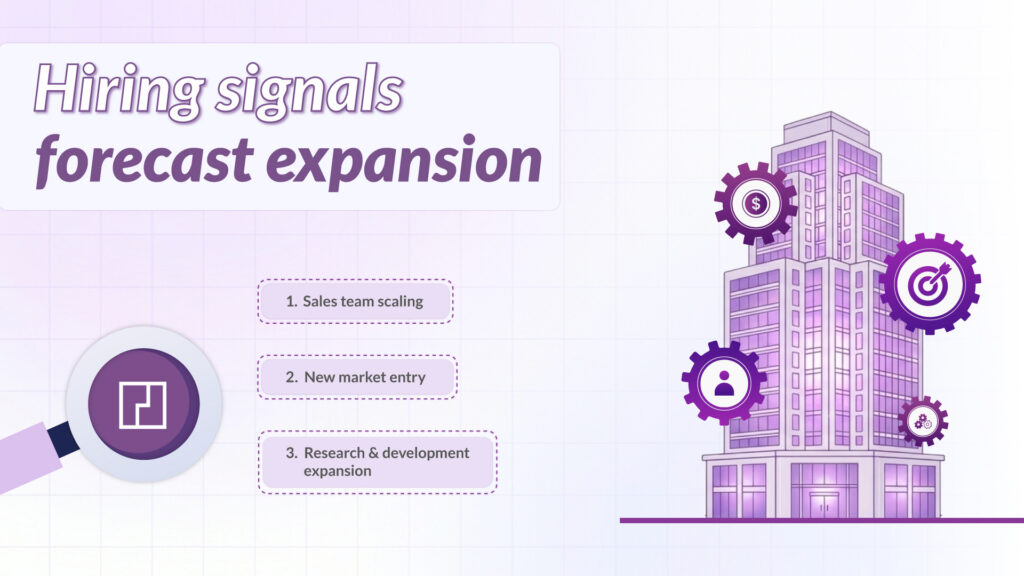
A company hiring multiple engineers suggests product expansion while hiring sales and marketing roles signals go-to-market investment. A company opening roles in new regions indicates geographic expansion.
These signals are often visible before any official announcement.
Early Detection of Growth
One of the key advantages of job openings data is timing.
Companies typically hire before major changes become visible externally. They build teams before launching products and hire engineers before scaling infrastructure. They expand hiring before entering new markets.
This means job openings data allows you to detect growth earlier than traditional indicators.
For investors, this can signal opportunity. Sales teams use it to highlight accounts that are about to increase spending. For analysts, it reveals shifts in market dynamics.
From Hiring Activity to Strategic Insight
Hiring data is not just about counting jobs. It is about understanding intent.
A sudden increase in hiring often indicates acceleration. A shift in job roles can reveal a strategic pivot. Consistent hiring in specific areas shows long-term focus.
For example, if a company starts hiring data engineers, machine learning specialists, and infrastructure roles at the same time, it likely indicates a deeper investment in data capabilities.
This type of insight is difficult to capture with traditional datasets.
For a practical example, see our guide on how to find companies hiring data engineers using hiring signals and job data.
Why Data Quality Matters
Not all job openings data is equally reliable.
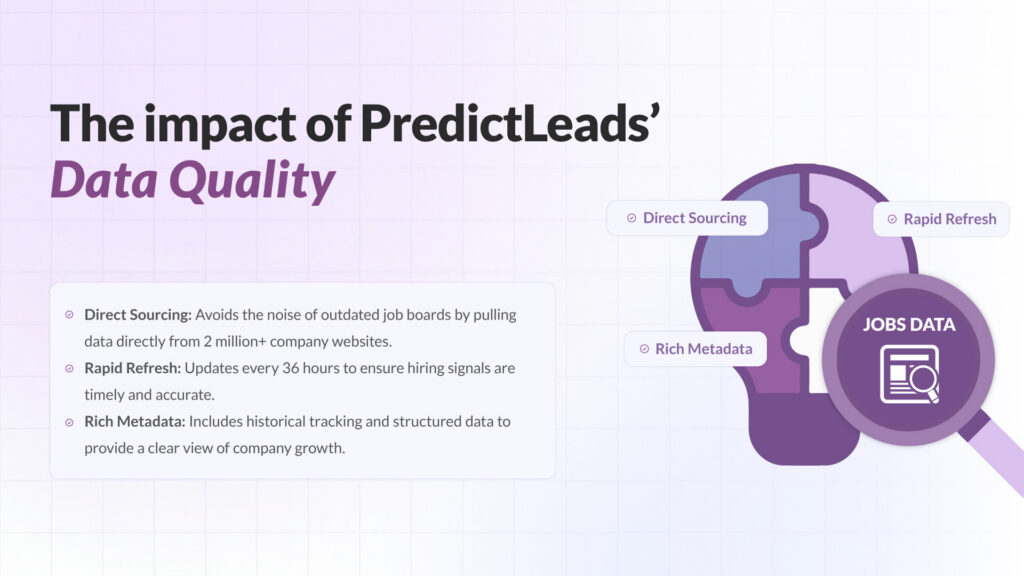
Many providers rely on job boards, which often contain outdated or duplicated listings. This introduces noise and reduces the usefulness of the data.
Accurate job openings data should be:
- sourced directly from company websites
- frequently updated
- enriched with structured metadata
- historically tracked
This is where PredictLeads stands out.
By sourcing job data directly from company websites and refreshing it every 36 hours, PredictLeads provides a more accurate and timely view of hiring activity across more than 2 million companies globally.
Connecting Hiring Data With Other Signals
Job openings data becomes even more powerful when combined with other datasets.
When hiring signals are aligned with funding events, product launches, or technology adoption, the picture becomes much clearer.
A company raising funding while expanding hiring is likely scaling. A company hiring engineers while adopting new technologies may be investing in infrastructure. A company expanding hiring across regions may be entering new markets.
This combination transforms hiring data into a broader company intelligence layer.
Real-World Applications
Organizations are increasingly using job openings data to guide decisions.
Sales teams use it to identify companies that are actively investing and likely to buy. Investors use it to detect early growth signals and evaluate momentum. Market intelligence teams use it to track industry trends and understand how companies evolve over time.
In all cases, the value comes from timing and context.
Final Thoughts
Job openings data provides a unique view into company behavior.
It captures what companies are doing before it becomes visible through traditional signals. It reveals growth, strategy, and intent in real time.
As a result, it has become one of the most effective leading indicators of company growth.
For organizations looking to move faster and make better decisions, hiring data is no longer optional. It is essential.
Quick Chat?
If you want access to reliable, real-time job openings data, PredictLeads provides structured hiring data sourced directly from company websites, with global coverage and continuous updates.
Learn more:
https://docs.predictleads.com/guide/job_openings_dataset
Related Reading
- PredictLeads Job Openings Dataset for Hiring Signals
- Job Postings Data for GTM Buying Signals
- Job Openings Data for Sales Prospecting
Ready to see this in your own data?
Get 100 free API requests/month – no credit card, no sales call.