
NVIDIA hiring trends offer a useful example of how job openings data can reveal company strategy before it appears in earnings calls, product announcements, or analyst reports. By looking at the roles a company is hiring for, teams can understand where it may be investing next.
For NVIDIA, hiring activity around AI engineering, GPU systems, data center infrastructure, healthcare AI, automotive, and global engineering hubs points to broader market demand for AI infrastructure and specialized technical talent.
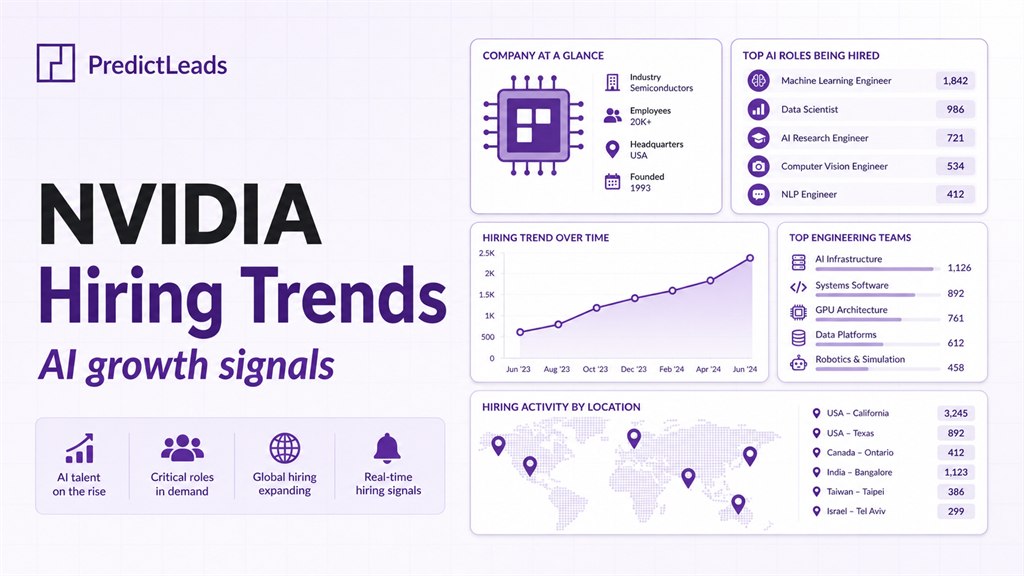
Quick Answer: What NVIDIA Hiring Trends Reveal
NVIDIA hiring trends suggest continued investment in AI infrastructure, deep learning, GPU systems, data center optimization, and industry-specific AI applications. Job postings can reveal which skills, locations, and product areas are becoming priorities long before those priorities become visible through traditional company news.
Related guides: job openings data as a leading indicator of company growth, how to use job openings data for sales prospecting, and AI adoption and sector shifts through job openings data.
1. AI Engineering Talent Is a Core Signal
NVIDIA job postings often highlight demand for AI and deep learning talent. Roles such as deep learning engineers, AI solutions architects, GPU computing specialists, and infrastructure engineers can show where the company is expanding technical capacity.
Common skill signals include:
- PyTorch and TensorFlow
- CUDA and GPU programming
- large language models and inference optimization
- distributed systems and high-performance computing
These roles matter because they reflect more than general hiring. They point to the technical capabilities NVIDIA needs to support AI workloads at scale.
2. Data Center and Infrastructure Roles Show AI Demand
Hiring for data center, cloud infrastructure, networking, and systems engineering roles can indicate where AI infrastructure demand is growing. For a company like NVIDIA, these roles are especially important because AI adoption depends on hardware, software, networking, and deployment expertise working together.
When hiring increases across infrastructure-related teams, it can signal product scaling, customer demand, or expansion of enterprise AI workloads.
3. Global Hiring Hubs Reveal Expansion Priorities
NVIDIA hiring activity across the United States, India, Israel, and other technical hubs can reveal how the company distributes engineering and customer-facing work globally.
- United States: AI, product, infrastructure, and high-value engineering roles.
- India: software engineering, system design, and data center optimization.
- Israel: networking, systems, and hardware-software integration.
Location patterns matter because they show where companies are building specialized teams and where regional expertise is becoming strategically important.
4. Healthcare and Automotive Roles Point to Industry-Specific AI
Some NVIDIA job postings point to industry-specific AI applications. Healthcare roles can indicate investment in AI-driven diagnostics, imaging, life sciences, or clinical workflows. Automotive roles can point to autonomous driving, simulation, embedded systems, and partnerships with automotive manufacturers.
These patterns show how hiring data can reveal not only internal growth, but also which industries a company is prioritizing.
5. Cross-Functional Roles Show Commercialization
Hiring for solutions architects, customer program managers, partner roles, and technical account roles can indicate that a company is not only building technology, but also helping customers adopt it.
For NVIDIA, these roles are important because AI infrastructure often requires deep technical implementation support. Cross-functional hiring can signal that demand is moving from experimentation into production deployment.
Why Job Data Matters for Company Research
Job data is useful because it captures company behavior. Companies hire when they need capacity, skills, and execution. This makes hiring activity a strong signal for company growth, product focus, market expansion, and buying intent.
For market intelligence teams, investors, and GTM teams, NVIDIA is a good example of how hiring data can help answer questions such as:
- Which technical skills are becoming more important?
- Which teams or locations are expanding?
- Which industries are receiving more investment?
- Which signals suggest future product or infrastructure priorities?
How to Analyze Company Hiring Trends with PredictLeads
PredictLeads tracks job openings across companies and returns structured hiring data through APIs and datasets. You can use it to analyze a single company, monitor competitors, identify hiring spikes, or find companies hiring for specific roles.
https://predictleads.com/api/v3/companies/nvidia.com/job_openings
From there, teams can analyze job titles, descriptions, locations, categories, seniority, technologies mentioned, first seen dates, and active status.
Final Thoughts
NVIDIA hiring trends show how job openings data can reveal more than open roles. It can uncover growth signals, AI infrastructure demand, global expansion, skill priorities, and commercialization momentum.
For teams that need earlier market signals, hiring data provides a practical way to understand what companies are doing before those moves become obvious elsewhere.