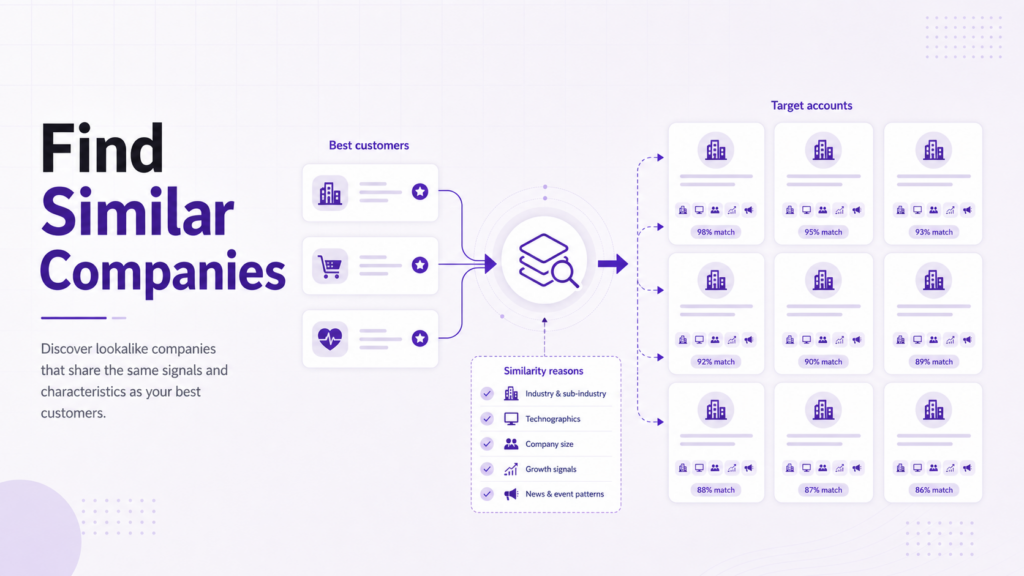
Your best customers are one of the clearest inputs for account expansion. In fact, targeting companies similar to your best customers can be a powerful way to grow your business.
They already bought from you, found value in your product, and proved that your sales motion can work in a specific kind of company. If you can identify what those customers have in common, you can build a better target account list.
That is the basic idea behind finding companies similar to your best customers. Instead of starting with broad filters such as industry, headcount, or country, you start with known accounts and look for companies that resemble them.
What does it mean to find companies similar to your best customers?
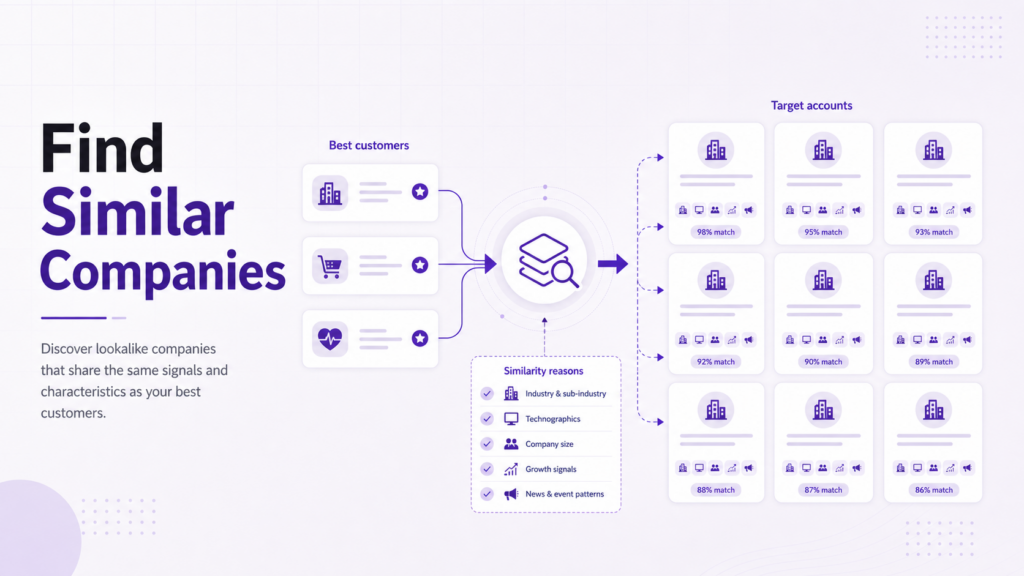
Finding companies similar to your best customers means using existing customer accounts as seed companies, then identifying other companies with related characteristics.
Those similarities may include:
- Similar website positioning
- Related products or services
- Similar technology usage
- Shared target markets
- Comparable hiring patterns
- Similar company activity
- Related business models
- Similar customer or partner ecosystems
The goal is not to create a perfect clone of your current customer base. The goal is to find accounts that are more likely to understand the same problem, buy a similar solution, or fit the same go-to-market motion.
If you are still choosing a provider, see 6 Best Company Lookalike Tools in 2026.
Why manual filters are not enough while looking for companies similar to your best customers
Many teams try to find lookalike accounts with manual filters.
They might search for companies in the same industry, with the same employee range, in the same country, or using the same software category.
Those filters can help, but they are often too shallow. Two companies can share an industry code and still have very different products, buyers, or priorities. Two companies can have the same headcount and still sell to completely different markets.
Manual filters are useful for narrowing a list. They are weaker at understanding why one company actually resembles another.
A structured similar-company workflow should add richer signals. It should look at company context, website meaning, company attributes, and business signals, then explain why a match is relevant.
Step 1: Choose the right seed customers
Start with a small set of best customers.
Do not use every customer in your CRM. A broad customer list can produce broad results. Instead, select customers that represent the type of account you want more of.
Good seed customers often have:
- High retention
- Strong expansion potential
- Clear product fit
- Fast sales cycles
- Strong usage
- Strategic market importance
- Good margin or contract value
You can also create different seed groups. For example, one group might contain enterprise customers, another might contain fast-growing startups, and another might contain customers in a specific vertical.
This matters because the quality of the lookalike list depends on the quality of the seed list.
Step 2: Convert customers into company domains
Most similar-company workflows work best when the input is a company domain.
For each best customer, collect a clean company domain. Avoid personal email domains, regional subdomains, tracking links, or old domains when possible.
Your input list might look like:
- customer-domain.com
- target-account.com
- competitor-domain.com
- partner-domain.com
Once the domains are clean, each company can be used as a seed for similar-company discovery.
Step 3: Retrieve similar companies
With PredictLeads, teams can use the Similar Companies Dataset to retrieve companies that are similar to a target company.
The relevant endpoint is:
/companies/{company_id_or_domain}/similar_companiesAccording to the local PredictLeads schema, this endpoint returns a list of a company’s similar companies and, for the top matches, provides a reason why they are considered similar.
The output can include:
- Similar company relationship
- Similarity score
- Position in the list
- Similarity reason
- Refreshed timestamp
The similarity reason is especially useful. It helps a sales, marketing, or AI workflow understand why a company appears in the list instead of treating the result as a black box.
For a broader dataset angle, see How to Use the PredictLeads Similar Companies Dataset for Market Mapping.
Step 4: Combine results across your best customers
One customer can produce useful matches. A group of best customers can produce a stronger account list.
After retrieving similar companies for each seed customer, combine the results into one table.
Useful columns include:
- Seed customer
- Similar company domain
- Similarity score
- Similarity reason
- Position
- Number of seed customers that returned the same company
- Notes for sales or marketing
If the same company appears as a match for multiple best customers, that account may deserve higher priority.
You can also group results by segment. For example, enterprise seed customers can create one lookalike list, while mid-market customers create another.
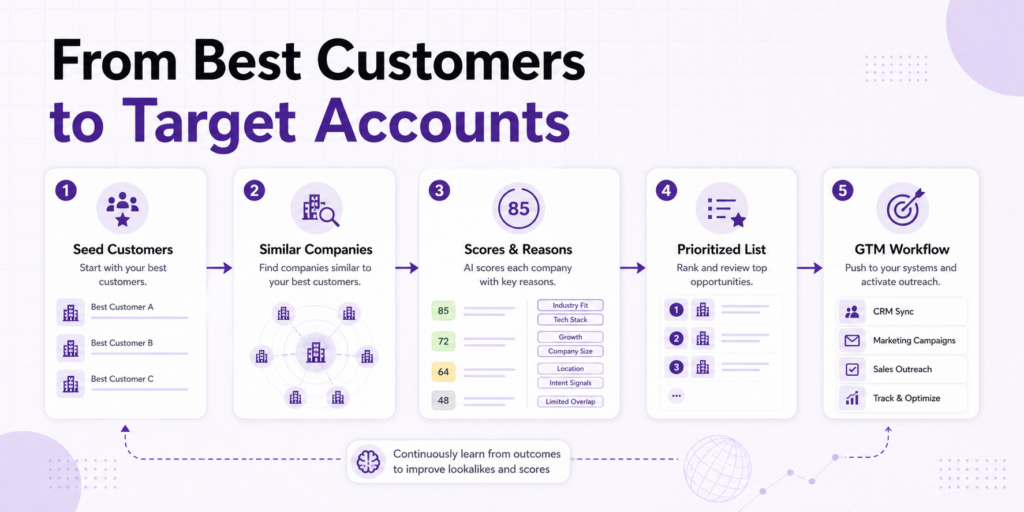
Step 5: Prioritize the list
A lookalike list should not go straight into outbound without review.
Prioritize it first.
Useful prioritization rules include:
- Higher similarity score
- Strong similarity reason
- Match appears across multiple seed customers
- Company fits your geography or segment
- Company shows relevant hiring, technology, funding, product, or news signals
- Company is not already a customer or active opportunity
This is where similar-company data becomes more useful when combined with other company intelligence. A company may look similar to your best customer and also show buying context, such as hiring for a relevant team or adopting a related technology.
Step 6: Turn similarity reasons into outreach context
Similarity reasons can support better outreach.
For example, instead of saying “we work with companies like yours,” a seller can say:
“We noticed your company appears similar to several teams in our customer base because of your product category and market focus.”
The message should still be reviewed by a human, but the similarity reason gives the rep a better starting point. It also helps RevOps and marketing teams segment accounts with more context than a flat company list.
Step 7: Use the list in GTM workflows
Once the list is cleaned and prioritized, it can support several workflows.
Sales teams can use it for account expansion and outbound prospecting.
Marketing teams can use it for account-based marketing audiences.
RevOps teams can use it to enrich CRM accounts with similarity context.
Data teams can add similar-company recommendations to internal tools.
AI agents can use it to research accounts, explain why they fit, and suggest next actions.
If you want to compare tools for these workflows, use 6 Best Company Lookalike Tools in 2026 as the provider selection guide.
Common mistakes to avoid while looking for companies similar to your best customers
The first mistake is using weak seed accounts. If the seed list is noisy, the output list will be noisy.
The second mistake is treating similarity as intent. Similarity means the company resembles another company. It does not automatically mean the company is ready to buy.
The third mistake is ignoring the reason. Scores are useful, but the reason tells teams how to interpret the match.
The fourth mistake is creating one generic list. A better workflow creates separate lookalike lists by segment, product line, region, or use case.
Final takeaway
Finding companies similar to your best customers is one of the most practical ways to expand a target account list.
The best workflow starts with carefully selected seed customers, retrieves similar companies, keeps the reasons and scores, combines results across seeds, and then prioritizes accounts with additional company signals.
PredictLeads is useful when similar-company data needs to power repeatable workflows, AI agents, data products, enrichment pipelines, or GTM systems.
Compare the best company lookalike tools in 2026, or explore the PredictLeads API documentation.