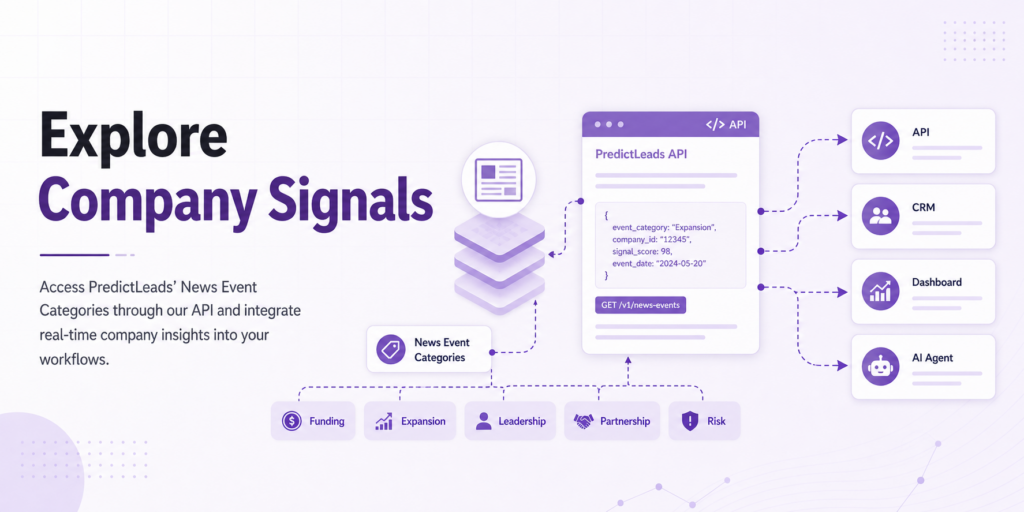
News event categories turn company news into structured business signals.
Without categories, a company announcement is just text. It might describe a funding round, a new office, a product launch, a lawsuit, a leadership hire, or a partnership. A person can read the article and understand the difference. A CRM, data warehouse, sales workflow, or AI agent needs the event to be classified.
PredictLeads news event categories solve that problem by assigning company events to specific categories and broader groups. This makes it easier to filter, monitor, route, and summarize company activity at scale.
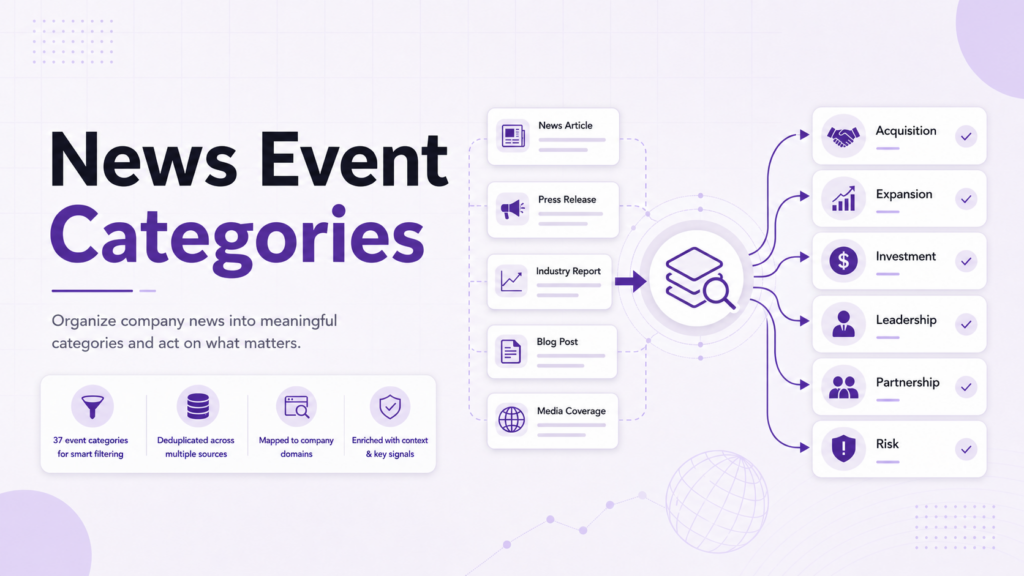
What are PredictLeads news event categories?
PredictLeads news event categories are structured labels that describe what happened to or around a company.
The taxonomy currently includes 37 categories across 11 broader groups. Those groups make the dataset easier to filter at a high level, while the individual categories give teams the precision they need for routing, search, enrichment, and AI-agent workflows.
Examples include:
acquireswhen a company acquired another companyreceives_financingwhen a company receives funding, a loan, a grant, or similar financinglauncheswhen a company launches a new offeringpartners_withwhen a company partners with another companydecreases_headcount_bywhen a company lays off employeeshireswhen a company hires executive or senior personnel
Each category belongs to a broader group, such as acquisition, investment, expansion, leadership, partnership, contract, cost cutting, new offering, or corporate challenges.
This structure helps teams move from “something happened” to “this specific type of company signal happened.”
For broader context on company signals and monitoring, see: Strategic Market Intelligence with PredictLeads News Events Dataset
Why news event categories matter for SEO, LLMs, and AI agents
News event categories are useful for people, but they are especially important for systems that need clear answers.
LLMs and AI agents work better when company events have precise labels. If an agent is asked, “Which companies recently expanded offices, launched products, or received funding?”, it needs structured categories rather than long article summaries alone.
Category labels also help with search and retrieval. A phrase like “company funding events” can map to receives_financing, while “company layoffs” can map to decreases_headcount_by. This makes the data easier to use in answer engines, internal search, enrichment systems, and automated research workflows.
For SEO, category-specific content is useful because it answers direct questions:
- What company event categories exist?
- What does each category mean?
- Which categories indicate growth, risk, partnership, or investment?
- How can teams use event categories in workflows?
This article is designed to answer those questions clearly.
The main PredictLeads news event groups
PredictLeads categories are organized into groups. Groups make the taxonomy easier to understand because many detailed categories describe a similar business theme.
The main groups include:
- Acquisition
- Contract
- Corporate challenges
- Cost cutting
- Expansion
- Investment
- Leadership
- New offering
- Partnership
- Recognition
- Relational
These groups are useful when you want a broad signal type. The individual categories are useful when you need more precision.
For example, the investment group includes goes_public, has_earnings, has_revenue, has_valuation, invests_into, invests_into_assets, and receives_financing. A sales team may care most about receives_financing, while an investor or market intelligence team may want all investment-related activity.
For more insights, check “Using PredictLeads Financing Events Dataset for Investor Research Workflows“
Acquisition categories
Acquisition events describe ownership changes, mergers, and asset transactions.
The acquisition group includes:
acquires: Company acquired another company.merges_with: Company merges with another company.sells_assets_to: Company sells assets, such as properties or warehouses, to another company.
These categories are useful for market mapping, account monitoring, competitor research, and corporate development analysis. An acquisition can suggest a new product strategy, market expansion, integration requirement, or change in buying structure.
Contract and partnership categories
Contract and partnership events describe business relationships between companies.
Categories
signs_new_client: Company signs a new client.loses_client: Company loses a client.
Partnership categories
partners_with: Company partners with another company.ends_partnership_with: Company ends a partnership with another company.
These signals are practical for sales and market intelligence teams. A new client announcement can validate traction in a market. A partnership can show ecosystem movement, channel strategy, or product integration activity.
Corporate challenge and cost cutting categories
Not every company signal is a growth signal. Some categories point to risk, pressure, or operational change.
Corporate challenges categories
declares_bankruptcy: Organization declares bankruptcy.files_suit_against: Company files suit against another company.has_issues_with: Company has vulnerability problems.
Cost cutting categories
closes_offices_in: Company closes existing offices.decreases_headcount_by: Company lays off employees.
These categories can support risk monitoring, vendor review, market research, and account prioritization. A company filing suit, closing offices, or reducing headcount may need to be handled differently than a company expanding facilities or receiving financing.
Expansion categories
Expansion categories describe signals that a company may be growing its presence, operations, or activity.
The expansion group includes:
attends_event: Company attends an event.expands_facilities: Company opens new or expands existing facilities such as warehouses, data centers, or manufacturing plants.expands_offices_in: Company expands existing offices.expands_offices_to: Company opens new offices in another town, state, country, or continent.increases_headcount_by: Company offers new job vacancies.opens_new_location: Company opens a new service location such as a hotel, restaurant, bar, or hospital.
These categories are useful for GTM teams because expansion often changes company needs. A company opening offices, facilities, or new service locations may need vendors, software, logistics, hiring support, infrastructure, or market-specific services.
For a related workflow, see: How to Identify Companies Expanding Into New Markets Using Structured News Events Data
Investment categories
Investment categories describe financing, valuation, earnings, and asset investment activity.
The investment group includes:
goes_public: Company issues shares to the public for the first time.has_earnings: Earnings were reported for a company.has_revenue: Revenue was reported for a company.has_valuation: Valuation was reported for a company.invests_into: Company invests into another company.invests_into_assets: Company buys assets, such as properties or warehouses, from another company.receives_financing: Company receives financing such as venture funding, a loan, or a grant.
These categories are especially useful for investors, sales teams, and data platforms. Funding and valuation events can change a company’s budget, hiring plan, and growth priorities.
If your workflow is specifically about funding signals, see
Leadership categories
Leadership categories describe changes in executive or senior personnel.
The leadership group includes:
hires: Company hired new executive or senior personnel.leaves: Executive or senior personnel left the company.promotes: Company promoted existing executive or senior personnel.retires_from: Executive or senior personnel retired from the company.
Leadership changes are often important account signals. A new executive may review vendors, change priorities, start transformation projects, or reorganize teams. A departure or retirement may signal transition risk or planning changes.
New offering categories
New offering categories describe product, service, and integration activity.
The new offering group includes:
integrates_with: Company integrates with another company.is_developing: Company is developing a new offering.launches: Company launches a new offering.
These categories are useful for product marketing, competitor monitoring, partner teams, and market intelligence. They can show when a company is entering a new category, extending a platform, or adding integrations.
Recognition and relational categories
Recognition categories
receives_award: Company or person at the company receives an award.recognized_as: Company or person at the company receives recognition.
Relational categories
identified_as_competitor_of: New or existing competitor was identified.spins_off_company: Company spins off another company.spins_off_division: Company spins off a division.
These categories can support market maps, competitor databases, and account intelligence. They are often useful as context rather than immediate action triggers.
How teams can use category groups in workflows
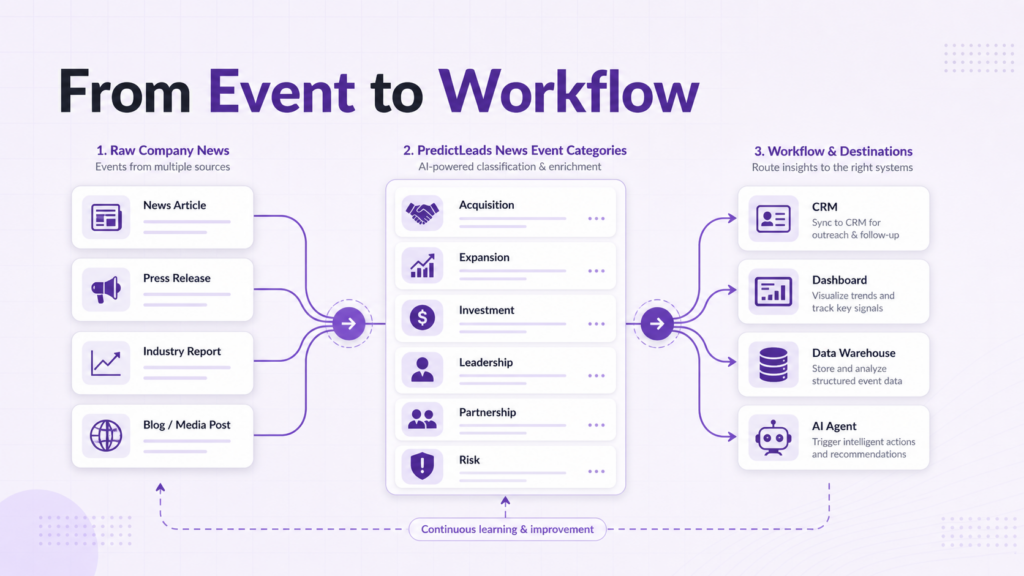
The best way to use news event categories is to map each group to a workflow.
Sales and RevOps teams
- Expansion events can trigger account review.
- Funding events can trigger prioritization.
- Leadership hires can trigger executive research.
- New client announcements can support account qualification.
Market intelligence teams
- Acquisition events can update market maps.
- New offering events can show product movement.
- Partnership events can reveal ecosystem changes.
- Corporate challenge events can support risk monitoring.
Investors
- Financing events can identify active companies.
- Expansion events can show operational momentum.
- Leadership events can indicate management changes.
- Corporate challenge events can flag risk.
AI agents and data platforms
- Categories can route records to the right summary template.
- Groups can power dashboards and alerts.
- Category labels can improve retrieval and filtering.
- Source URLs and article sentences can support evidence-backed summaries.
API access for news event categories
PredictLeads supports News Events through API endpoints such as:
/companies/{company_id_or_domain}/news_events
/discover/news_events
Company-level requests are useful when you want to monitor a specific account. Discover requests are useful when you want to search across companies by event type, category, timing, or market focus.
In practical terms, a workflow can:
- Choose the categories or groups that matter.
- Retrieve relevant events.
- Store category, group, source, date, and related company information.
- Route the event into a CRM, warehouse, dashboard, or AI research workflow.
- Review the source URL or article sentence when evidence is needed.
How to choose the right categories
Start with the business question.
When the question is “Which companies are growing?”, focus first on signals tied to expansion, investment, leadership changes, and new offerings.
For questions like “Which companies may be under pressure?”, prioritize corporate challenges, cost-cutting activity, lost clients, and bankruptcy-related signals.
If the goal is to understand “Which markets are changing?”, begin with acquisitions, partnerships, new offerings, spin-offs, and competitor relationships.
For “Which accounts should sales review?”, emphasize funding activity, expansion signals, executive hires, new clients, new office locations, and product launches.
This approach keeps the workflow focused and decision-oriented. Instead of using every available category, select the signal groups that directly support the outcome you want to improve.
Explore PredictLeads news event categories
PredictLeads news event categories help teams turn company activity into structured signals. The categories make it easier to monitor companies, filter events, build alerts, enrich company profiles, and give AI agents cleaner company context.
If your team needs company events that are easier to search, classify, and route into workflows, start with the PredictLeads API documentation.