
Introduction to PredictLeads Financing Events Dataset
Investor research depends on accurate, timely, and structured information about company financing activity. The PredictLeads Financing Events Dataset provides a valuable resource for gaining these insights.
When a company raises capital, it can signal growth, market validation, expansion plans, increased investor confidence, or a shift in strategic direction. For investors, corporate development teams, venture firms, private equity teams, and market intelligence teams, these signals can help identify opportunities earlier and prioritize research more effectively.
The challenge is that financing information is often scattered across press releases, news articles, company websites, investor announcements, and third-party sources. Without structure, it becomes difficult to compare companies, monitor funding activity at scale, or connect financing events with other company signals.
The PredictLeads Financing Events Dataset helps solve this by turning company funding activity into structured, queryable data that can be used in investor research workflows, market mapping, due diligence, and internal scoring models.
interested in what PredictLeads news events dataset is capable of? Feel free to check it here: How a B2B Data Platform Used PredictLeads News Events to Add Real-Time Company Context
What Is the PredictLeads Financing Events Dataset?
The PredictLeads Financing Events Dataset is a structured dataset focused on company financing activity.
It helps teams monitor and analyze funding-related company signals, such as venture rounds, private equity investments, debt financing, grants, convertible instruments, and other capital events.
Instead of relying only on unstructured announcements or manual research, teams can use the dataset to track financing events in a more systematic way.
The dataset can support workflows such as:
- Monitoring companies that recently raised funding
- Identifying startups or scaleups in specific markets
- Tracking funding activity across industries or geographies
- Enriching CRM records with recent financing signals
- Supporting market mapping and due diligence
- Prioritizing companies based on funding activity
Because the data is structured, it can be integrated into CRMs, data warehouses, enrichment pipelines, internal dashboards, scoring models, or investor research tools.
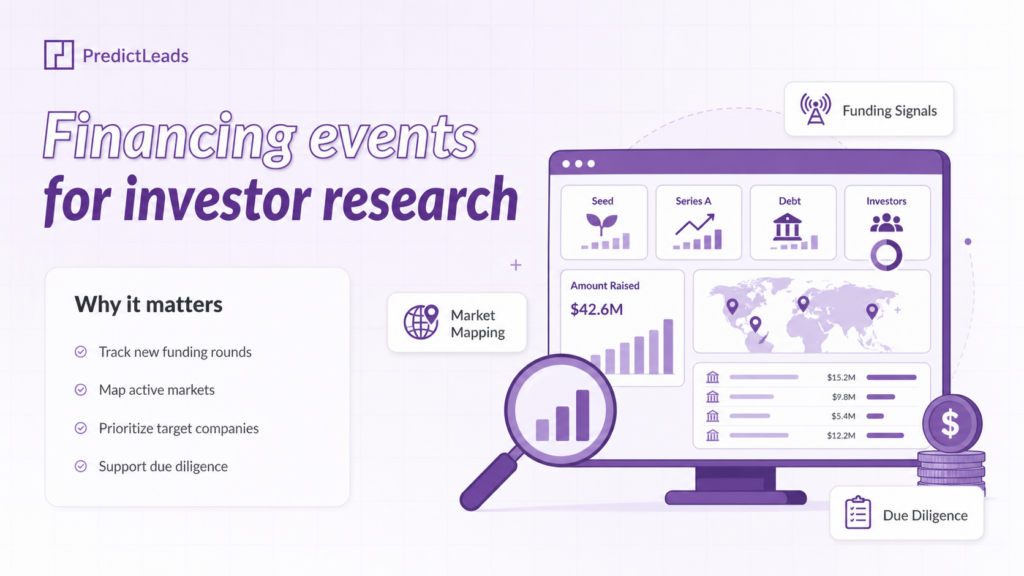
What Do Financing Event Signals Actually Tell You?
Financing events can reveal important information about a company’s current position and future direction.
A recent funding round may suggest that a company is entering a new growth phase, expanding its team, investing in product development, entering new markets, or preparing for strategic initiatives.
For investor research teams, these signals can help answer questions such as:
- Which companies recently raised capital?
- Which industries are seeing increased funding activity?
- Which companies may be preparing to scale?
- Which competitors just received new backing?
- Which startups are gaining investor attention?
- Which companies should be prioritized for deeper research?
Financing data becomes even more valuable when combined with other company signals, such as hiring activity, technology usage, website changes, news events, or company growth indicators.
For example, a company that recently raised a Series A round and is also rapidly hiring sales and engineering roles may be showing stronger growth intent than a company with funding data alone.
Where Teams Usually Get This Wrong
Financing data is useful, but it can also be misread when used without enough context.
One common mistake is treating every funding announcement as an equally strong signal. In reality, different financing types can mean different things. A seed round, Series B round, debt facility, grant, or private equity investment may all point to different company situations.
Another common mistake is relying only on unstructured sources. Press releases and articles can be useful, but they are difficult to monitor consistently at scale. They may also use different terminology, omit important details, or make comparison across companies harder.
Teams also often look at financing data in isolation. A funding event becomes much more useful when it is connected to broader company context, such as industry, location, headcount, technologies, hiring activity, and recent company news.
In short, financing data should not be treated as a standalone answer. It should be treated as a structured signal that helps guide deeper research.
How to UsePredictLeads Financing Events Dataset in an Investor Research Workflow
1. Import financing events into your internal systems
The first step is to bring structured financing events into the tools your team already uses.
This could include a CRM, data warehouse, spreadsheet, internal dashboard, BI tool, or investment research platform.
By importing financing data regularly, teams can keep company profiles up to date and reduce manual research work.
2. Filter companies based on your investment criteria
Once the data is available, teams can filter financing events based on their research focus.
Common filters may include:
- Financing type
- Funding round
- Funding amount
- Event date
- Company location
- Industry
- Company size
- Investor participation
- Target market or sector
For example, a venture capital team focused on early-stage European software companies may filter for Seed or Series A financing events in relevant technology sectors.
A private equity team may focus more on later-stage companies, growth financing, or companies showing signs of expansion.
3. Enrich financing data with other company signals
Financing events are more useful when combined with additional company data.
For example, investor research teams may enrich financing events with:
- Firmographic data
- Hiring signals
- Technology usage
- Company news
- Website changes
- Industry classification
- Company location
- Growth indicators
This creates a more complete company profile and makes it easier to evaluate whether a company is relevant to your investment thesis.
4. Monitor new financing events
Instead of doing one-time research, teams can use financing events data for ongoing monitoring.
For example, you can create alerts for:
- New funding rounds in a specific sector
- Companies in your target market that recently raised capital
- Portfolio competitors receiving new funding
- Companies backed by specific investors
- Funding events above a certain amount
- New financing activity in a specific geography
This helps research teams stay informed without manually checking multiple sources.
5. Score and prioritize companies
Financing events can also be used as part of a company scoring model.
A simple scoring model might consider:
- Recency of funding
- Funding amount
- Financing type
- Investor quality
- Company industry
- Company location
- Hiring activity
- Technology usage
- Strategic fit
The goal is not to make investment decisions automatically. Instead, financing data can help prioritize which companies deserve deeper research first.
6. Support due diligence
During due diligence, financing event data can help validate company claims, understand funding history, identify investor involvement, and provide context around a company’s growth trajectory.
It can also help compare a target company with similar companies in the same market.
For example, if several competitors recently raised capital, that may indicate a growing market. If one company raised capital while others did not, that may suggest a unique investor belief, stronger traction, or a differentiated position.
What Fields Matter in Financing Events Data?
When using financing data in investor research, the most useful fields are the ones that help teams filter, compare, and contextualize events.
Important fields may include:
- Company name
- Company identifier
- Financing type
- Funding round
- Amount raised
- Event date
- Investor names
- Company location
- Industry or category
- Source information
- Related company metadata
These fields make it easier to match companies correctly, segment opportunities, and connect financing events with other internal or external datasets.
A Simple Example Workflow
Imagine an investor focused on early-stage technology companies in Europe.
A simple workflow could look like this:
- Query the PredictLeads Financing Events Dataset for recent Seed and Series A rounds in Europe.
- Filter the results by relevant industries, such as software, fintech, cybersecurity, infrastructure, or AI.
- Enrich the companies with firmographic, hiring, and technographic data.
- Score companies based on funding recency, funding amount, hiring activity, investor involvement, and strategic fit.
- Add the strongest matches to a CRM or research dashboard.
- Set up alerts for new financing events that match the same criteria.
- Use the enriched company list to guide outreach, research, or due diligence.
This type of structured workflow helps teams move from reactive research to systematic opportunity discovery.
Where PredictLeads Fits
PredictLeads is useful for teams that need structured company signals they can query, monitor, enrich, and integrate into internal systems.
The PredictLeads Financing Events Dataset can help investor research teams track funding activity without relying only on fragmented, manual research.
It works especially well when combined with other PredictLeads datasets, such as:
- Job openings data
- News events data
- Technologies data
- Website evolution data
- Company data
Together, these signals can help teams understand not only which companies raised funding, but also what those companies may be doing next.
For example, a company that raised funding, started hiring aggressively, adopted new technologies, and appeared in recent market news may deserve a higher research priority than a company with only one isolated signal.
FAQ
The dataset is updated regularly to capture new financing events and support ongoing monitoring workflows.
Yes. The dataset includes classifications for different financing types, such as equity, debt, convertible instruments, grants, and other capital events where available.
Yes. Investor names are included when available, making it easier to understand who participated in a financing event.
Yes. The dataset is structured and can be integrated into CRMs, data warehouses, dashboards, enrichment workflows, and internal research systems.
It is useful for venture capital firms, private equity teams, corporate development teams, market intelligence teams, sales intelligence teams, and other organizations that monitor company growth and financing activity.
Conclusion
Financing events are valuable signals for investor research, but they become much more powerful when they are structured, queryable, and connected with broader company context.
The PredictLeads Financing Events Dataset helps teams monitor company funding activity, identify relevant opportunities, enrich internal systems, and support more systematic research workflows.
For investors and research teams that want to move beyond manual tracking and fragmented sources, structured financing event data can provide a stronger foundation for market mapping, prioritization, and due diligence.
Learn more about PredictLeads Financing Events Dataset?
For detailed guidance on integrating PredictLeads datasets into investor research workflows, visit: