
Job postings data can reveal what a company is building, where it is investing, and which teams are growing. For GTM teams, hiring activity is one of the clearest external signals of company movement.
A company that opens new roles is often doing something operationally important. It may be expanding into a market, building a new product, growing a sales team, investing in infrastructure, or strengthening a function that supports a larger business priority.
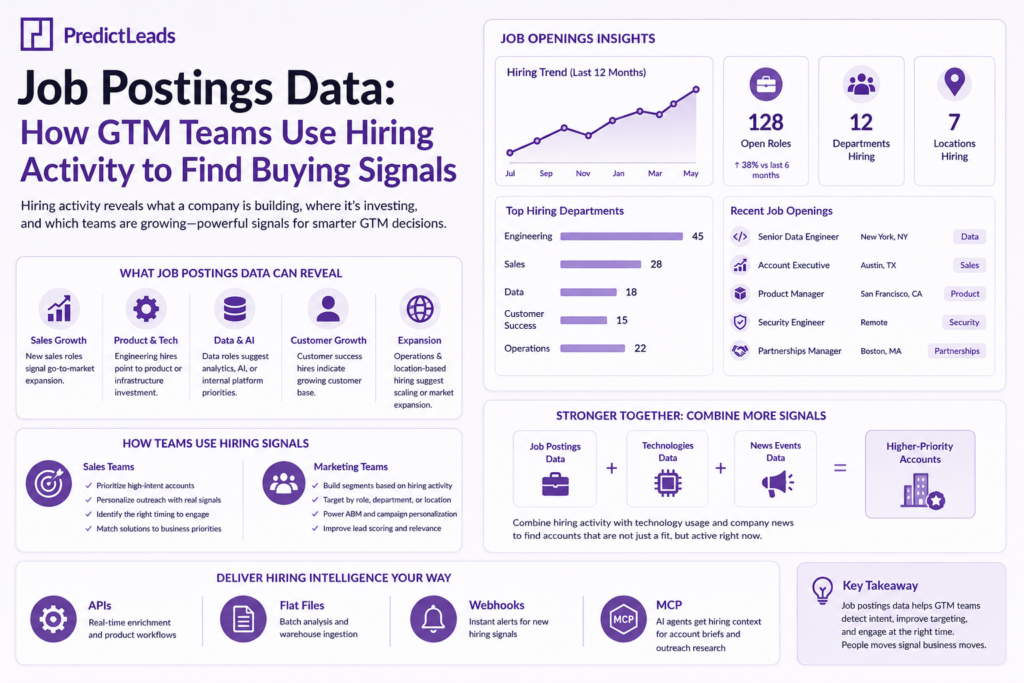
Why job postings data matters for GTM
Sales and marketing teams often rely on static firmographic data to decide which companies to target. Firmographics help define fit, but they do not always show timing. Job postings data adds movement.
Job openings are also a recognized labor-market indicator. The U.S. Bureau of Labor Statistics Job Openings and Labor Turnover Survey tracks job openings, hires, and separations at the macro level. GTM teams can apply a similar idea at the company level by watching which accounts are actively hiring and where that hiring is concentrated.
If a company starts hiring account executives, it may be expanding revenue capacity. If it hires data engineers, it may be investing in data infrastructure. If it hires security roles, it may be strengthening compliance or risk programs. If it hires partnership roles, it may be building a channel motion.
These signals can help teams understand not only who to target, but why now.
Looking for companies hiring data engineers? Find the guide here: How to Find Companies Hiring Data Engineers Using Hiring Signals and Job Data
What job postings data can reveal
Job postings data is useful because roles often map to business priorities. A single job post may not tell the full story, but patterns across roles, teams, locations, and time can reveal meaningful intent.
- New sales roles can point to go-to-market expansion.
- Engineering roles can point to product or infrastructure investment.
- Data roles can suggest analytics, AI, or internal platform priorities.
- Customer success roles can point to customer base growth.
- Operations roles can suggest scaling, restructuring, or geographic expansion.
The PredictLeads Job Openings Dataset collects job postings directly from company websites, which helps teams avoid relying only on third-party job boards that may be incomplete, delayed, or noisy.
How sales teams use hiring signals
Sales teams can use hiring activity to improve account prioritization and outreach. Instead of reaching out with generic messages, reps can reference a real business signal.
For example, a company hiring multiple data engineers may be a better fit for data infrastructure, analytics, enrichment, or automation products. A company hiring many sales roles may be a good fit for sales enablement, data enrichment, lead routing, or pipeline intelligence tools.
Hiring signals can also help reps decide when to reach out. Timing matters. A company that is actively building a team may be more open to tools, services, or data that support that team.
How marketing teams use job postings data
Marketing teams can use job postings data to build sharper audiences. Instead of targeting every company in a market, they can create segments based on real activity.
Examples include companies hiring AI engineers, companies expanding sales teams, companies opening roles in a new region, or companies hiring for specific technologies. These segments can support account-based marketing, campaign personalization, and better lead scoring.
Use hiring data with other company signals
Job postings data becomes even stronger when combined with other PredictLeads datasets. Hiring activity can show operational movement, while Technologies Dataset can show stack fit and News Events Dataset can show external business events.
For example, a company hiring data engineers, using relevant technologies, and announcing a funding round may be a higher-priority account than a company with only one of those signals.
Delivery options for hiring data
Teams can use hiring data in several ways. APIs can support real-time enrichment and product workflows. Flat files can support batch analysis and warehouse ingestion. Webhooks can alert teams when new hiring signals appear. MCP can help AI agents retrieve hiring context while preparing account briefs or outreach research.
For teams that are building broader enrichment workflows, Google Cloud’s overview of data enrichment is a helpful neutral reference for how external data can add context to existing records.
Frequently Asked Questions
What is job postings data?
Job postings data is structured information collected from company job listings, including open roles, departments, locations, seniority, skills, and hiring trends.
How can GTM teams use job postings data?
GTM teams use job postings data to identify company growth, team expansion, market entry, budget movement, hiring intent, and better sales outreach timing.
Why are job openings useful as buying signals?
Job openings can reveal what a company is investing in. New roles in sales, engineering, data, security, or operations often point to current business priorities.
Final takeaway
Job postings data gives GTM teams a practical way to detect company intent. It shows where companies are investing people, budget, and operational attention.
For sales, marketing, RevOps, and data teams, hiring activity can improve prioritization, segmentation, timing, and personalization. When combined with company profiles, technologies, and news events, job postings data becomes a powerful signal for finding accounts that are not just a fit, but active right now.