
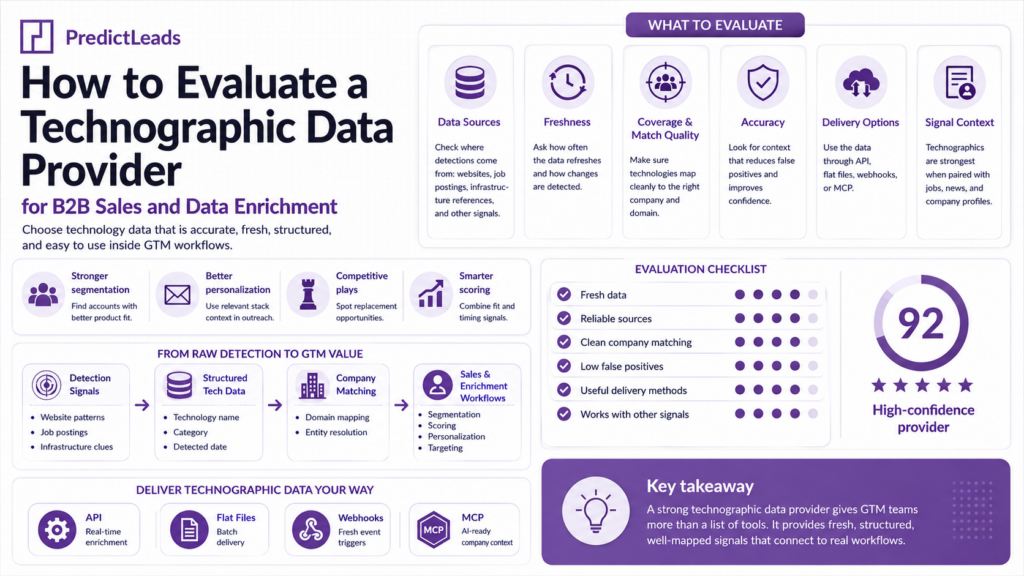
Choosing a technographic data provider is not only about finding a list of companies using a specific tool. B2B teams need technology data that is accurate, fresh, structured, and easy to use inside sales, marketing, enrichment, and product workflows.
Technographic data helps teams understand what technologies a company appears to use. That context can support segmentation, partner targeting, competitive displacement, account scoring, and personalization. As Demandbase explains in its technographics overview, technology stack data can help B2B teams segment and target accounts with more precision. But the value of the data depends heavily on how the provider collects, verifies, updates, and delivers it.
What does a technographic data provider do?
A technographic data provider identifies technologies used by companies and turns those signals into structured data. This can include software, platforms, scripts, infrastructure signals, analytics tools, ecommerce systems, marketing tools, payment tools, and other detectable technologies.
For PredictLeads, technology detection is part of a broader company intelligence layer. The Technologies Dataset can be combined with hiring activity, company news, similar companies, and company profiles to create a more complete account view.
This article focuses on evaluation criteria for enrichment workflows. For the broader vendor comparison, read Best Technographic Data Providers for B2B Targeting in 2026. For the main definition page, start with What Is Technographic Data?.
Start with the data sources
The first question is simple: where does the technographic data come from?
Some providers rely mainly on website detection. Others combine multiple sources. A stronger technographic workflow should look for signals that reduce false positives and give teams more confidence in the data.
For example, a static script on a website may suggest that a company uses a tool, but it may not always prove active usage. Signals become more useful when they are supported by multiple forms of evidence, such as website patterns, job postings, infrastructure references, and other company activity.
Check freshness
Technology stacks change. Companies remove tools, adopt new platforms, migrate infrastructure, and test vendors. Old technographic data can lead sales teams into weak personalization and poor targeting.
When evaluating a technographic data provider, ask how often the data refreshes, how changes are detected, and whether historical data is available. Freshness matters most when the data supports active sales plays, enrichment, scoring, or product workflows.
Check coverage and match quality
Coverage matters, but broad coverage is not enough. The data also needs to match the right company domain and entity. If technology signals are not mapped cleanly to companies, teams can end up enriching the wrong records.
This is why technographic data should connect well with company profiles. The Companies Dataset can provide the base company layer, while the Technologies Dataset adds stack-level context.
Evaluate accuracy and false positives
Accuracy is one of the hardest parts of technographic data. A company may have traces of a tool on its website without actively using it in the way a GTM team assumes. A job posting may mention a technology because the company is hiring for that skill, but it still needs context.
The best approach is to treat technographic data as a signal, not a magic answer. Strong providers give enough context for teams to make confident decisions and combine technologies with other signals.
Look at delivery options
A technographic data provider should support the way your team works. Product teams may need an API. Data teams may prefer flat files. Revenue teams may need webhooks or CRM enrichment workflows. AI teams may want MCP access so agents can use company intelligence inside research and writing tasks.
Delivery matters because even accurate data creates little value if teams cannot use it easily. If the data is used on public pages or product documentation, teams should also think about machine-readable structure. Google Search Central’s structured data documentation is a useful reference for how structured information can help search systems understand page content.
Use technographics with other company signals
Technographic data becomes more useful when it is combined with other business activity. A company using a specific platform is interesting. A company using that platform while hiring for related roles, expanding a team, and announcing new initiatives is much more interesting.
That is why teams often combine the Technologies Dataset with the Job Openings Dataset and News Events Dataset. Together, those signals can show stack fit, operational need, and timing.
Frequently Asked Questions
What is a technographic data provider?
A technographic data provider identifies the technologies companies use and turns those signals into structured data for sales, marketing, enrichment, and GTM workflows.
How should you evaluate a technographic data provider?
Evaluate a technographic data provider by checking data sources, freshness, coverage, accuracy, false positive handling, company matching, and delivery options such as API, flat files, webhooks, or MCP.
Why does technographic data matter for B2B sales?
Technographic data helps B2B sales teams find companies using relevant tools, identify replacement opportunities, personalize outreach, and prioritize accounts with stronger product fit.
Final takeaway
A good technographic data provider should give B2B teams more than a list of tools. It should provide fresh, structured, well-mapped technology signals that connect to real GTM workflows.
When evaluating providers, focus on sources, freshness, coverage, accuracy, delivery, and how well the data connects with broader company intelligence. That is what turns technographic data from a static field into a useful revenue signal.