
Account based marketing data helps GTM teams decide which accounts to target, how to segment them, and what message to use. The best ABM programs do not rely only on company size, industry, and region. They use live company signals to understand fit, timing, and relevance.
For B2B teams, account selection is one of the most important parts of ABM. If the account list is weak, campaign creative and sales follow-up have to work too hard. Better data creates a better starting point. LinkedIn’s account-based marketing guide frames ABM as a focused B2B strategy built around high-value accounts, which is why the quality of account data matters so much.
What is account based marketing data?
Account based marketing data is the company-level information used to build, prioritize, segment, and personalize target account lists. It can include firmographics, technographics, hiring activity, company news, funding events, partnerships, customer relationships, and similarity signals.
The goal is not simply to collect more fields. The goal is to identify which accounts deserve attention and why they matter now.
Why ABM needs more than firmographics
Firmographic filters are useful for defining a market. A team might target software companies with 200 to 2,000 employees in North America. That creates a broad account universe, but it does not show which companies are active, expanding, or ready for a specific message.
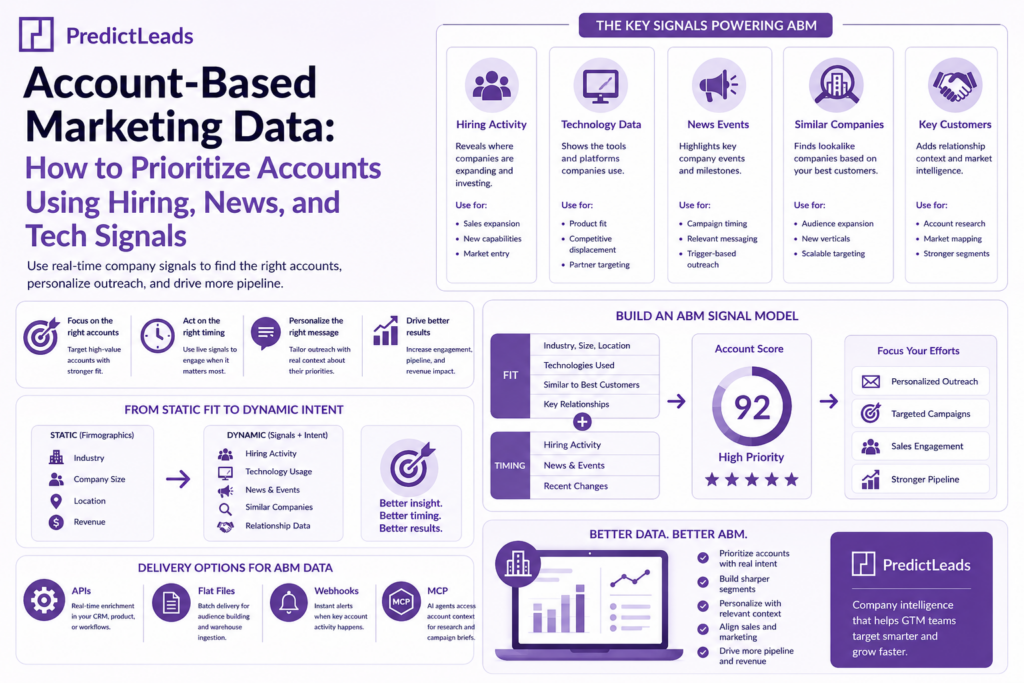
Dynamic company signals help ABM teams move from static fit to actionable timing. A company hiring a new data team, adopting specific technologies, announcing expansion, or matching your best customers may deserve higher priority.
For broader B2B growth research, the LinkedIn B2B Institute is a useful reference because it focuses on how B2B brands grow, build demand, and reach buying committees over time.
Hiring signals for ABM prioritization
Hiring activity can reveal where a company is investing. The Job Openings Dataset helps teams identify companies that are expanding specific teams, entering new markets, or building new capabilities.
For ABM, this can support segments such as companies hiring sales leadership, companies hiring data engineers, companies expanding customer success, or companies adding roles tied to a specific technology category.
Technology signals for account segmentation
Technographic data can help teams target companies based on the tools and platforms they use. The Technologies Dataset supports use cases such as competitive displacement, partner targeting, integration-based campaigns, and product-fit scoring.
For example, if your product works especially well with a certain platform, technology signals can help you find companies that already have the right environment for your message.
Interested in how a technology dataset can be used? We suggest looking at “Technology Adoption Trends for ABM: Find Better Target Accounts“
News events for timing and personalization
Company news can help ABM teams understand what is happening around an account. The News Events Dataset tracks structured company events such as funding, acquisitions, partnerships, product launches, executive changes, and expansion signals.
These events can shape campaign timing and messaging. A funding announcement may support a growth-focused message. A partnership may reveal ecosystem priorities. A product launch may create a reason to talk about data, automation, or market intelligence.
Similar companies for audience expansion
ABM teams often start with a list of best customers and ask a simple question: which companies look similar to these accounts?
The Similar Companies Dataset can help teams expand from known customer examples into new lookalike account lists. This is useful when building vertical campaigns, partner motions, or expansion segments.
Key customers and relationship context
Relationship data can add another layer of relevance. The Key Customers Dataset helps teams understand known customer and vendor relationships where available. For ABM, this can support market mapping, account research, and stronger segmentation.
How to build an ABM signal model
A practical ABM model should combine fit and timing. Fit can come from company profile data, industry, size, location, similar companies, and technology usage. Timing can come from hiring activity, news events, and recent changes.
A simple scoring model might give points for companies that match your ICP, use relevant technologies, are hiring in key departments, recently announced growth events, and resemble your best customers. The score does not need to be perfect. It needs to help teams focus.
For teams still defining the basic ABM operating model, HubSpot’s account-based marketing resource is a useful general primer on aligning marketing and sales around target accounts.
Delivery options for ABM data
Different teams need account based marketing data in different places. APIs can enrich accounts inside a product or CRM workflow. Flat files can support batch audience building. Webhooks can alert teams when key accounts show new activity. MCP can help AI agents prepare account research, campaign briefs, and sales summaries.
Frequently Asked Questions
What is account based marketing data?
Account based marketing data is company-level information used to choose, segment, prioritize, and personalize target accounts in ABM campaigns.
What data is useful for ABM?
Useful ABM data includes firmographics, technographics, hiring activity, company news, funding events, similar companies, customer relationships, and buying signals.
How does PredictLeads support account based marketing?
PredictLeads supports ABM by providing company signals such as job openings, technology detections, news events, similar companies, key customers, and company profiles.
Final takeaway
Account based marketing data should help teams target the right accounts with the right message at the right time. Static firmographics are only one part of that. Hiring signals, technology data, company news, similar companies, and relationship data make ABM more precise and more useful.
For teams improving ABM, the next step is to connect account fit with real company activity. PredictLeads datasets give GTM teams the company signals they need to prioritize accounts, build sharper segments, and personalize outreach with better context.