
Technology adoption signals show when a company starts using, evaluating, or hiring around a specific technology. For GTM teams, these signals can reveal changing priorities, new projects, integration needs, and potential buying intent.
A company’s tech stack is not just a list of tools. It is a map of how the business operates. When the stack changes, the company may need new services, integrations, data, infrastructure, or support.
This guide explains how technology adoption signals work and how sales, marketing, and data teams can use them to find accounts that are more likely to buy.
What Are Technology Adoption Signals?
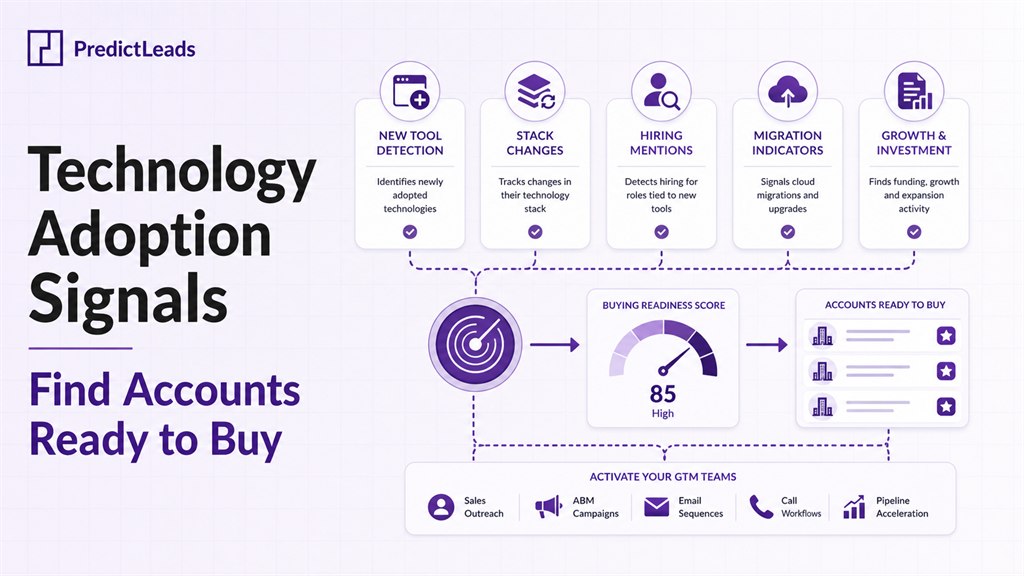
Technology adoption signals are data points that suggest a company uses or is moving toward a specific technology. They can come from websites, job postings, DNS records, infrastructure clues, public pages, or other company-level evidence.
- new technologies detected on a company website
- job postings mentioning specific tools
- infrastructure or DNS changes
- technology categories tied to company domains
- signals that a tool is active, removed, or changing
PredictLeads explains these collection methods in How Technographic Data Is Collected.
Why Technology Adoption Signals Matter
Technology adoption often points to business change. A new analytics stack may signal a data initiative and new CRM may signal GTM transformation. A new cloud platform may signal migration or infrastructure growth.
These changes create moments when a company may need help. That is why technology adoption signals matter for sales timing, ABM segmentation, partner targeting, and lead scoring.
For a deeper ABM angle, see Account-Based Marketing Technographic Data.
How GTM Teams Use Technology Adoption Signals
Find accounts using complementary tools
If your product integrates with a specific CRM, data warehouse, cloud provider, or marketing platform, technology adoption signals can help you find accounts where your product already fits the workflow.
Identify migration or modernization projects
Technology changes can reveal modernization work. A company adopting cloud infrastructure, data platforms, or new developer tools may be entering a period of operational change.
PredictLeads has a related guide on cloud data warehouse migration signals.
Improve segmentation and personalization
Technology adoption signals make segmentation more precise. Instead of targeting all SaaS companies, a team can target SaaS companies using a specific stack, hiring for a related tool, or showing signs of a technical migration.
That approach connects closely with technographic segmentation.
Technology Adoption Signals to Watch
- New tool detection: a technology appears for the first time on a company domain.
- Hiring mentions: job postings ask for experience with a specific technology.
- Stack expansion: a company adds tools across several related categories.
- Technology replacement: old tools disappear while new tools appear.
- Category maturity: the stack becomes more sophisticated in areas such as analytics, security, or GTM operations.
Each signal becomes stronger when it matches your product’s use case and the account’s ICP fit.
Why Data Quality Matters
Adoption signals can be noisy if the data comes from only one source. A script on a website does not always mean a tool is actively used. A stale record can make an account look relevant when it is not.
Better technographic data uses multiple sources and freshness checks. That helps teams avoid false positives and build more reliable segments.
For more detail, read Technographic Data Accuracy.
Final Thoughts
Technology adoption signals help GTM teams find accounts that are changing their systems and may be closer to a buying moment. They improve targeting, segmentation, personalization, and account prioritization.
PredictLeads provides technographic data and related company signals that help teams understand which companies use specific technologies and how those signals connect to real GTM workflows.