
A technographic data API helps B2B teams enrich company records with the technologies companies use. Instead of manually checking websites or researching tools one account at a time, teams can use an API to detect technology stacks, update account profiles, build segments, score leads, and trigger GTM workflows.
This technical guide supports our comparison of the best technographic data providers in 2026 for B2B targeting. Use that article to compare providers, and use this guide to understand how technographic data APIs fit into real workflows. For the main concept page, start with What Is Technographic Data?. For broader enrichment strategy, see B2B Data Enrichment with Company Signals.
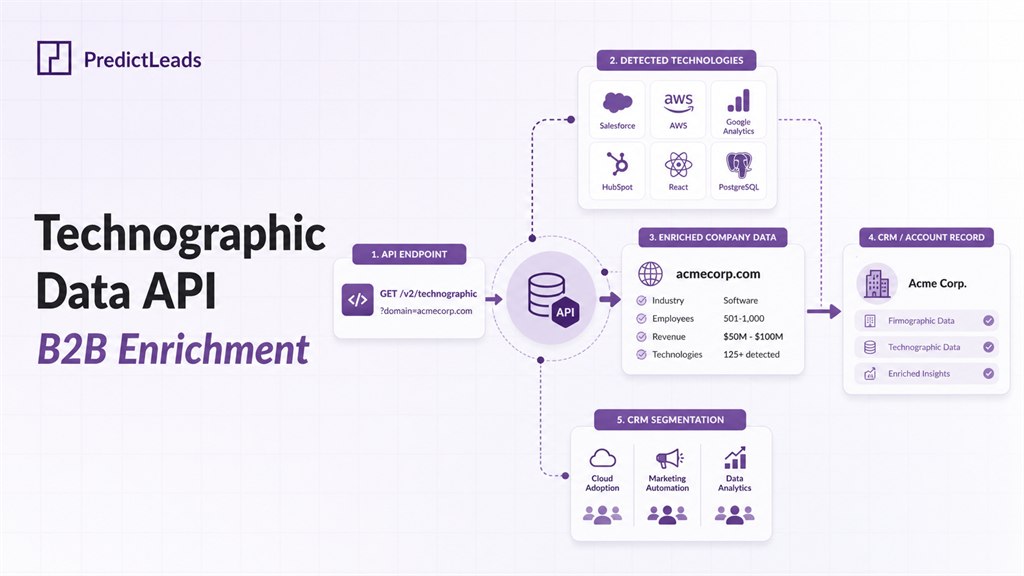
What Is a Technographic Data API?
A technographic data API returns structured information about the technologies associated with a company. Depending on the provider, this can include software tools, analytics platforms, ecommerce systems, cloud infrastructure, developer frameworks, marketing technologies, security tools, data warehouses, and other technology signals.
The API usually accepts a company domain, company identifier, or other lookup input. It then returns technology records that teams can store in a CRM, warehouse, enrichment system, sales intelligence platform, or internal application.
Common Technographic Data API Inputs and Outputs
| API layer | Example | Why it matters |
|---|---|---|
| Lookup input | Company domain or company ID | Connects the request to the right company |
| Technology name | Salesforce, HubSpot, Snowflake, AWS | Shows which tools appear in the company stack |
| Technology category | CRM, cloud, analytics, ecommerce, security | Makes segmentation and scoring easier |
| Detection source | Website signal, job posting, DNS, public content | Helps teams understand confidence and context |
| First seen / last seen | Date fields | Shows when the technology appeared or changed |
| Company metadata | Name, domain, industry, location | Connects technographic data to firmographics |
Why Technographic Data APIs Matter for B2B Teams
Technographic data becomes much more useful when teams can access it programmatically. A static spreadsheet can support one campaign, but an API can power ongoing account enrichment, routing, scoring, alerts, and AI-assisted research.
- Sales teams can prioritize companies using complementary or competing technologies.
- Marketing teams can build segments based on stack fit and technology adoption.
- RevOps teams can enrich CRM records and improve lead routing.
- Data teams can add technology signals to warehouses, scoring models, and internal products.
- AI teams can give agents fresher context about company tools, stack changes, and account fit.
Example Workflow: Account Enrichment
A common workflow starts with a list of company domains from a CRM, product signup flow, data warehouse, or target account list. The system sends each domain to a technographic data API, receives technology records, and writes selected fields back into the account profile.
| Step | Workflow | Output |
|---|---|---|
| 1 | Collect company domains | Target account list |
| 2 | Call technographic data API | Technology detections |
| 3 | Normalize categories | CRM-friendly fields |
| 4 | Score account fit | Higher or lower priority |
| 5 | Route or trigger workflow | Sales task, campaign, alert, or dashboard update |
Example Workflow: Lead Scoring
Technographic data can improve lead scoring when the presence or absence of specific tools changes account fit. For example, a company selling Snowflake consulting services may score accounts higher when they use Snowflake, Databricks, BigQuery, Fivetran, dbt, or other modern data stack technologies.
The score becomes stronger when technographic data connects to other company signals. A company using a relevant technology and hiring data engineers may deserve a higher score than a company with the technology signal alone. A company that also raised funding or launched a new data product may deserve an even higher score.
Related reading: how job openings data improves technographic data accuracy and how job postings data reveals company growth and buying intent.
How PredictLeads Fits
PredictLeads technology data helps teams connect technographic signals with broader company intelligence. That broader context matters because technology adoption often becomes more actionable when paired with hiring activity, news events, financing events, product launches, and other business changes.
For technical teams, this means PredictLeads can support enrichment pipelines, internal data products, GTM scoring models, market intelligence systems, and AI workflows that need structured company signals rather than manual research.
Best Practices for Using Technographic Data APIs
- Start with a clear use case before choosing fields or providers.
- Map technologies into categories that sales and marketing teams understand.
- Track recency, not only whether a technology has ever appeared.
- Combine technographic data with hiring, company news, and firmographic signals.
- Keep scoring rules explainable so GTM teams trust the output.
- Review false positives and stale technologies regularly.
FAQ
What is a technographic data API?
A technographic data API gives teams programmatic access to structured information about the technologies companies use, such as CRM systems, analytics tools, cloud platforms, ecommerce software, and developer frameworks.
How do GTM teams use technographic data APIs?
GTM teams use technographic data APIs for account enrichment, segmentation, sales prospecting, lead scoring, routing, alerts, and personalized outreach.
Why combine technographic data with job postings or company news?
Combining signals adds context. Technology detections show what tools a company uses, while job postings and company news can show whether the company is growing, investing, launching products, or changing strategy.