
B2B data enrichment helps revenue teams turn basic company and contact records into useful account intelligence. A CRM record with a company name, domain, industry, and employee count is a starting point. It tells you who the account is. It does not always tell you what the account is doing right now.
That is where company signals matter. Hiring activity, technology usage, company news, expansion events, partnerships, funding signals, and customer relationships can help sales, marketing, RevOps, and data teams understand which accounts deserve attention and why.
Quick Answer
B2B data enrichment adds structured business context to company, account, lead, or CRM records. The strongest enrichment workflows combine static company fields with dynamic signals such as job openings, technology usage, news events, funding, partnerships, and similar companies.
Static Data vs Company Signals
| Data type | Examples | What it helps answer |
|---|---|---|
| Static company data | Company name, domain, industry, location, size | Who is this account? |
| Hiring signals | Open roles, departments hiring, seniority, location | Where is the company investing headcount? |
| Technographic data | Software, infrastructure, cloud, analytics, security tools | What technology context or stack fit exists? |
| News events | Funding, partnerships, launches, acquisitions, expansion | What changed recently? |
| Similar companies | Related companies, lookalike accounts, market clusters | Which accounts resemble known customers or competitors? |
Related Reading
- Technographic Data API for B2B Enrichment
- PredictLeads Company Data for Sales Intelligence
- Data Enrichment for Prospect Prioritization
- Company Data API vs Flat Files vs Webhooks
What is B2B data enrichment?
B2B data enrichment is the process of adding useful business context to existing company, account, lead, or CRM records. Instead of working with a thin record, teams enrich each account with structured data that supports segmentation, prioritization, routing, scoring, and personalization.
Traditional enrichment often focuses on firmographic fields such as company size, location, industry, and revenue range. Those fields are useful, but they are mostly static. Modern GTM teams also need dynamic signals that show movement inside a company.
Why static CRM data is not enough
A company can look like a good-fit account on paper and still have no current buying intent. Another company may look average in a database but suddenly become highly relevant because it is hiring a new data team, opening roles in a new market, adopting new software, or announcing a strategic partnership.
Good B2B data enrichment should help teams answer questions like:
- Is this company growing or restructuring?
- Which departments are hiring?
- What technologies does the company appear to use?
- Has the company announced funding, expansion, product launches, or partnerships?
- Which companies look similar to our best customers?
- Which accounts should sales prioritize this week?
The company signals that matter most
PredictLeads focuses on company intelligence that reflects real business activity. For B2B data enrichment, the most useful signals usually come from several datasets working together.
Companies Dataset gives teams a foundation for company profiles and domain-based enrichment. It helps normalize account records and connect signals back to the right company.
Job Openings Dataset shows hiring activity directly from company career pages. Hiring data can reveal growth, budget allocation, team expansion, and operational priorities.
Technologies Dataset helps identify which tools and technologies companies use. This is useful for technographic segmentation, partner targeting, competitive displacement, and product-fit scoring.
News Events Dataset tracks structured company events such as funding, partnerships, product launches, acquisitions, executive changes, and other market signals.
Similar Companies Dataset helps GTM teams find lookalike accounts based on company similarity. This is valuable for building audience segments from existing customers or high-performing accounts.
Key Customers Dataset adds relationship context by showing customer and vendor connections where available. This can support account research, market mapping, and prioritization.
How GTM teams use enriched company data
Sales teams use B2B data enrichment to decide which accounts to contact first and what to say. A generic outreach message based only on industry is weak. A message based on hiring activity, recent expansion, or a relevant technology signal is much stronger.
Marketing teams use enriched data to build better audiences. Instead of targeting every company in a broad industry category, they can segment companies that are hiring for specific roles, adopting specific technologies, or showing signs of expansion.
RevOps and data teams use enrichment to improve routing, scoring, and account coverage. The goal is not just to add more fields. The goal is to add fields that help teams take better action.
API, flat files, webhooks, and MCP
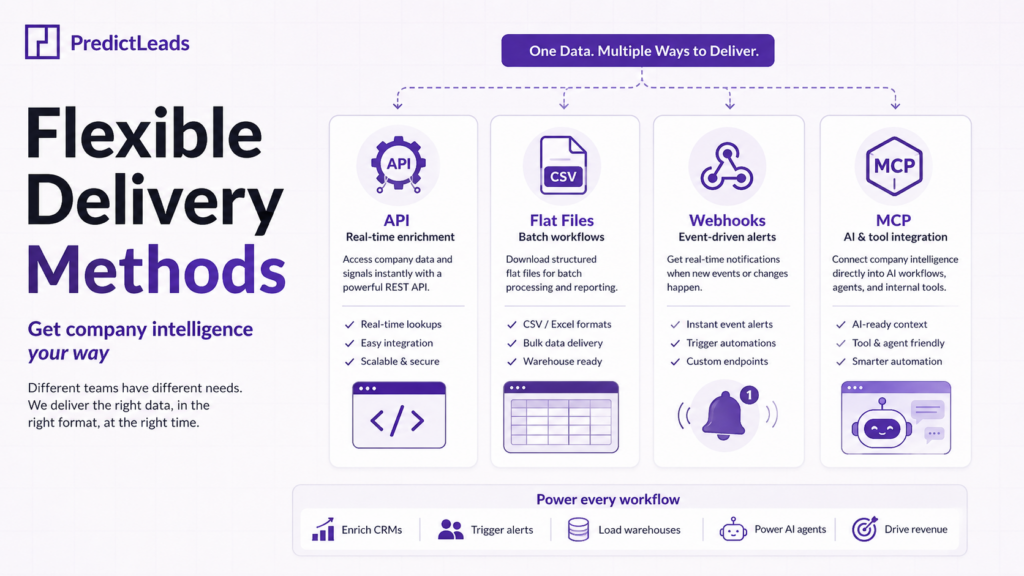
Different teams need different delivery methods. For real-time enrichment, many use an API. Flat files work well for batch workflows and warehouse ingestion. Webhooks can trigger alerts or automations when new company events appear. MCP can also connect company intelligence directly into AI workflows and internal tools.
This matters because B2B data enrichment should fit the way the team already works. A sales team may need account-level signals in the CRM. A data team may need structured records in a warehouse. An AI agent may need company context through MCP before writing a sales brief or account summary.
What good enrichment looks like
Good enrichment is accurate, structured, timely, and easy to connect to workflows. It should not create more manual research. It should help teams move from raw records to better decisions.
For PredictLeads, the strongest enrichment use cases come from combining static company data with dynamic company activity. That blend helps teams see not only what a company is, but what it is doing.
FAQ: B2B Data Enrichment
What is B2B data enrichment?
B2B data enrichment is the process of adding useful business context to existing company, account, lead, or CRM records, such as hiring activity, technology usage, company news, and other signals.
Why is static CRM data not enough?
Static CRM data can tell you what a company is, but not what it is doing right now. Dynamic signals help teams understand timing, intent, growth, and relevance.
Which signals are most useful for enrichment?
The most useful signals often include job openings, technologies used, company news, funding events, partnerships, similar companies, and customer or vendor relationships.
How do GTM teams use enriched company data?
Sales teams use it to prioritize accounts and personalize outreach. Marketing teams use it to build better segments. RevOps and data teams use it to improve scoring, routing, and account coverage.
How can enriched data be added to existing workflows?
Enriched data can be delivered through APIs, flat files, webhooks, or MCP, depending on whether the team needs real-time enrichment, batch workflows, automated alerts, or AI-ready company context.
Final takeaway
B2B data enrichment is no longer just about filling missing CRM fields. It is about adding context that helps GTM teams identify timing, fit, intent, and relevance. Hiring signals, technology data, company news, similar companies, and relationship data can turn a basic account list into a sharper revenue workflow.
For teams building enrichment workflows, start with the Companies Dataset, then layer in Job Openings, Technologies, and News Events based on the GTM motion you want to improve.