
Hiring signals help B2B sales teams understand which companies are growing, changing priorities, or preparing to invest. When a company opens new roles, expands a department, or starts hiring for a specific technology stack, it often reveals what the business is trying to do next.
That makes hiring signals useful for account prioritization, lead scoring, sales outreach, market mapping, and GTM planning. Instead of treating every account the same way, teams can focus on companies that show real movement.
This guide explains how B2B sales teams can use hiring signals to identify growth intent, prioritize accounts, and time outreach with more relevance.
What Are Hiring Signals?
Hiring signals are patterns in job openings that reveal what a company may be planning. A single job post can be useful, but the strongest signal usually comes from a pattern across roles, departments, locations, and timing.
For example, a company hiring five new sales roles may be expanding revenue capacity. A company hiring data engineers may be investing in analytics, AI infrastructure, or internal data platforms. A company hiring customer success managers may be preparing for customer growth or retention work.
PredictLeads covers this through structured job openings data that can reveal company growth, hiring momentum, and operational change.
Why Hiring Signals Matter for B2B Sales
Most B2B sales teams already use firmographic data such as industry, company size, location, and revenue. That data helps define the ideal customer profile, but it does not always show timing.
Hiring signals add movement. They show which companies are actively changing, not just which companies match a static profile.
- A company hiring sales leaders may need tools for pipeline generation or territory planning.
- A company hiring engineers may need developer tools, cloud infrastructure, or data services.
- A company hiring finance roles may be preparing for reporting, fundraising, or operational scale.
- A company hiring in a new country may be entering a new market.
These patterns help sales teams decide who to contact, what message to use, and when to act.
How to Prioritize Accounts With Hiring Signals
The best way to use hiring signals is to connect them to a specific business hypothesis. A job opening only becomes useful when it points to a likely need.
1. Map job roles to buying intent
Start by listing the roles that often appear before a company buys your product. Then group those roles by department and business function.
- Sales roles can signal revenue expansion.
- Marketing roles can signal demand generation investment.
- Data roles can signal analytics or AI investment.
- Security roles can signal compliance or infrastructure investment.
This mapping turns raw job openings into practical sales intelligence.
2. Score the strength of the signal
Not every job opening deserves the same weight. A single general role may be weak. A cluster of roles in the same department may be much stronger.
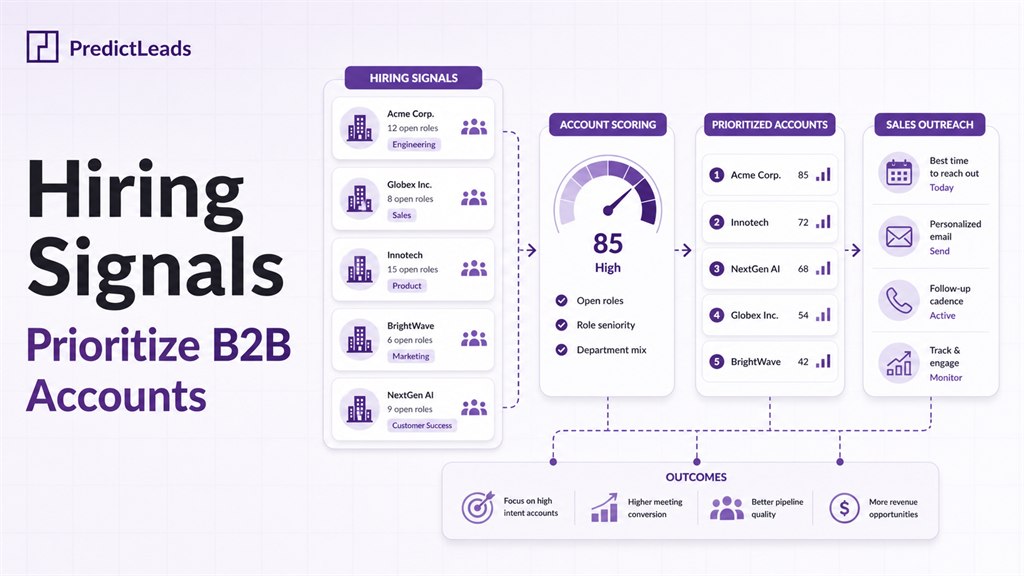
A simple hiring signal score can include:
- number of open roles
- role relevance to your product
- department or function
- seniority level
- new location or market
- change compared with previous hiring activity
Teams can combine this with other signals, such as funding, partnerships, technology adoption, or company news events. That creates a more complete view of growth intent.
For a broader view of provider selection, see this guide to the best job data providers in 2026 for labor market data.
3. Segment accounts by hiring pattern
Hiring signals become more useful when they support segmentation. Instead of using one generic prospect list, sales teams can build account segments around business movement.
- Companies hiring revenue teams
- Companies hiring data or AI teams
- Companies opening roles in new markets
- Companies hiring around a specific technology
- Companies increasing hiring after funding or a major announcement
This type of segmentation makes outreach more relevant. A rep can reference the likely business priority instead of sending a generic message.
Examples of Hiring Signals for Sales Teams
Here are common hiring signals that B2B sales teams can use in account scoring and outreach.
Sales team growth
Open roles for account executives, sales development representatives, sales operations, and revenue leaders can signal go-to-market expansion. These accounts may need data enrichment, territory planning, lead scoring, or sales intelligence.
Data and engineering hiring
Roles such as data engineer, machine learning engineer, analytics engineer, platform engineer, and infrastructure engineer can show investment in technical systems. These hiring signals often matter for cloud, data, developer tooling, and AI vendors.
PredictLeads has a related guide on how to find companies hiring data engineers using hiring signals and job data.
New market entry
When a company starts hiring in a new region, it may be opening an office, entering a market, or building local operations. This can help sales teams identify expansion-stage accounts before a formal announcement appears.
Technology-specific hiring
Job descriptions often mention tools, systems, and platforms. When a company hires for Snowflake, BigQuery, Salesforce, Kubernetes, or other technologies, it can reveal the account’s technology environment.
This becomes stronger when combined with technographic data. PredictLeads explains that approach in job openings data and technographics.
How Hiring Signals Improve Sales Outreach
Hiring signals make outreach more specific. A sales team can move from “we help companies like yours” to “we noticed your team is hiring for a new data function, which often creates a need for cleaner company intelligence and enrichment.”
That context helps the message feel relevant. It also helps reps explain why they are reaching out now.
A practical workflow might look like this:
- Monitor target accounts for new job openings.
- Identify role clusters that match your product’s buying triggers.
- Score accounts based on hiring volume, role relevance, and timing.
- Route high-score accounts to sales or marketing workflows.
- Personalize outreach around the likely business priority.
For a deeper GTM workflow, read how to use job openings data for sales prospecting.
What Data Fields Matter Most?
Good hiring signals need more than a job title. To use job openings data in sales workflows, teams need structured fields they can filter, score, and route.
- company name and domain
- job title
- job description
- department or function
- location
- posting date
- source URL
- detected technologies or keywords
These fields make hiring signals easier to use in CRM enrichment, lead scoring, account monitoring, and AI agent workflows.
Common Mistakes When Using Hiring Signals
Hiring signals are powerful, but teams can misuse them if they treat every job opening as equal.
- Using only job counts: Volume matters, but role relevance matters more.
- Ignoring company matching: A signal loses value if the job is tied to the wrong company.
- Missing timing: Recent openings usually matter more for outreach than old postings.
- Skipping context: Hiring signals work best alongside news events, funding, technologies, and firmographics.
The goal is not to chase every open job. The goal is to find patterns that reveal a business priority.
Final Thoughts
Hiring signals give B2B sales teams a practical way to identify companies with growth intent. They help teams prioritize accounts, score leads, personalize outreach, and spot changes before those changes become obvious in public announcements.
For companies that sell into fast-moving markets, job openings data can become a valuable layer in the GTM stack. It turns hiring activity into a signal that sales, marketing, data, and AI teams can act on.
PredictLeads helps teams access structured job openings data and related company signals, so they can move from static account lists to dynamic, signal-based prioritization.