
Company news data providers help teams track important business developments such as funding rounds, acquisitions, partnerships, product launches, expansions, leadership changes, and other company events.
Instead of manually following press releases, business publications, company blogs, and news websites, teams can use company news data providers to monitor company activity at scale.
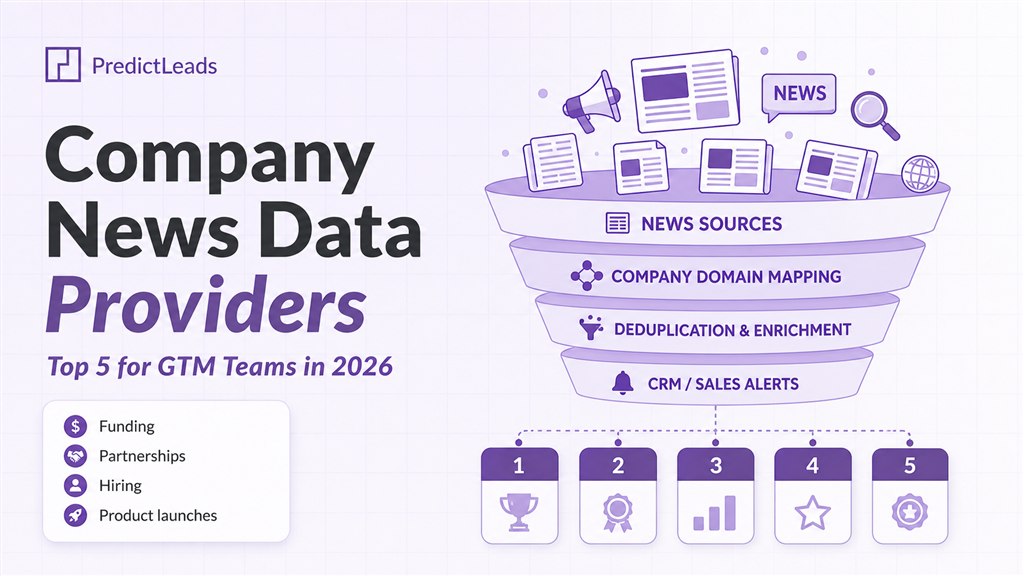
The best company news data providers in 2026 include Crunchbase, PredictLeads, CB Insights, AlphaSense, and Owler. These platforms help sales, marketing, RevOps, data, investment, and research teams find relevant company changes and use them in workflows.
We selected these providers because they are commonly associated with company activity, business news, private company intelligence, competitor monitoring, or structured company event data.
But not every provider works the same way. Some focus on company profiles and funding data. Others are built for market research, competitor monitoring, enterprise search, or structured company news events delivered through APIs.
In this guide, we compare the top company news data providers based on their strengths, limitations, pricing, and best-fit use cases.
What is company news data?
Company news data is structured information about important business developments involving companies.
This can include events such as:
- funding rounds
- acquisitions
- partnerships
- product launches
- expansions
- leadership changes
- new customer announcements
- awards
- regulatory updates
- strategic initiatives
The source material usually comes from company news pages, press releases, business publications, blogs, and other public web sources.
The output depends on the provider. Some company news data providers offer searchable company profiles. Others provide alerts, dashboards, research platforms, or raw news feeds.
More structured providers turn company news into categorized business events. This makes the data easier to use in sales workflows, market intelligence systems, enrichment pipelines, AI agents, and internal data products.
The main difference is whether a provider gives you articles to read or structured company events you can act on.
Quick comparison of the best company news data providers
| Provider | Best for | Provider type | Main tradeoff |
| Crunchbase | Company activity, funding data, startup intelligence, and company profiles | Company intelligence database with company, funding, firmographic, and private market data | More database-led than event/API-led |
| PredictLeads | Structured company news events, API access, GTM workflows, AI agents, and data products | Company news events dataset with categorized events from PR sites, news outlets, and blogs | Less focused on manual research UI |
| CB Insights | Market intelligence, startup tracking, funding research, and analyst-style insights | Market intelligence platform focused on private companies, markets, and competitive signals | More platform/research-led than raw data infrastructure |
| AlphaSense | Enterprise company research, financial intelligence, news search, and document monitoring | Enterprise market intelligence and AI search platform | Best suited for research teams, not lightweight data workflows |
| Owler | Competitor monitoring, company alerts, and business news tracking | Company monitoring platform with company profiles, competitor graphs, and news alerts | More alert/UI-led than structured dataset-led |
Company news data providers are not all built for the same workflow.
Crunchbase is strong for researching companies and funding activity. CB Insights and AlphaSense are better suited for market intelligence and enterprise research. Owler is useful for following competitors and receiving company alerts.
PredictLeads is different because it focuses on structured company news events that can be used directly in APIs, enrichment workflows, GTM systems, AI agents, and data products.
1. Crunchbase: Best for company activity and funding intelligence
Crunchbase is one of the most recognized company intelligence platforms, especially for tracking startups, private companies, funding rounds, investors, acquisitions, leadership, and company growth activity.
For many teams, Crunchbase is the default starting point when they want to understand a company’s background, funding history, investors, competitors, and recent activity. It is widely used by sales teams, investors, founders, corporate development teams, and market researchers.
How it works
Crunchbase collects and organizes company information into searchable company profiles. These profiles can include details such as company description, industry, location, funding rounds, investors, acquisitions, leadership, employee estimates, website, and related companies.
For company news data use cases, Crunchbase is most useful when the goal is to research company activity in context. Users can look up a company, review its funding history, track acquisitions, monitor startup growth, and identify companies in specific industries or markets.
Strengths
- Strong brand recognition in company intelligence and startup data
- Useful for researching funding rounds, investors, acquisitions, and company profiles
- Good fit for sales, investment, venture capital, and corporate development workflows
- Broad coverage of startups and private companies
- Easy for non-technical teams to understand and use
- Strong association with company activity, startup intelligence, and private market data
Limitations
- More focused on company profiles and funding intelligence than structured company news events
- Less ideal for teams that need normalized event data delivered directly through APIs
- Not built primarily as a real-time business event detection system
- API access is typically part of a custom data licensing or enterprise package
- May require additional tooling if the goal is to automate GTM triggers, enrichment workflows, or AI agent inputs
Pricing
Crunchbase has a free account option for basic company research and a paid Pro plan for more advanced prospecting and company intelligence workflows.
As of 2026, Crunchbase Pro is listed at $99 per month when billed monthly. Crunchbase has also offered annual discounts or introductory annual offers, so the effective monthly cost may be lower for annual subscriptions.
Crunchbase API access is not priced like a simple self-serve API plan. Full API access typically requires an Enterprise or Applications license, and pricing is customized based on use case, customer volume, and the type of data being licensed.
For teams that only need manual company research, Crunchbase Pro can be relatively accessible. For teams that need API access, bulk exports, integrations, or commercial data licensing, Crunchbase becomes a custom-priced enterprise data product.
When to use Crunchbase
Use Crunchbase if your team needs a well-known company intelligence platform for researching companies, funding rounds, investors, acquisitions, and startup activity.
It is especially useful when the workflow starts with manual research, market mapping, investment sourcing, sales prospecting, or understanding the background of a specific company.
Crunchbase is a strong choice for company research and funding intelligence, but teams that need structured company news events for automation may need a more event-focused data provider.
2. PredictLeads: Best for structured company news events and API workflows
PredictLeads is a company news data provider focused on structured business events. Instead of only providing raw articles, company profiles, or research dashboards, PredictLeads extracts company developments from news sources and turns them into categorized company news events.
The News Events dataset is built for teams that want to use company news data inside workflows, products, enrichment systems, GTM tools, market intelligence platforms, and AI agents.
PredictLeads is especially useful when the goal is not just to read company news, but to detect relevant company changes and act on them programmatically.
How it works
PredictLeads monitors company news sources, press releases, blogs, and business publications, then extracts relevant business events from that content.
These events can include categories such as:
- product launches
- funding announcements
- partnerships
- acquisitions
- expansions
- leadership changes
- new customers
- awards
- hiring-related announcements
- other company activity signals
Each company news event is structured into a record that can include the company, event category, source URL, date, description, article context, location data, investment amounts, and other event-level metadata.
This makes PredictLeads different from traditional news APIs. A raw news API might return articles that mention a company. PredictLeads focuses on identifying the actual company event inside the article and making it usable as structured data.
Strengths
- Strong fit for structured company news events
- API-first delivery for GTM, data, and AI workflows
- Useful for sales triggers, account monitoring, market intelligence, and enrichment
- Turns unstructured company news into categorized business events
- Supports automation better than manual research tools
- Good fit for AI agents and internal data products that need company activity data
- More actionable than raw news feeds when the goal is to detect business changes
Limitations
- Less focused on being a manual research platform compared with tools like AlphaSense or CB Insights
- Not primarily a company profile database like Crunchbase
- Best suited for teams that have a clear workflow for using structured company news data
- Teams looking for analyst reports, broad market research, or a traditional dashboard experience may need to combine it with other tools
Pricing
PredictLeads has one of the more transparent pricing models among company news data providers.
For API access, PredictLeads offers 100 free API credits per month. After that, API usage is billed on a pay-as-you-go model with volume-based discounts:
| Monthly API usage | Price |
| 100 API credits/month | Free |
| 101–5,000 API credits | $0.04 per API credit |
| 5,001–10,000 API credits | $0.02 per API credit |
| 10,001–100,000 API credits | $0.01 per API credit |
| 100,001–500,000 API credits | $0.004 per API credit |
| 500,001+ API credits | $0.002 per API credit |
There is a $40 minimum monthly charge once a team moves beyond the free tier.
For most endpoints, 1 API request equals 1 API credit. For the News Events endpoint, one API call can return up to 1,000 news event records, so the effective cost per record can be low when teams use pagination and filters efficiently.
PredictLeads also offers flat file and webhook delivery for teams that need larger-scale or recurring data delivery. Flat file pricing is usually quoted separately and typically starts around $24,000 to $150,000 per dataset, depending on the dataset, volume, history, delivery frequency, and commercial use case.
This makes PredictLeads flexible for both smaller teams testing company news data through APIs and larger data teams that need full dataset access through flat files, S3, GCS, SFTP, or webhooks.
When to use PredictLeads
Use PredictLeads if your team needs structured company news data that can be integrated directly into products, workflows, or data pipelines.
It is especially useful for:
- company news event detection
- sales triggers
- account monitoring
- GTM workflows
- market intelligence
- CRM enrichment
- AI agents
- lead scoring
- investment sourcing
- company activity tracking
- internal data products
PredictLeads is a strong choice when your team wants company news data as infrastructure, not just as a research interface.
If your workflow depends on detecting company changes automatically and acting on them through an API, webhook, flat file, or AI workflow, PredictLeads is one of the most relevant options in this category.
3. CB Insights: Best for market intelligence and startup tracking
CB Insights is a market intelligence platform used by strategy, innovation, corporate development, venture capital, and research teams to track companies, markets, funding activity, competitors, and technology trends.
It is especially strong in private company intelligence and startup tracking. Teams use CB Insights to understand which companies are growing, which markets are changing, where investors are placing capital, and what trends may affect their industry.
For company news data use cases, CB Insights is useful when the goal is broader market understanding rather than only event extraction. It can help teams monitor companies, discover emerging startups, track funding activity, analyze competitors, and follow market movements.
How it works
CB Insights organizes company and market data into a research platform. Users can search for companies, build market maps, track funding rounds, monitor competitors, follow emerging technology categories, and review research reports.
The platform includes company profiles, funding data, acquisitions, market categories, predictive scoring, business relationships, customer and partner signals, analyst research, and AI-assisted research workflows.
CB Insights is not just a company news feed. It is closer to a market intelligence system that combines company data, private market signals, research, and analytics.
For teams that want context around company activity, this can be valuable. For teams that need clean, structured company news events delivered into a data pipeline, it may be heavier than necessary.
Strengths
- Strong authority brand in market intelligence and private company data
- Useful for tracking startups, funding activity, acquisitions, investors, and emerging markets
- Good fit for corporate strategy, innovation, venture capital, and corporate development teams
- Strong research and analyst-style workflow
- Useful for market maps, technology scouting, competitive intelligence, and industry trend analysis
- Offers more context around companies and markets than a basic news API
- Strong semantic association with company intelligence, startup intelligence, and market research
Limitations
- More research/platform-led than dataset-led
- Usually better for analysts and strategy teams than lightweight API workflows
- Not primarily built as a structured company news events dataset
- Can be expensive for smaller teams or simple company monitoring use cases
- Teams that need normalized event records for GTM workflows, AI agents, or data products may need a more API-first data provider
Pricing
CB Insights does not usually publish simple self-serve pricing in the same way as lower-cost SaaS tools or API providers.
Public buyer-reported benchmarks commonly place CB Insights in the enterprise pricing range. Reported annual contract values often start around $25,000 to $30,000 per year, with many teams budgeting closer to $50,000+ per year depending on seats, modules, and access level.
Some pricing benchmarks estimate higher-tier CB Insights contracts at around $60,000 to $100,000+ per year, especially for enterprise deployments, broader team access, API access, data feeds, integrations, or advanced modules.
For programmatic access, data feeds, integrations, and larger enterprise use cases, pricing is typically custom. Teams should expect pricing to depend on the number of users, product modules, data access, integration requirements, and whether the data will be used internally or embedded into products and workflows.
This makes CB Insights a stronger fit for enterprise strategy, innovation, investment, and market intelligence teams than for small teams looking for a simple company news API.
When to use CB Insights
Use CB Insights if your team needs a market intelligence platform for tracking startups, private companies, emerging markets, competitors, funding activity, and technology trends.
It is especially useful for:
- corporate strategy
- innovation teams
- venture capital
- corporate development
- technology scouting
- market research
- competitive intelligence
- startup tracking
- investment research
CB Insights is a strong choice when your team needs research, context, and market-level analysis around company activity.
If your team mainly needs structured company news events delivered through an API, webhook, or flat file, a more event-focused company news data provider may be a better fit.
4. AlphaSense: Best for enterprise company research and news monitoring
AlphaSense is an enterprise market intelligence and AI search platform used by corporate strategy teams, financial institutions, consultants, analysts, and research teams.
It is especially strong for teams that need to search across large amounts of business content, including company filings, earnings transcripts, broker research, expert call transcripts, trade journals, news, and internal documents.
For company news data use cases, AlphaSense is useful when the goal is deep research and monitoring rather than structured event data delivery. Teams use it to track companies, markets, competitors, industry changes, and business developments from a research interface.
How it works
AlphaSense brings together external business content and internal company knowledge into a searchable research platform.
Users can search for companies, competitors, industries, keywords, products, executives, filings, transcripts, research reports, and news mentions. AlphaSense uses AI search, summarization, alerts, and document analysis to help teams find relevant insights faster.
For company news workflows, AlphaSense is useful when analysts need to understand what is happening around a company or market and review the underlying sources.
It is less focused on delivering normalized business event records into an API, and more focused on helping knowledge workers search, summarize, and analyze company information.
Strengths
- Strong enterprise brand in market intelligence and AI-powered research
- Useful for company research, competitor monitoring, market analysis, and financial intelligence
- Broad coverage of business content such as filings, transcripts, research, expert interviews, and news
- Good fit for corporate strategy, investment, consulting, and analyst teams
- Strong search and summarization experience for large volumes of unstructured business content
- Useful when teams need to read source material, compare documents, and understand market context
- Strong association with enterprise intelligence, market intelligence, financial research, and company monitoring
Limitations
- More research-platform-led than dataset-led
- Not primarily built as a structured company news events API
- Can be too heavy for teams that only need company news event data
- Pricing is typically enterprise-oriented and quote-based
- Less ideal for product teams, GTM systems, or AI agents that need normalized event records delivered through an API, webhook, or flat file
- Teams may still need a separate data provider if they want structured company event data inside internal workflows or products
Pricing
AlphaSense does not publish simple self-serve pricing.
The company positions pricing as annual subscription-based and customized by team size, product package, content access, and enterprise requirements.
Public pricing benchmarks commonly estimate AlphaSense contracts in the $10,000 to $100,000+ per year range, depending on the number of seats, selected modules, and content packages.
For individual or small-team access, public buyer-reported benchmarks often place AlphaSense around $10,000 to $25,000 per user per year for core market intelligence and AI search workflows.
For premium content, financial research, expert transcript access, and larger enterprise deployments, pricing can move into the $25,000 to $50,000+ per user per year range, with enterprise-wide deployments sometimes reaching $50,000 to $100,000+ annually.
This makes AlphaSense a premium enterprise option compared with lightweight company news APIs or structured event data providers.
When to use AlphaSense
Use AlphaSense if your team needs an enterprise research platform for company research, market intelligence, financial analysis, and competitive monitoring.
It is especially useful for:
- corporate strategy
- investment research
- consulting
- market intelligence
- financial research
- competitive intelligence
- M&A research
- earnings and filings analysis
- expert transcript search
- enterprise knowledge search
AlphaSense is a strong choice when your team needs to search and analyze business content in depth.
If your team mainly needs structured company news events that can be sent directly into GTM workflows, AI agents, enrichment systems, or data products, AlphaSense may be more than you need.
5. Owler: Best for competitor monitoring and company alerts
Owler is a company monitoring and competitive intelligence platform used by sales, marketing, business development, and research teams to follow companies, competitors, prospects, and industry updates.
It is especially useful for teams that want an easy way to track company news without building their own monitoring system. Users can follow companies, receive alerts, review company profiles, monitor competitors, and stay updated on business events that may be relevant for outreach or account planning.
For company news data use cases, Owler is strongest as a monitoring and alerting tool rather than a structured company news events dataset.
How it works
Owler lets users follow companies and receive updates about news, funding, leadership changes, product announcements, partnerships, acquisitions, and other business developments.
The platform combines company profiles, competitor relationships, news feeds, alerts, and business intelligence into a user-friendly interface. Sales and marketing teams can use Owler to monitor target accounts, personalize outreach, track competitors, and discover new companies.
Owler also offers API and enterprise options for teams that want to integrate company data, news, and competitor intelligence into other systems.
Compared with a raw news API, Owler is more focused on company tracking and alerts. Compared with a structured company news events dataset, it is more focused on user-facing monitoring workflows than normalized event data infrastructure.
Strengths
- Strong fit for competitor monitoring and company alerts
- Easy for sales, marketing, and business development teams to use
- Useful for tracking prospects, customers, competitors, and industries
- Includes company profiles, news updates, competitor relationships, and trigger alerts
- More practical for account monitoring than a generic news feed
- Helpful for outreach personalization and sales research
- Lower-cost entry point compared with many enterprise market intelligence platforms
Limitations
- More alert/UI-led than dataset-led
- Less focused on structured event records for data pipelines and AI workflows
- Not primarily designed as a bulk company news events dataset
- API and enterprise access usually require custom pricing
- Better for monitoring known companies than building large-scale event-driven data products
- Teams that need normalized company news events through APIs, flat files, or webhooks may need a more data-infrastructure-focused provider
Pricing
Owler has a free Community plan for basic company tracking and limited alerts.
For paid access, Owler Pro is commonly listed at $468 per year, which equals $39 per month when billed annually. Owler Pro is designed for individual professionals and smaller teams that want broader company tracking, advanced search, company news alerts, and access to more company intelligence features.
Owler also offers team, API, and enterprise options. These are generally custom-priced and aimed at teams that need business news, competitor intelligence, firmographic data, CRM integrations, Slack or Microsoft Teams workflows, automated research workflows, or broader team access.
Public pricing directories list Owler’s enterprise-style offering, often referred to as Owler Max, as starting around $350 per month, or roughly $4,200 per year. However, final enterprise pricing depends on the number of users, integrations, API access, support, onboarding, data licensing, and commercial use case.
For teams evaluating Owler, a practical pricing benchmark is:
| Plan / access level | Estimated pricing |
| Community | Free |
| Owler Pro | $39/month billed annually, or $468/year |
| Owler Max / enterprise-style access | Around $350/month starting estimate |
| Owler API / Enterprise | Custom pricing |
This makes Owler relatively accessible for individual users and small teams compared with enterprise market intelligence platforms. However, teams that need API access, CRM integrations, or larger-scale company news and competitor intelligence workflows should expect custom pricing.
When to use Owler
Use Owler if your team wants a simple way to follow companies, monitor competitors, track target accounts, and receive business news alerts.
It is especially useful for:
- competitor monitoring
- account tracking
- sales research
- prospect monitoring
- customer intelligence
- outreach personalization
- company alerts
- industry monitoring
- lightweight market research
Owler is a strong choice when the main workflow is following companies and staying informed.
If your team needs structured company news events that can be integrated directly into GTM systems, AI agents, enrichment pipelines, or data products, a more event-focused provider may be a better fit.
Detailed comparison: company news data providers
| Provider | Best for | Main output | Data delivery | Pricing snapshot | Main limitation |
| Crunchbase | Company research, funding data, startup tracking | Company profiles, funding rounds, investors, acquisitions | Platform, exports, API on higher tiers | Pro around $99/month; API and enterprise access custom-priced | More database-led than event-led |
| PredictLeads | Structured company news events, GTM triggers, AI workflows | Categorized business events from company news | API, webhooks, flat files, S3, GCS, SFTP | API includes 100 free credits/month, then $0.04–$0.002 per credit; flat files typically $24k–$150k per dataset | Less focused on manual research UI |
| CB Insights | Market intelligence, startup tracking, private company research | Company data, funding data, market maps, analyst insights | Platform, data feeds, integrations, API options | Custom pricing; public estimates often around $25k–$100k+ per year | More research-led than workflow-led |
| AlphaSense | Enterprise research, financial intelligence, news monitoring | News, filings, transcripts, research, expert calls | Platform, alerts, integrations, enterprise search | Custom pricing; public estimates often around $10k–$100k+ per year | More document-search-led than event-led |
| Owler | Competitor monitoring, company alerts, sales research | Company profiles, news alerts, competitor data | Platform, alerts, API and enterprise options | Free tier; Pro around $39/month billed annually; enterprise-style access around $350/month+; API custom | More alert-led than dataset-led |
Final thoughts
The best company news data provider depends on the workflow your team is trying to support.
Crunchbase is a strong fit if you need a well-known company intelligence database for funding rounds, startup tracking, investors, acquisitions, and company profiles.
PredictLeads is a better fit if you need structured company news events that can be used directly in APIs, GTM workflows, enrichment pipelines, AI agents, and data products.
CB Insights is best suited for teams that need market intelligence, startup tracking, industry research, and broader context around private companies and emerging markets.
AlphaSense is a strong option for enterprise research teams that need to search and analyze business content such as news, filings, transcripts, broker research, expert interviews, and internal documents.
Owler is useful for teams that want a simple way to monitor competitors, follow companies, and receive business news alerts.
The main difference comes down to whether your team wants to research company news manually or use company news data programmatically.
If your team mainly needs a research platform, tools like Crunchbase, CB Insights, AlphaSense, and Owler may be the right fit.
If your team needs company news data as infrastructure, a structured events dataset is usually easier to integrate into sales systems, market intelligence workflows, AI agents, and internal data products. In that case, PredictLeads is built specifically for turning company news into categorized business events that teams can act on.
Pingback: News Data vs News APIs: What GTM Teams Actually Need