
Understanding companies requires more than basic business information. Today, sales, marketing, and research teams rely on several types of company intelligence data to identify opportunities and prioritize accounts, including technographic data vs firmographic data insights.
Two of the most common datasets are firmographic data and technographic data. Although both describe companies, they reveal very different insights.
In this article, we explain the difference between technographic and firmographic data. In addition, we show how companies combine both datasets to improve targeting and market analysis.
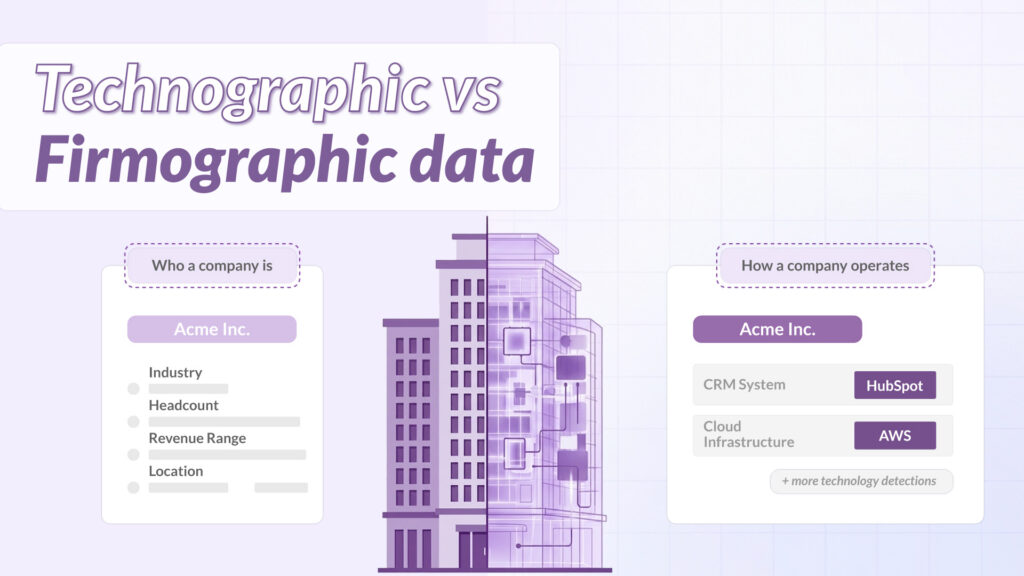
What Is Firmographic Data?
Firmographic data describes the basic characteristics of a company.
It works similarly to demographic data, but it applies to organizations instead of individuals.
Typical firmographic attributes include:
- company name
- industry
- location
- company size
- number of employees
- annual revenue
- founding year
Because of this, firmographic data helps companies segment markets and identify relevant customer groups.
For example, a company selling enterprise software may focus on organizations with:
- more than 500 employees
- $50M+ annual revenue
- operations in North America or Europe
As a result, firmographic data remains a core part of traditional B2B targeting strategies.
What Is Technographic Data?
Technographic data describes the technologies a company uses across its digital infrastructure.
These technologies often include:
- CRM systems
- marketing automation platforms
- analytics tools
- developer frameworks
- cloud infrastructure
- payment systems
Unlike firmographic data, technographic data reveals how companies operate internally.
If you want to understand this concept in more detail, you can read our guide on What Is Technographic Data.
However, understanding how the data is collected also matters. For that reason, we explain the detection process in How Technographic Data Is Collected: Methods, Sources, and Detection Techniques.
Key Differences Between Technographic and Firmographic Data
Although both datasets describe companies, they answer different questions.
| Firmographic Data | Technographic Data |
|---|---|
| Describes company characteristics | Describes company technology usage |
| Includes industry, size, location | Includes tools, platforms, and infrastructure |
| Helps segment markets | Helps understand operational environment |
| Usually changes slowly | Changes frequently as companies adopt tools |
In simple terms, firmographic data tells you who a company is.
Meanwhile, technographic data shows how a company operates.
Why Technographic Data Is Becoming More Important
Today, many B2B markets revolve around software ecosystems. As companies adopt new tools, they often expand their technology stack with related platforms.
For example, a company using a specific CRM platform will likely adopt integrations that support that ecosystem.
Therefore, technographic signals help teams identify companies that are more likely to purchase related products.
As a result, technographic data now plays an important role in:
- sales prospecting
- account-based marketing
- competitive intelligence
- investment research
If you want to see a practical example, our article How to Use Technographic Data for Sales Prospecting explains how revenue teams apply these signals.
Combining Them Together?
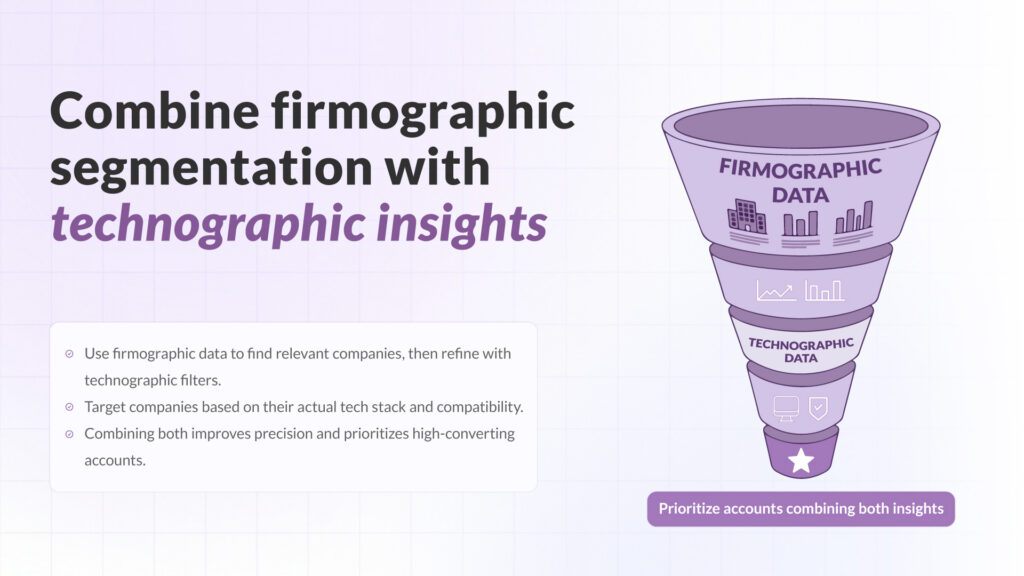
The most effective company intelligence strategies combine firmographic segmentation with technographic insights.
First, teams use firmographic data to identify relevant companies.
Next, they apply technographic filters to identify companies with compatible technology environments.
For example, a sales team might target companies that meet both criteria:
Firmographic filters:
- SaaS companies
- 100–1000 employees
- North America
Technographic filters:
- companies using a specific CRM
- companies adopting cloud infrastructure tools
- companies using modern analytics platforms
Consequently, this combined approach improves targeting accuracy and helps teams prioritize high-potential accounts.
So – Technographic Data vs Firmographic Data – Why not both?

How Technographic Data Is Collected at Scale
Technographic datasets rely on multiple detection methods.
PredictLeads collects technographic signals using:
- large-scale website technology detection
- job posting analysis
- integration signals
- ecosystem relationships
Because these methods run continuously, PredictLeads can track technology adoption across millions of companies.
Currently (March, 2026), PredictLeads tracks:
- 53,000+ technologies
- 1.2+ billion technology adoptions detected since 2018
- 85million websites with detected technologies
These signals appear in the Technologies Dataset and Technology Detections Dataset, which allow teams to analyze technology stacks at scale.
Choosing the Right Data for Your Use Case
Firmographic and technographic datasets serve different purposes.
Firmographic data helps identify which companies to target.
Meanwhile, technographic data reveals how those companies operate.
Therefore, organizations that combine both datasets gain a much clearer view of the market.
In fact, many teams now rely on technographic signals to identify buying triggers, technology adoption trends, and competitive shifts.
If you want to compare available providers, you can also review our article on the 6 Best Technographic Data Providers in 2026.