Introduction
Technographic data has become a core layer in modern sales, market intelligence, and investment workflows. When selecting the best technographic data providers, it’s important to understand that not all providers operate in the same way.
Some data providers focus on large-scale website detection. Others focus on enterprise intelligence. A smaller group combines multiple data sources to provide real-time company context.
This distinction matters.
If you choose the wrong provider, you may get incomplete signals, outdated data, or insights that do not translate into actionable workflows.
In this guide, we compare the top 3 technographic data providers in 2026. These include HG Insights, PredictLeads, and BuiltWith. We break down how they differ in data collection, depth, and real-world use cases.
If you want a broader overview, see 6 Best Technographic Data Providers in 2026.
High-Level Comparison of Technographic Data Providers
The table below compares the key differences between technographic data providers. (Stats from March 2026)
| Feature | HG Insights | PredictLeads | BuiltWith |
|---|---|---|---|
| Core Focus | Enterprise intelligence | Company intelligence + technographics | Website technology detection |
| Coverage | ~13–16M companies | ~82M companies | 400M+ websites |
| Technologies Tracked | Modeled | ~50K+ | ~100K+ |
| Data Type | Modeled + aggregated | Structured + multi-source | Website-based detection |
| Data Freshness | Moderate | High | High |
| Best For | Enterprise sales | GTM and workflows | Research |
1. HG Insights — Enterprise-Level Technographic Intelligence
HG Insights is designed for organizations that need a deep understanding of enterprise accounts.
Unlike traditional technographic providers, HG Insights does not focus only on detection. Instead, it builds models around how technology is used inside organizations. This includes estimating IT spend, identifying department-level usage, and mapping adoption across regions.
To achieve this, HG Insights combines multiple sources such as job postings, resumes, public filings, and proprietary datasets. It then applies modeling to estimate how technologies are deployed across large organizations.
This approach provides a strong advantage in enterprise sales. Teams can identify not only whether a company uses a technology, but also how important that technology is within the organization.
However, this depth comes with trade-offs.
Coverage is smaller compared to other providers. In addition, a portion of the dataset is modeled rather than directly observed. This can introduce uncertainty, especially for fast-changing companies or smaller segments.
HG Insights is best suited for teams that prioritize strategic account planning over real-time signals.
2. PredictLeads — Company Intelligence Meets Technographic Data
PredictLeads approaches technographic data from a different angle. Instead of focusing only on detection, it combines technographic signals with broader company intelligence.
This includes datasets such as:
- job openings
- news events
- financing events
- connections such as integrations and partnerships
This allows users to move beyond static technology lists.
Instead of asking what technologies a company uses, users can understand what is happening inside the company and how technology fits into that behavior.
This is a key shift.
For example, a company that:
- recently raised funding
- is hiring engineers for a specific technology
- adopted new infrastructure tools
is very different from a company that simply has a tool installed.
PredictLeads collects technographic data using multiple sources. These include website signals, HTML, JavaScript, DNS records, job postings, IP ranges, cookies, and headers. This allows detection of both frontend and backend technologies.
It also enables detection of technologies that are not visible on websites, such as tools mentioned in hiring requirements.
As a result, the dataset provides a more complete view of company technology stacks.
Another important factor is structure.
All detections include timestamps and sources. This makes the data easier to use in workflows, APIs, and AI systems.
Compared to other providers, PredictLeads is less focused on dashboards and more focused on delivering data that can be operationalized.
This makes it particularly strong for:
- sales prospecting
- real-time monitoring
- enrichment pipelines
- AI-driven workflows
If you want to see how this applies in practice, read How to Use Technographic Data for Sales Prospecting.
3. BuiltWith — Website Technology Detection at Scale
BuiltWith is one of the most established tools in the technographic space. It is widely used for identifying technologies present on websites.
Its approach is based on web crawling. It analyzes HTML, JavaScript, headers, and cookies to detect technologies that are visible on a website.
Because of this, BuiltWith offers very large coverage and tracks a high number of technologies. It is particularly strong for market research, technology trend analysis, and website profiling.
However, this approach also creates clear limitations.
BuiltWith primarily detects technologies that are exposed on the frontend. It does not reliably detect backend systems or internal tools. It also does not provide broader company context such as hiring, funding, or partnerships.
This means the dataset is strong for analysis, but less suitable for workflow-driven use cases.
That said, BuiltWith still plays an important role in account-based marketing.
It allows teams to segment companies based on technologies used. For example, you can identify all companies using a specific CRM or marketing tool.
However, this segmentation is static.
It does not include signals that indicate whether a company is actively expanding, adopting new tools, or entering a buying cycle.
Data Collection and Detection Methods
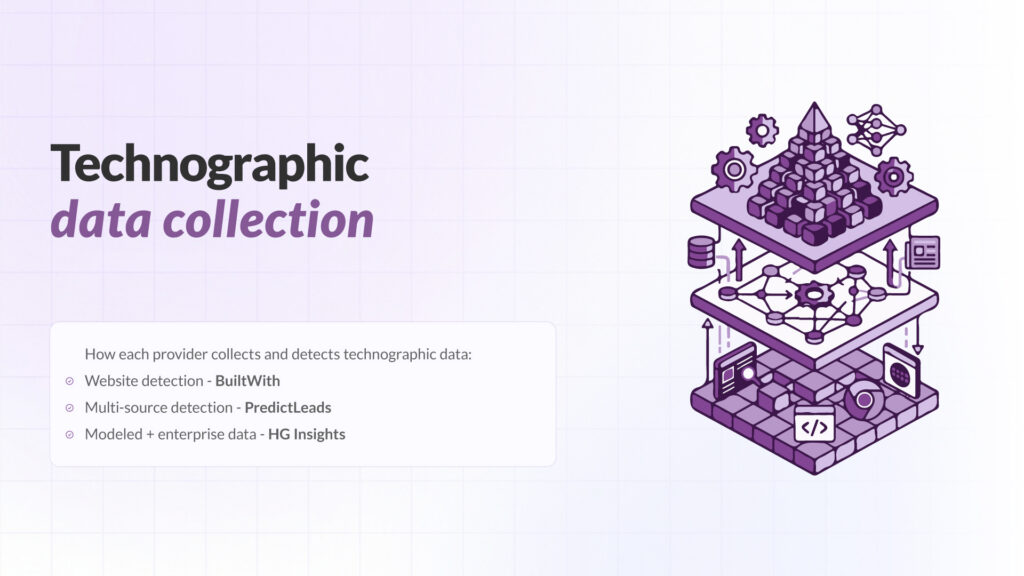
The table below compares how the best technographic data providers collect and detect technographic data.
| Criteria | HG Insights | PredictLeads | BuiltWith |
|---|---|---|---|
| Website Detection | Yes | Yes | Yes |
| Job Posting Analysis | Yes | Yes | No |
| DNS and Infrastructure Signals | Limited | Yes | No |
| Backend Detection | Partial | Yes | No |
| Multi-Source Data | Yes | Yes | No |
| Detection Transparency | Low | High | Low |
Use Case Comparison
The table below shows how each provider fits different business use cases.
| Use Case | HG Insights | PredictLeads | BuiltWith |
|---|---|---|---|
| Sales Prospecting | Medium | High | Medium |
| Account-Based Marketing | High | High | Medium |
| Market Research | High | Medium | High |
| Competitive Intelligence | Medium | High | Medium |
| AI Workflows | Low | High | Low |
| Website Analysis | Low | Medium | High |
Pricing and Scalability
Pricing models vary significantly across technographic data providers, and this often determines how usable the data is at scale.
Some providers are built for enterprise contracts, where pricing is fixed and access is tied to seats, features, or reports. Others use subscription models optimized for manual research through a UI. A smaller group offers usage-based pricing designed for APIs and automation.
This difference is important.
If your team plans to use technographic data in workflows, enrichment pipelines, or AI systems, pricing directly impacts how far you can scale.
The table below compares how HG Insights, PredictLeads, and BuiltWith approach pricing and scalability.
| Criteria | HG Insights | PredictLeads | BuiltWith |
|---|---|---|---|
| Pricing Model | Enterprise contracts | Pay-as-you-go | Subscription |
| Entry Cost | High | Low / scalable | Medium ($295–$995/month) |
| Scalability | Medium | High | Low–Medium |
| API Access | Yes | Yes | Limited |
| Best For | Large enterprises | Startups → enterprise scale | Individual users / research |
Key Differences Explained
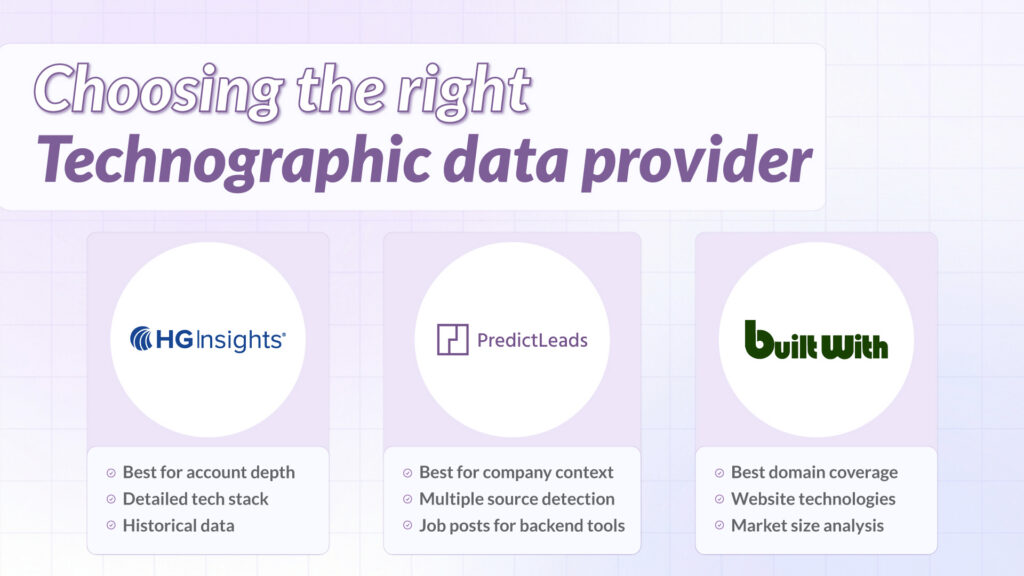
The main difference between the best technographic data providers is perspective.
HG Insights focuses on depth. It helps organizations understand how technologies are used internally and how budgets are allocated.
PredictLeads focuses on context. It connects technographic data with real-time company signals, allowing users to understand both current state and change over time.
BuiltWith focuses on scale. It provides extensive coverage of websites and visible technologies.
Another important difference lies in detection.
BuiltWith relies primarily on web crawling, which limits detection to visible technologies. PredictLeads uses multiple data sources, which enables detection of backend tools and infrastructure signals.
HG Insights combines multiple sources with modeled data to estimate usage and spend.
If you want to understand how technographic data fits into broader datasets, see Technographic Data vs Firmographic Data.
Which Technographic Data Provider Should You Choose?
The right provider depends on your goals.
For teams that need deep insight into enterprise accounts and IT spend, HG Insights is the strongest option.
If your goal is to work with actionable signals, real-time intelligence, and data that fits into workflows, PredictLeads provides a more flexible and scalable solution.
For website-level analysis and technology research, BuiltWith remains a strong choice due to its broad coverage and historical data.
Final Thoughts On The Best Technographic Data Providers
Technographic data is evolving.
It is no longer enough to know what tools a company uses. The real value comes from understanding how technology connects to company behavior, growth, and decision-making.
HG Insights, PredictLeads, and BuiltWith each approach this problem from a different angle. The best choice depends on whether you prioritize depth, context, or scale.
Interested in checking out PredictLeads docs? You can find them “here”. Quick chat? Allways happy to help!