Introduction
Technographic data is only valuable if it is accurate. However, many providers struggle with data accuracy because they prioritize scale over validation.
They often highlight database size or the number of technologies tracked. However, these metrics say little about whether the data reflects reality.
As a result, teams rely on incomplete or misleading signals.
In this guide, we break down what technographic data accuracy really means, what most providers get wrong, and how to evaluate whether a dataset can be trusted.
What Is Technographic Data Accuracy?
Technographic data accuracy refers to how reliably a dataset reflects the technologies a company actually uses.
This includes:
- correct detection of technologies
- avoiding false positives
- identifying backend and non-visible tools
- keeping data up to date
However, accuracy is not just about detection. It is also about validation and context.
For example, detecting a technology once on a website is very different from confirming that it is actively used across a company’s infrastructure. This is where data accuracy becomes critical for real-world use cases.
Why Single-Source Detection Reduces Data Accuracy
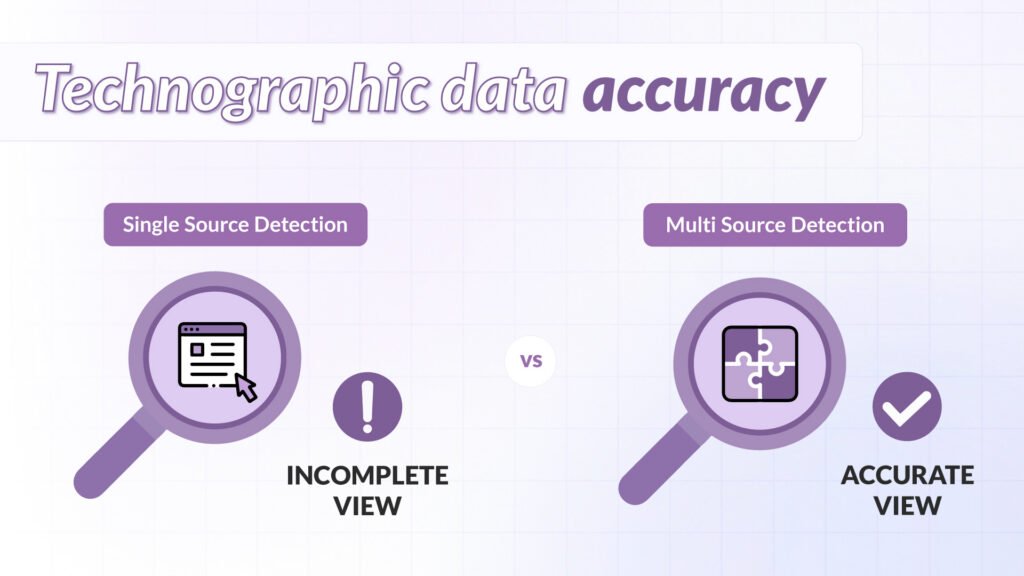
Most technographic providers rely heavily on website scraping.
They analyze:
- HTML
- JavaScript
- headers
- cookies
This approach works well for detecting frontend technologies. However, it creates major blind spots.
Website-based detection cannot reliably identify:
- backend systems
- internal tools
- infrastructure technologies
- tools mentioned in hiring but not visible in code
As a result, relying only on website scraping reduces overall technographic data accuracy.
False Positives and Their Impact on Technographic Data Accuracy
Another common issue is false positives.
For example:
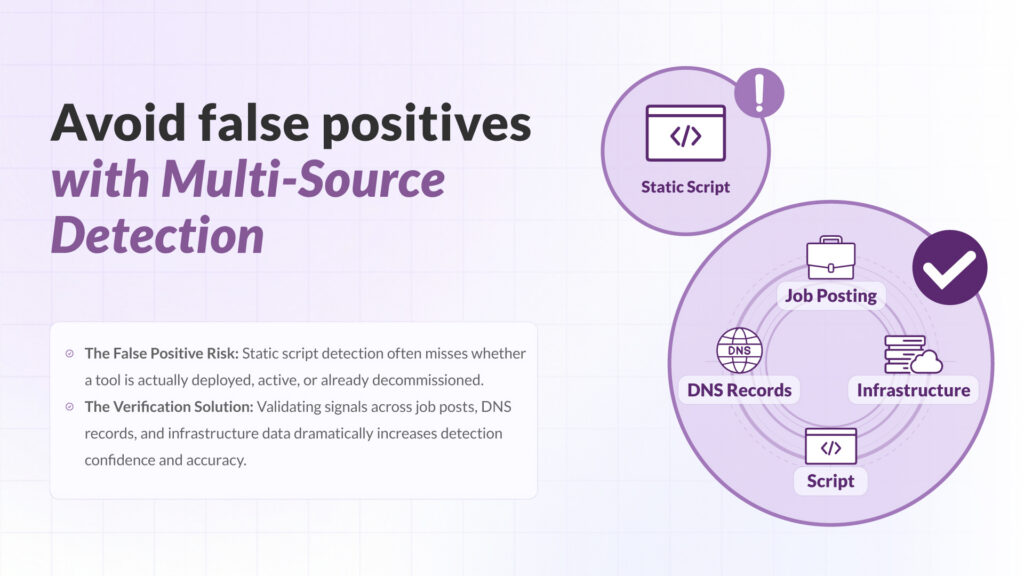
- a script may appear on a page but not be actively used
- a tool may be mentioned but not deployed
- a technology may have already been removed
Without proper validation, these detections remain in the dataset.
At the same time, many providers miss context entirely. They cannot answer when a technology was adopted, whether it is still in use, or why it was implemented.
This lack of context directly reduces data accuracy and limits the usefulness of the dataset.
How Multi-Source Detection Improves Technographic Data Accuracy
More advanced providers improve accuracy by combining multiple data sources.
These typically include:
- website signals
- job postings
- infrastructure data
- DNS records
- company activity
Each additional signal increases confidence.
For example, if a company:
- lists a technology in job descriptions
- shows it in infrastructure signals
- and references it in product development
then the likelihood of correct detection increases significantly.
This approach improves technographic data accuracy by validating signals across multiple sources and reducing false positives.
For a broader vendor comparison, see our guide to the best technographic data providers for B2B targeting.
Why Freshness Matters for Data Accuracy
Technographic data is constantly changing.
Companies adopt new tools, replace existing systems, and evolve their stacks over time. Therefore, outdated data quickly becomes unreliable.
Accurate providers track:
- first detection
- last seen usage
- changes over time
This allows teams to understand not just what technologies are used, but how they evolve.
Without frequent updates, technographic data accuracy declines rapidly.
Structured Data and Its Role in Technographic Data Accuracy
Even accurate detections are not useful if the data is not structured.
Some providers deliver raw or inconsistent data that requires additional processing. Others provide structured datasets with:
- categorized technologies
- normalized company mapping
- timestamps
- deduplicated records
This structure makes it easier to:
- filter data
- build workflows
- integrate with CRMs and APIs
Without proper structuring, even correct detections reduce overall technographic data accuracy in practical applications.
Comparing Detection Approaches and Technographic Data Accuracy
The table below highlights how different detection methods impact data accuracy.
| Detection Approach | Strengths | Weaknesses |
|---|---|---|
| Website-only detection | High coverage, easy to scale | Misses backend tools, higher false positives |
| Multi-source detection | Higher accuracy, broader coverage | More complex to build |
| Modeled data | Provides estimates and trends | Less transparent, not always verifiable |
Why This Matters for Use Cases
Technographic data accuracy directly impacts how the data can be used.
For example:
- In sales prospecting, inaccurate data leads to poor targeting
- In ABM, missing signals reduce campaign effectiveness
- In market intelligence, outdated data creates misleading insights
- In AI workflows, unreliable data breaks automation
If you want to see how accurate data is applied in practice, read How to Use Technographic Data for Sales Prospecting.
How to Evaluate Data Accuracy
When evaluating providers, focus on the following:
| Criteria | What to Check |
|---|---|
| Data sources | Are multiple sources used or only websites? |
| Validation | Is there context or just detection? |
| Freshness | Are timestamps available? |
| Transparency | Can you see how data was detected? |
| Structure | Is the data clean and usable? |
Evaluating technographic data accuracy should be a core part of selecting any provider.
For a broader framework, see How to Choose a Technographic Data Provider. For vendor comparison, read our guide to the best technographic data providers for B2B targeting.
What Most Providers Get Wrong About Data Accuracy
Most providers optimize for scale instead of reliability.
They:
- rely heavily on website scraping
- prioritize database size over validation
- lack multi-source verification
- provide limited transparency
As a result, they compromise technographic data accuracy, even if their datasets appear large.
Final Thoughts
Technographic data accuracy is not just about detecting technologies. It is about detecting them correctly, validating them across sources, and keeping them up to date.
Providers that rely on a single source will always have limitations. In contrast, multi-source detection combined with structured data produces more reliable and actionable insights.
Ultimately, technographic data accuracy determines whether your data can be trusted and used at scale.
Quick chat?
If you want access to structured, multi-source technographic data with timestamps and company context, PredictLeads provides technology detections combined with hiring, funding, and news signals.
Learn more: PredictLeads Docs
Quick Chat?