Introduction
Choosing a technographic data provider is not just about coverage or price. It directly impacts how accurately you can identify target companies, prioritize accounts, and build workflows.
However, most teams evaluate providers based on surface-level metrics such as the number of technologies tracked or database size. As a result, they often end up with incomplete or unusable data.
This guide breaks down how to choose a technographic data provider based on what actually matters: data quality, detection methods, and real-world usability.
If you want a direct comparison of vendors, see Top 3 Technographic Data Providers in 2026 (In-Depth Comparison).
What Is a Technographic Data Provider?
A technographic data provider collects and structures information about the technologies companies use.
This includes tools such as:
- CRM systems
- marketing platforms
- developer tools
- infrastructure technologies
However, not all providers collect this data in the same way.
Some rely only on website scraping. Others combine multiple sources such as job postings, infrastructure signals, and company activity.
This difference has a direct impact on data accuracy.
If you are new to the topic, you can also read Technographic Data vs Firmographic Data to understand how these datasets differ.
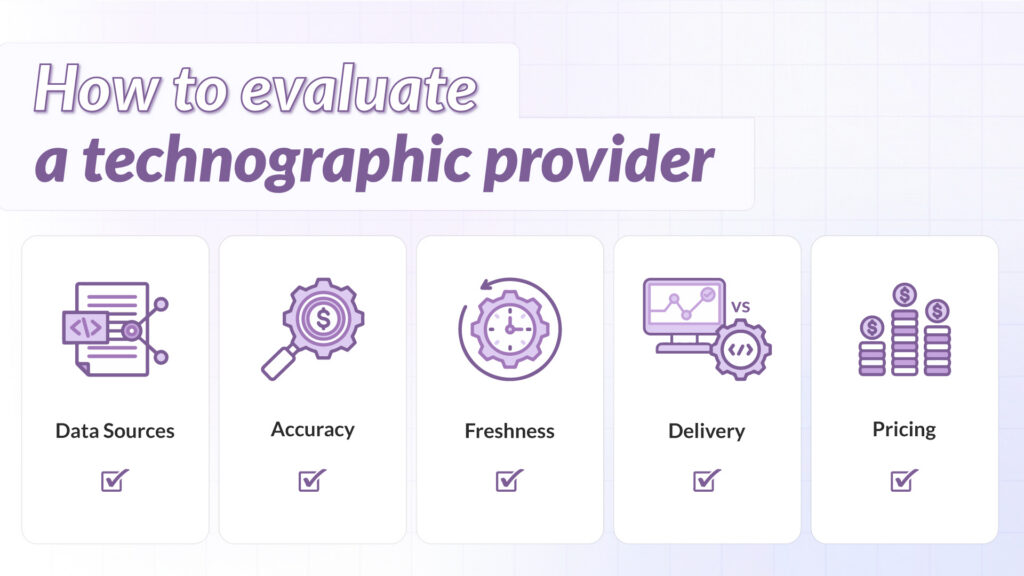
Key Criteria for Choosing a Technographic Data Provider
The table below outlines the most important criteria when evaluating providers.
| Criteria | What to Look For | Why It Matters |
|---|---|---|
| Data Sources | Multi-source detection (web, jobs, infrastructure) | Increases accuracy and coverage |
| Technology Depth | Frontend + backend detection | Avoids missing critical tools |
| Data Freshness | Frequent updates with timestamps | Ensures relevance |
| Data Structure | Clean, categorized, deduplicated | Enables automation |
| Delivery Method | API, flat files, webhooks | Supports workflows |
| Transparency | Source data and detection logic | Builds trust in data |
1. Detection Method Matters More Than Database Size
Most providers highlight how many technologies or websites they track.
However, this metric alone is misleading.
A provider that tracks 100,000 technologies through website scraping may still miss:
- backend systems
- internal tools
- technologies mentioned in hiring
On the other hand, providers that use multiple data sources can detect technologies that are not visible on websites.
Therefore, always prioritize how data is collected, not just how much data exists.
2. Look Beyond Static Technology Lists
Many tools provide a static snapshot of a company’s tech stack.
While this is useful for segmentation, it does not indicate whether a company is actively adopting, expanding, or replacing technologies.
For example, a company using a CRM is not necessarily a good prospect.
However, a company that:
- is hiring engineers for that CRM
- recently raised funding
- adopted new infrastructure
is much more likely to be in a buying cycle.
This is where combining technographic data with other signals becomes important.
3. Evaluate Data Structure and Usability
Raw data is not useful unless it can be used in workflows.
Some providers deliver unstructured or duplicated data that requires additional processing.
Others provide:
- categorized signals
- deduplicated events
- consistent schemas
- timestamps
This reduces engineering effort and allows teams to integrate data directly into:
- CRMs
- enrichment pipelines
- AI systems
In practice, this often matters more than raw coverage.
4. Consider Your Use Case First
Different providers are optimized for different use cases.
The table below shows how provider types align with typical use cases.
| Use Case | Best Provider Type |
|---|---|
| Enterprise sales planning | Enterprise intelligence platforms |
| Sales prospecting | Multi-source technographic providers |
| Market research | Website detection platforms |
| AI workflows | API-first data providers |
| Competitive intelligence | Signal-based company data providers |
Before choosing a provider, define whether you need:
- depth
- coverage
- or real-time signals
5. Pricing Model Impacts Scalability
Pricing is often overlooked during evaluation.
However, it determines how easily you can scale your usage.
Most providers fall into two categories:
- Subscription-based pricing
- Usage-based pricing
Subscription models are often optimized for manual usage through dashboards. They can become expensive when scaling data extraction.
Usage-based pricing is typically better suited for:
- APIs
- automation
- large-scale enrichment
Therefore, align pricing with how you plan to use the data.
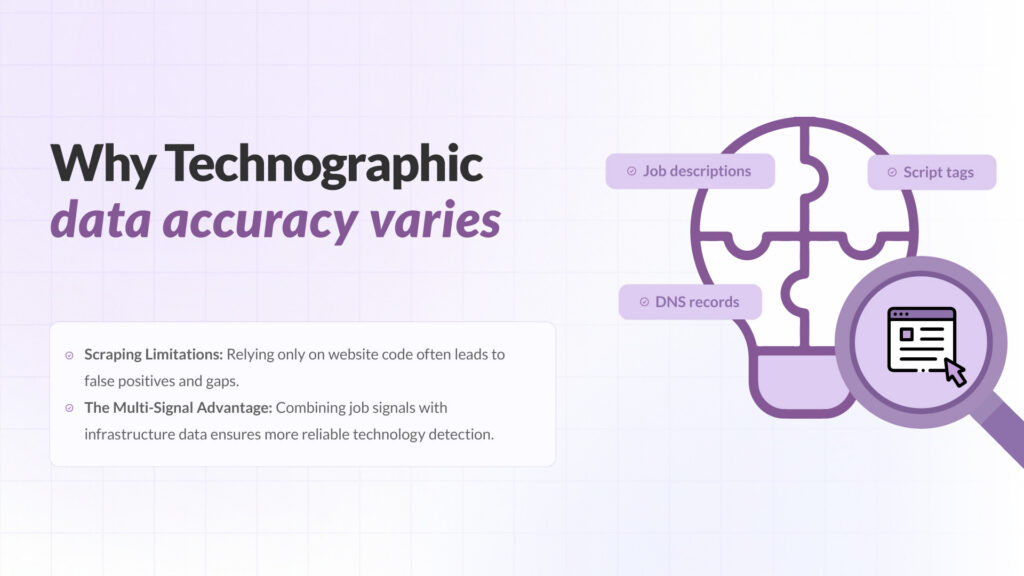
6. Accuracy Is a Function of Data Sources
Technographic data accuracy depends on how signals are collected and validated.
Providers that rely only on website scraping often produce:
- false positives
- incomplete detections
In contrast, providers that combine multiple signals such as job postings and infrastructure data can validate technology usage more reliably.
We explore this in more detail in Technographic Data Accuracy: What Most Providers Get Wrong.
How Leading Providers Compare
The table below summarizes how different types of providers perform across key dimensions.
| Dimension | Enterprise Platforms | Multi-Source Providers | Website-Based Tools |
|---|---|---|---|
| Depth | High | Medium | Low |
| Coverage | Medium | High | Very High |
| Context | Medium | High | Low |
| Real-Time Signals | Medium | High | Medium |
If you want a breakdown of some vendors, see 6 Best Technographic Data Providers in 2026.
Common Mistakes When Choosing a Provider
Many teams make similar mistakes during evaluation.
First, they focus too much on database size instead of data quality.
Second, they underestimate the importance of structured data and integration capabilities.
Finally, they ignore how data will be used in real workflows.
Avoiding these mistakes can significantly improve the value you get from technographic data.
Final Thoughts
Choosing the right technographic data provider depends on understanding how the data is collected, structured, and used.
The best provider is not the one with the largest dataset. Instead, it is the one that aligns with your workflows and provides reliable, actionable signals.
As technographic data becomes more central to GTM and AI systems, this decision becomes increasingly important.
Quick Chat?
If you want to explore how structured technographic data can be used in real workflows, PredictLeads provides multi-source technology detections combined with company intelligence signals such as hiring, funding, and news events.
Learn more: PredictLeads Docs
Quick Chat?