
Company news event data has become increasingly valuable: company news has been helping people make money (gold coins) for centuries.
Imagine you’re a merchant in Ancient Greece.
News spreads that a nearby city is preparing for war. Most people hear the news and move on with their day.
The guy selling medical supplies hears the same news and thinks:
“Looks like demand is about to increase.”
Same information.
Different action.
That’s essentially what sales triggers are.

Something changes.
Someone notices.
Someone acts before everyone else.
Fast forward a few thousand years and the principle hasn’t changed.
Companies are constantly telling the market what they’re about to do next.
They launch products.
Hire executives.
Expand into new markets.
Raise funding.
Acquire competitors.
Announce partnerships.
The challenge isn’t finding information anymore.
The challenge is knowing which information actually matters.
That’s where company news event data comes in.
Instead of reading hundreds of articles, newsletters, press releases, and LinkedIn posts, GTM teams can use structured company news events to identify buying signals, prioritize accounts, improve lead scoring, and reach prospects when timing is on their side.
Because timing matters.
A company that raised funding yesterday is very different from a company that raised funding three years ago.
Think of a company that just launched a new AI product. They probably have different priorities than one that’s been sitting still for twelve months.
Also – A company expanding into Europe is likely facing different challenges than one focused on maintaining existing operations.
Change creates needs and needs create opportunities.
And company news events help you spot those opportunities before your competitors do.
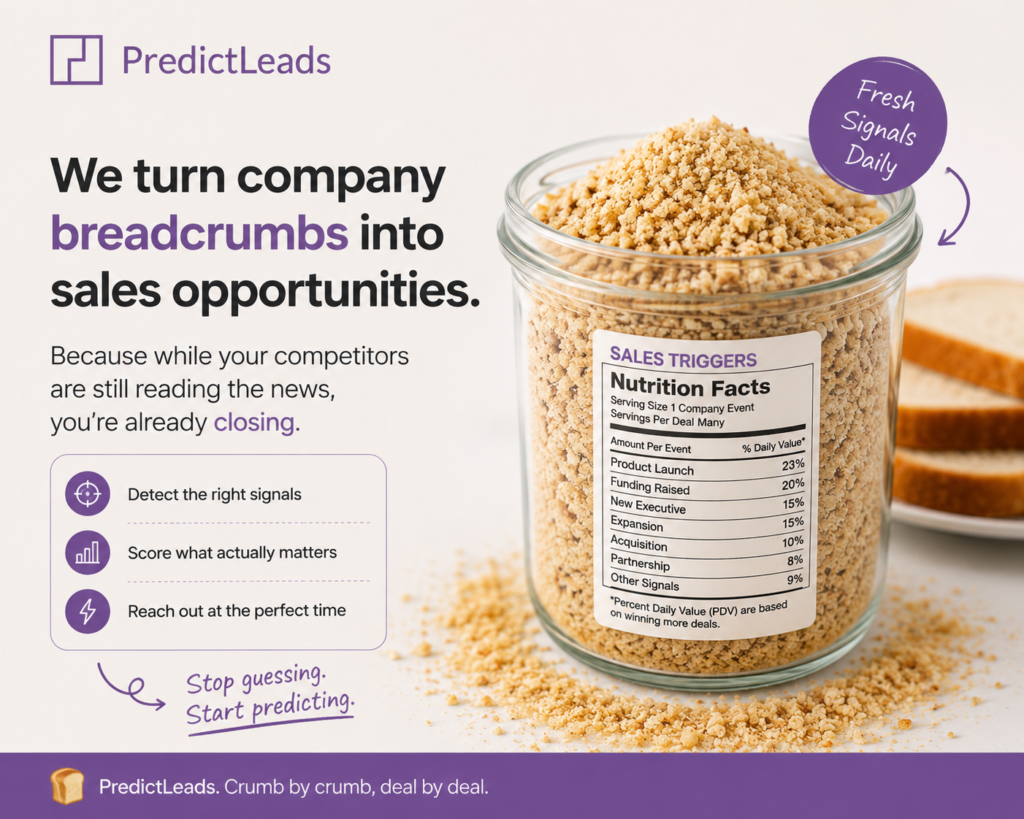
Every Company Leaves Breadcrumbs
One of the biggest mistakes GTM teams make is assuming buying intent starts when someone visits a pricing page.
In reality, buying intent often starts much earlier.
A company launches a product.
A new VP joins.
Engineering hiring accelerates.
A strategic partnership gets announced.
The company expands into a new market.
Individually these events may not mean much.
Together they tell a story and that’s when they start leaving breadcrumbs.
And if you collect enough breadcrumbs, you start understanding where a company is heading before they ever become an inbound lead.
That’s why the best sales teams often seem to have perfect timing.
It’s not magic.
They’re simply paying attention to change.
What Is Company News Event Data?
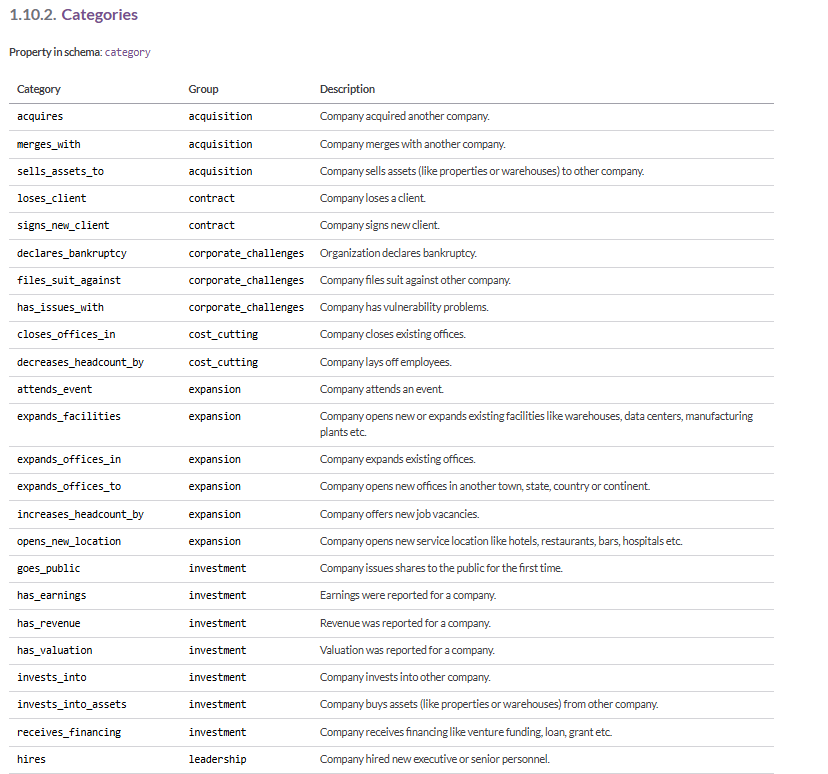
At its core, company news event data is structured information about things happening inside companies.
Instead of giving you a link to an article and expecting you to figure everything out yourself, a news event dataset categorizes and organizes company activity into usable records.
Events can include:
- Product launches
- Partnerships
- Expansions
- Acquisitions
- Leadership changes
- Funding announcements
- New office openings
- Strategic initiatives
- Market expansion
- Major customer announcements
Think of it as the difference between reading a newspaper and receiving a curated briefing that highlights exactly what matters.
A good news event record typically includes:
- Company name
- Domain
- Event category
- Event summary
- Source URL
- Event date
- Related companies
- Location information
The article tells you what happened while the event tells you what to do with it.
Why Company News Makes Great Sales Triggers
Let’s be honest.
Nobody wakes up thinking:
“I’d love another cold email today.”
But people do wake up thinking:
“We just launched a product and now we need infrastructure.”
“After raising $20 million, scaling suddenly became the priority.”
“Expanding internationally has created operational headaches we didn’t have before.”
“Our new CRO wants to rethink the entire GTM strategy.”
That’s where sales triggers come from.
A trigger isn’t just news.
It’s a moment where change creates a potential need.
For example:
Selling data infrastructure? A product launch often signals upcoming integration and scalability needs.
Recruiting software providers should pay close attention to hiring spikes, as they typically indicate growth and new budget allocation.
For RevOps teams, a newly hired VP of Sales can be a strong buying signal because leadership changes often trigger technology evaluations.
Cybersecurity vendors may find opportunities when companies expand into new regions, where compliance requirements and security complexity tend to increase.
The event itself isn’t the opportunity. The opportunity is what the event implies.

Why Most News Alerts Are Useless
Most GTM teams already have access to news.
That’s not the problem.
The problem is signal versus noise.
Google Alerts.
LinkedIn posts.
Industry newsletters.
RSS feeds.
Company blogs.
Press releases.
There is more information available today than ever before. (and most of it is useless.)
Generic alerts often tell you that a company was mentioned somewhere.
That’s not actionable.
A structured company news event tells you:
- What happened
- When it happened
- Which company was involved
- Why it might matter
Instead of reading ten articles, you can focus on the one signal that deserves attention.
That’s the difference between consuming news and operationalizing news.
Using Company News Events for Lead Scoring
Not every event deserves a higher score.
That’s where many teams make mistakes.
A company announcing a charity sponsorship probably shouldn’t jump to the top of your pipeline.
A company launching a new product in your category might.
Good lead scoring combines event data with context.
Questions worth asking:
- Is this company part of our ICP?
- How recent is the event?
- Does the event relate to our buyers?
- Does the event indicate growth?
- Are there supporting signals?
For example:
A product launch by itself might be interesting.
A product launch combined with aggressive hiring and recent funding is significantly more interesting.
The more signals point in the same direction, the stronger the score should become.
Which Events Usually Matter Most?
Product Launches
Product launches often indicate investment.
Companies launching products are spending money, allocating resources, and solving new problems.
They may need:
- Infrastructure
- Integrations
- Data
- Marketing support
- GTM tools
For many vendors, product launches are one of the strongest sales triggers available.
Partnerships
Partnership announcements reveal strategic priorities.
They show where companies are investing their attention and which ecosystems they want to be part of.
Partnerships can also uncover entirely new account relationships worth exploring.
Expansions
Growth creates complexity.
Opening a new office.
Entering a new market.
Hiring internationally.
All of these create operational challenges.
Operational challenges often create buying opportunities.
Acquisitions
Acquisitions create chaos and systems need to be integrated.
Teams need to be merged.
Processes need to be standardized.
Data needs to be consolidated.
This is why acquisition events are often highly valuable signals for sales and customer success teams.
Leadership Changes
New leaders bring new priorities.
New CRO may want better revenue visibility.
A new CTO may evaluate infrastructure vendors.
A new Head of Data may rethink data providers.
One person joining a company can create an entirely new buying cycle.
Funding Events
Funding doesn’t guarantee purchases.
But it usually increases the likelihood of future activity.
Companies often use funding to:
- Hire
- Expand
- Build products
- Enter new markets
- Invest in systems
Funding is rarely the final signal.
It’s usually the first signal.

The Real Power Comes from Combining Signals
The biggest mistake GTM teams make is treating signals individually.
The best teams stack them.
For example:
Product launch + hiring growth.
Funding + executive hire.
Expansion + technology adoption.
Acquisition + infrastructure changes.
One signal creates curiosity.
Multiple signals create confidence.
That’s why the strongest lead scoring models don’t rely on a single event.
They combine multiple indicators into a bigger story.
A Practical Example
Imagine you’re selling a data platform.
One of your target accounts launches a new AI product.
Interesting.
Then you notice they’ve hired fifteen engineers over the last sixty days.
Interesting.
Then you see they raised funding three months ago.
Now you have a story.
The company is investing.
Growing.
Building.
Moving.
That account should probably look different than another company that hasn’t shown any meaningful activity in twelve months.
This is exactly how company news events become sales triggers and lead scoring inputs.
Not because a headline exists, but because the headline helps explain where the company is heading.
How News Events Fit Into Modern GTM Workflows
The best GTM teams don’t use news events for research.
They use news events for automation.
A product launch happens.
The account score increases.
The event gets added to the CRM.
The account owner gets notified.
An AI agent creates a research brief.
A personalized outreach sequence is generated.
Nobody manually reads twenty articles.
The workflow handles the heavy lifting.
That’s where structured event data becomes powerful.
Not because it informs humans.
Because it enables systems.
The Bottom Line
News isn’t valuable because it’s news.
News is valuable because change creates opportunities.
Every product launch, partnership, acquisition, executive hire, expansion, and funding announcement tells a story about where a company is going next.
The companies that win aren’t necessarily the ones with the most information.
They’re the ones that act on the right information first.
Company news event data helps GTM teams do exactly that.
Instead of monitoring headlines, they monitor opportunities.
And that’s a much better use of everyone’s time.