
Why This Signal Matters
A company hiring data engineers is already showing a useful signal. They may be building infrastructure, scaling analytics, improving reporting, modernizing pipelines, or supporting new AI and data products.
A company adopting new data tools is also showing a useful signal. It may be changing its stack, moving workloads, expanding analytics capabilities, or replacing older systems.
Together, those two signals become more interesting. Why? Good question!
Hiring data engineers while adopting new data tools suggests that the company is not just talking about data transformation. It is adding people and systems at the same time.
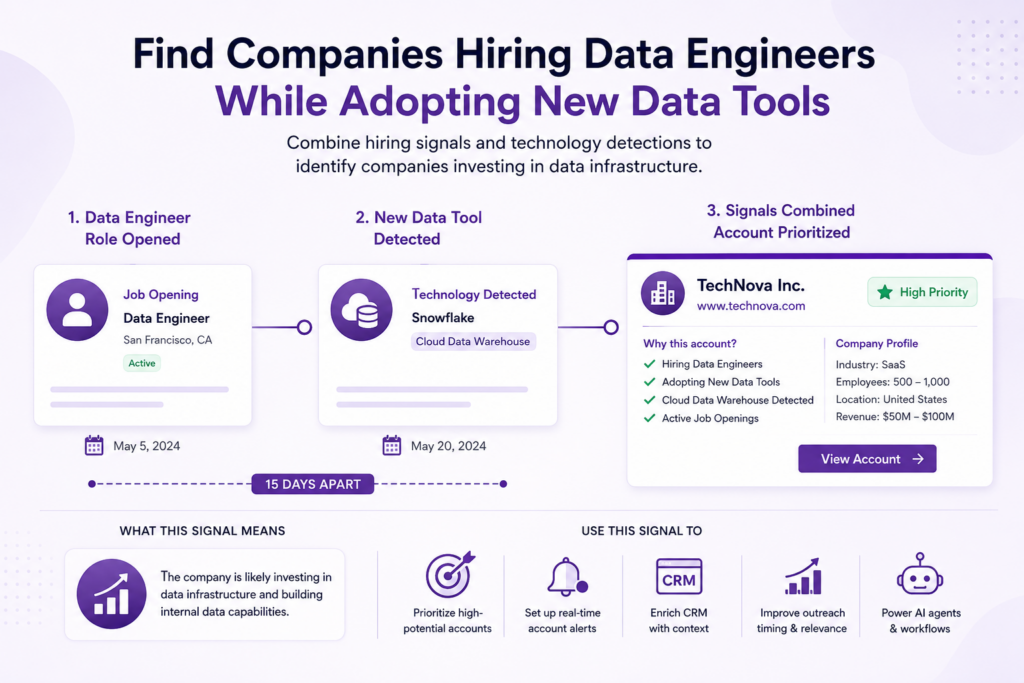
The Signal Logic
The workflow is simple:
- Find companies with active job openings for data engineers or adjacent roles.
- Check whether those companies are using or adopting relevant technology categories.
- Filter for company size, location, industry, or ICP fit.
- Prioritize accounts where hiring and technology changes happened close together.
This is useful because timing often hides in the overlap.
A job post is one clue. while a technology detection is another. Together, they can reveal a company actively building a data function.
Roles to Track
| Role Type | Why It Matters | Example Searches |
|---|---|---|
| Data Engineer | Pipeline and infrastructure investment | data engineer, analytics engineer, platform data engineer |
| Analytics Engineer | Modern BI and transformation workflows | analytics engineer, dbt engineer |
| Data Platform Engineer | Internal data platform buildout | data platform engineer, data infrastructure engineer |
| Machine Learning Engineer | AI and model infrastructure | ML engineer, AI platform engineer |
| Data Governance Roles | Compliance and data quality programs | data governance, data quality, data steward |
Technology Categories to Watch
Do not limit this workflow to one named vendor unless your sales motion depends on it.
Start with technology categories:
- Cloud data warehouses
- BI and analytics tools
- Reverse ETL and activation tools
- Data observability tools
- Customer data platforms
- Workflow and automation tools
- AI infrastructure and model tooling
If you sell into a specific ecosystem, narrow the query further.
For example, a vendor that integrates with Snowflake, BigQuery, Databricks, Looker, or dbt may want to track those technologies specifically.
Example GTM Workflow
Imagine your company sells a data quality platform.
A broad ICP list might include every SaaS company with 200–2,000 employees.
That list is too big.
A signal-based list might include companies that:
- Are hiring data engineers or analytics engineers
- Recently adopted cloud data warehouse or BI tooling
- Are located in your target markets
- Have active job openings rather than only historical postings
- Show additional news or funding momentum
That list is smaller, but much more useful. (and cost less due to time spent of finding the right company)
Practical Signal Workflow
- Define the target motion
Identify companies investing in data infrastructure. - Select hiring signals
Track data engineers, analytics engineers, ML engineers, and related roles. - Add technology signals
Monitor cloud warehouses, BI tools, CDPs, reverse ETL tools, and AI infrastructure. - Filter by ICP
Apply company size, industry, geography, and account criteria. - Combine signals
Prioritize companies where hiring and technology adoption occurred within a similar timeframe. - Activate workflows
Push results into CRM systems, sales intelligence platforms, AI agents, or outbound campaigns. - Review and refine
Measure conversion rates and adjust signal criteria over time.
How Data Platforms Can Use This
Data platforms and sales intelligence products can turn this signal into:
- Account scoring fields
- Weekly account alerts
- Territory prioritization lists
- CRM enrichment
- AI-generated account summaries
- Trigger-based outbound workflows
The important part is explainability.
A rep should not only see that an account was scored highly.
They should also understand why:
“Hiring two data engineers and detected new analytics tooling.”
How PredictLeads Supports This Workflow
PredictLeads has detected 271.3 million job openings since 2018 and currently tracks 9.9 million active job openings. It also tracks 50,000 technologies and has detected 1.3 billion technology adoptions since 2018.
For this workflow, the most relevant datasets are:
Job Openings Dataset
Use:
GET /companies/{company_id_or_domain}/job_openingsGET /discover/job_openings
Technology Detections Dataset
Use:
GET /companies/{company_id_or_domain}/technology_detectionsGET /discover/technologies/{technology_id_or_fuzzy_name}/technology_detections
Companies Dataset
Use:
GET /companies/{id_or_domain}GET /discover/companies
Teams can consume the data through:
- APIs
- Flat files
- Webhooks
Depending on whether the workflow requires real-time alerts, batch enrichment, or product integrations.
Frequently Asked Questions
Is Hiring a Data Engineer Always a Buying Signal?
No.
It is a company signal, not guaranteed intent. It becomes more useful when combined with technology adoption, funding, expansion, or other relevant changes.
Should I Track Exact Job Titles or Broad Categories?
Start with categories, then refine by title.
Exact titles reduce noise, but broader categories can reveal patterns you might otherwise miss.
How Recent Should the Signal Be?
For GTM prioritization, recent active openings are usually more valuable than stale historical openings.
Historical data remains useful for trend analysis.
Can This Workflow Support AI Agents?
Yes.
AI agents can use structured hiring and technology signals to:
- Search accounts
- Explain account priority
- Trigger workflows
- Generate account summaries
Find Companies Investing in Data Infrastructure
Companies hiring data engineers while adopting new data tools often reveal data modernization initiatives before they become obvious to the market.
By combining hiring and technology signals, GTM teams can focus on accounts that are actively building data capabilities rather than relying on static firmographic filters.
Explore the PredictLeads Job Openings Dataset and Technology Detections Dataset to find companies hiring into specific roles while adopting relevant tools.