
Why we looked at SpaceX in the first place?
SpaceX has been one of the most watched private companies in the world for years. It’s fascinating to see how many companies mentioning SpaceX are drawn into the conversation about innovation and the future of space travel. Between reusable rockets, Starlink, government contracts, private market demand, X + Grok and constant speculation around when the company would go public, it has become one of those companies that sits across multiple industries at once.
With the IPO now bringing even more attention to the company, most of the discussion is focused on the obvious things: valuation, investors, employees, Elon Musk, launch economics, Starlink revenue, and what happens next for the public space market.
That is all useful, but we wanted to look at it from a different angle.
Instead of only asking what SpaceX is doing, we wanted to see what kinds of companies are already publicly associating themselves with SpaceX. So we used PredictLeads company data and pulled the first 100 companies that mention SpaceX in their descriptions.
This was not meant to be a final market map but was a quick test to see what kind of output we would get, and whether the results would be interesting enough to explore further.
They were.
Quick thing before we start – If you’re looking more into Agtech stuff, perhaps this blog on signals to watch in 2026 will be of interest.
The results were much messier than “space companies”
The first thing that stood out was that the list was not just aerospace companies.
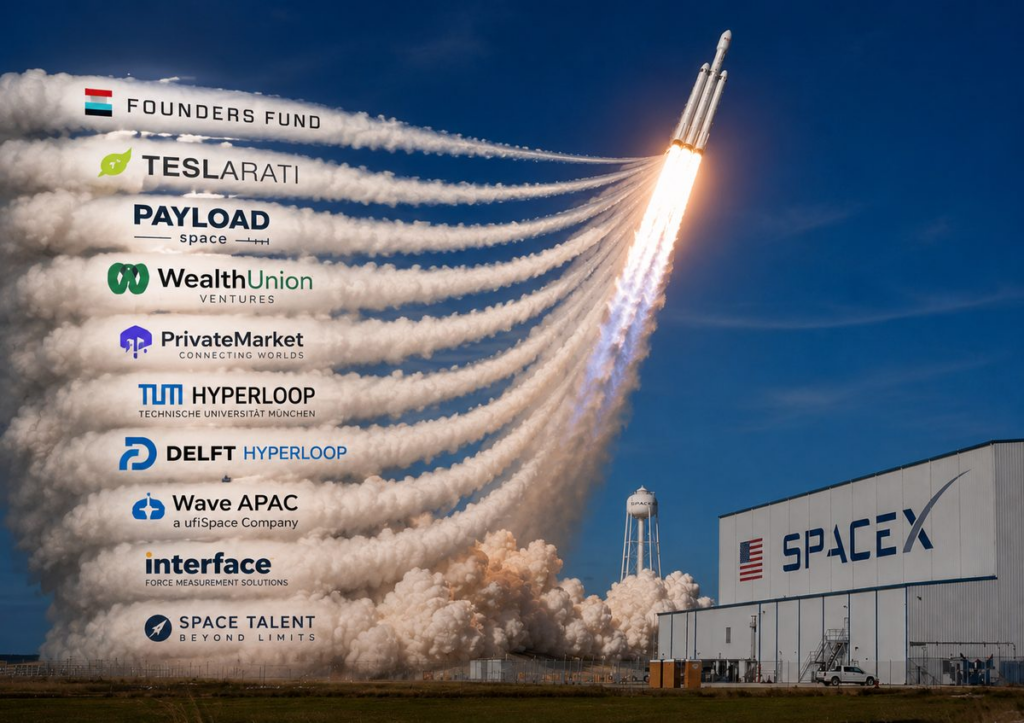
Yes, there were companies you would expect. Space media sites like Teslarati, Payload Space, and The Overview appeared because they cover SpaceX, launches, Starlink, and the broader space industry. There were also engineering and Hyperloop-related organizations like TUM Hyperloop, Delft Hyperloop, Warwick Hyperloop, Ryerson Hyperloop, Gatorloop, and AlbertaLoop.
But the list quickly moved outside the obvious space category.
There were investment platforms, wealth managers, telecom providers, manufacturers, AI tools, recruiting companies, tourism businesses, and design studios. In other words, companies were mentioning SpaceX for very different reasons.
That is where the data became more useful.
Some companies mention SpaceX because it helps explain an investment product
One clear group was private market and investment-related companies.
WealthUnion Ventures, Principal Pre-IPO Group, PrivateMarket, Secondary Signal, Lionshare Capital, PreStocks, Stack Capital, and others mention SpaceX because it is one of the private companies investors recognize immediately. For them, SpaceX is not really about rockets. It is shorthand for access to high-demand private companies.
This is very different from an aerospace supplier mentioning SpaceX.
An investment platform might mention SpaceX next to companies like OpenAI, Stripe, Anthropic, or ByteDance. The point is not technical capability. The point is access, scarcity, and investor interest.
That tells us something useful: when a company becomes valuable enough, other businesses start using it as a reference point in their own positioning.

Other companies are closer to the physical space industry
Then there were companies that looked much closer to the actual aerospace and industrial supply chain.
Highvac manufactures vacuum chambers and custom components. Interface builds sensors and force measurement systems used across aerospace, automotive, medical, energy, and industrial automation. We also found some smaller services which work with anodizing, passivation, plating, laser marking, and other industrial processes. Ezejector provides ejector design services for technical applications.
These companies are not as flashy as SpaceX, but they are more connected to the physical side of the industry. They represent the kind of supplier and engineering layer that is usually hidden behind the bigger brand names.
This is a completely different type of SpaceX mention than the investment platforms. One group uses SpaceX to explain investor access. Another group appears in the context of manufacturing, components, materials, and engineering.
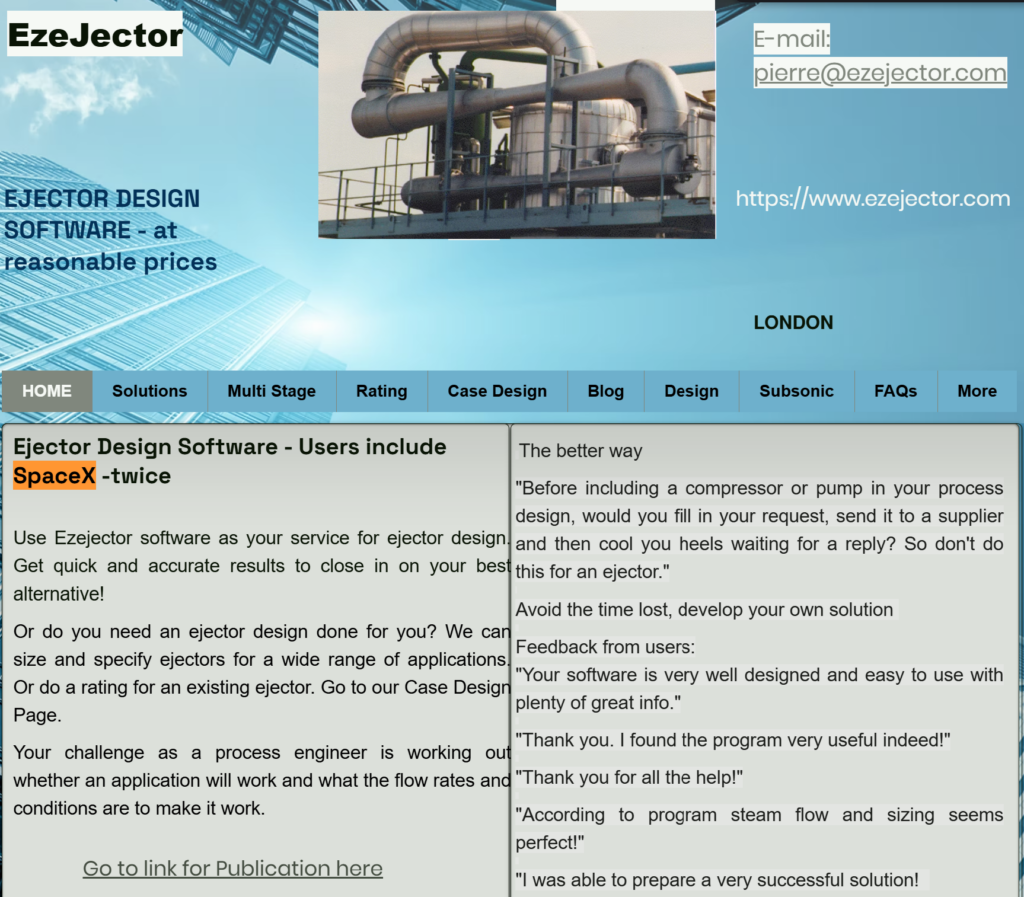
One unexpected side effect of this project was accidentally taking a tour of the internet from 2004. Some of these websites have clearly decided that if it isn’t broken, there’s no reason to redesign it. Example: https://www.ezejector.com/
Starlink created a separate branch of results
Another interesting group was connected more to Starlink than to rockets.
Wave APAC describes itself as a telecom provider deploying 5G and broadband services, including connectivity powered by SpaceX LEO infrastructure. Starsat sells business Starlink packages and hardware.
These companies are not trying to be part of the rocket launch story. They are connected to the communications side of SpaceX.
That is useful because it shows how one company can appear in multiple markets at the same time. SpaceX can show up in aerospace, but Starlink can show up in telecom, broadband, remote connectivity, and enterprise infrastructure.
Media companies showed up because attention is also a market
The media companies were not surprising, but they were still useful to see.
Teslarati, Payload Space, Rocket Reporter, The Overview, TLP Network, Today in Space, and similar companies mention SpaceX because SpaceX brings audience interest. Some focus on launch coverage. Some focus on space careers. Some focus on broader commercial space. Some mix Tesla, SpaceX, and Elon Musk-related coverage.
This is not the same as being a supplier or a customer. It’s what they do best – looking how to get your attention.
And let’s be honest – A company like SpaceX creates enough ongoing news that entire publications and content businesses can build around it.
Hyperloop results were a good reminder to separate current business from historical influence
The Hyperloop-related results were also interesting, but in a different way.
TUM Hyperloop, Delft Hyperloop, Warwick Hyperloop, Ryerson Hyperloop, Gatorloop, and AlbertaLoop appeared because of the broader history around SpaceX and Hyperloop competitions. These organizations are not necessarily current commercial partners of SpaceX. Some are student teams, research groups, or engineering organizations.
If we were doing this as a serious market map, we would not want to treat every SpaceX mention the same. Some mentions indicate a possible supplier relationship. Some indicate media coverage. Some indicate investment positioning. Some indicate historical connection. Some are just SEO or weak relevance.
The first job is not just finding the mentions but understanding why the mention exists.
What PredictLeads data makes possible next
This first sample was useful because it showed that a simple company-description search can surface different layers around SpaceX. But the real value comes from expanding and enriching the analysis.
The next step would be to pull all companies mentioning SpaceX, Starlink, Hyperloop, and related terms across the PredictLeads company database. Then we could classify them by the reason for the mention: investment, supplier, media, telecom, education, recruiting, software, manufacturing, tourism, or weak/noisy mention.
After that, we can enrich those companies with other PredictLeads signals.
For example, we could check which of these companies are hiring, which ones recently launched new products, which ones had relevant news events, which technologies they use, which companies changed their website messaging, which ones raised funding, and which ones are expanding into new markets.
That turns the analysis from “here are companies mentioning SpaceX” into something much more useful:
- Which companies are actually building around Starlink?
- Which companies are using SpaceX as an investment hook?
- Which companies look like aerospace suppliers?
- Which companies are media noise?
- Which companies are growing or hiring right now?
- Which similar ecosystems exist around OpenAI, Nvidia, Anthropic, Stripe, Databricks, or Palantir?
Why this is useful
The useful part is not that SpaceX is mentioned in a company description. A single mention does not mean much by itself.
The useful part is what happens when you collect many of those mentions, classify them, and combine them with other company signals.
You start to see the market around the company.
For SpaceX, that market includes investment platforms, industrial suppliers, Starlink telecom providers, media companies, Hyperloop organizations, engineering teams, and other businesses using SpaceX as a reference point.
That is the type of analysis we wanted to test.
Not a perfect report and definitely not a final answer. Just a practical example of how company data can be used to move from a trending company to the companies around it.
Want to map an ecosystem around a company?
PredictLeads helps teams find and enrich companies based on public company signals, including company descriptions, job openings, news events, technologies, funding events, website changes, and more.
If you want to understand the companies forming around SpaceX, OpenAI, Nvidia, Anthropic, Stripe, Databricks, or any other market leader, PredictLeads data can help you turn that curiosity into a structured company list.
Explore the data at PredictLeads or get in touch with us to build a custom company dataset for your market.