
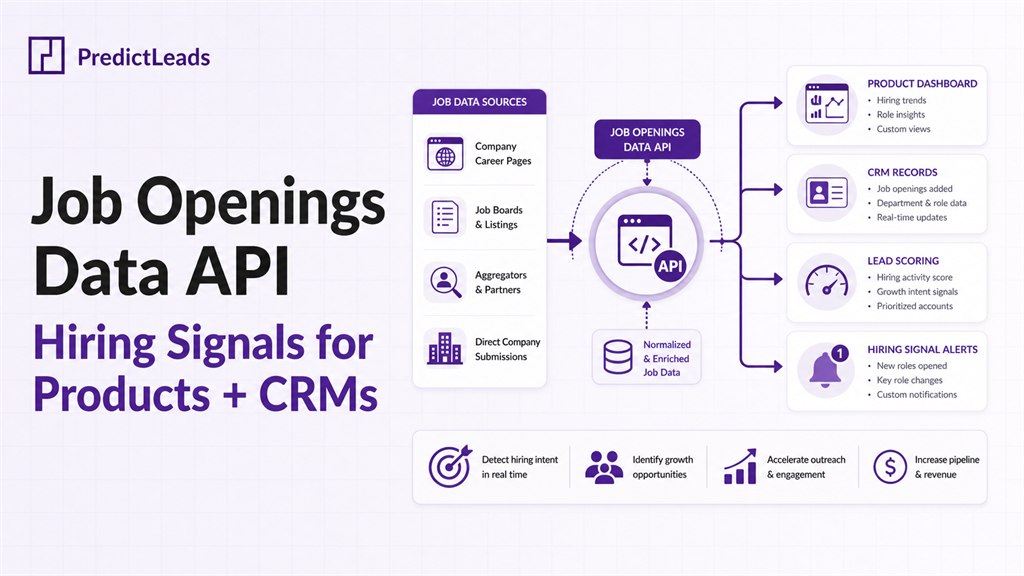
A job openings data API helps teams add hiring signals directly into products, CRMs, enrichment workflows, lead scoring models, and account monitoring systems. Instead of manually checking career pages, teams can use structured job data to understand which companies are hiring and what that hiring activity means.
Hiring activity often reveals company movement. A company hiring sales reps may be expanding revenue capacity while companies hiring data engineers may be investing in analytics or AI. A company hiring in a new country may be entering a new market.
This guide explains how a job openings data API works and how teams can use hiring signals in real GTM and product workflows. For the broader dataset overview, see the PredictLeads Job Openings Dataset page.
What Is a Job Openings Data API?
A job openings data API provides structured access to job postings data. It lets teams query, filter, and ingest job data without building their own scraping pipeline.
Useful job openings data usually includes:
- company name and domain
- job title
- job description
- location
- posting date
- source URL
- detected keywords or technologies
- historical or current status
PredictLeads provides job postings data through its jobs dataset and related company intelligence datasets.
Why Use an API Instead of Manual Collection?
Manual collection does not scale. Career pages change, job boards duplicate listings, and raw scraped data often needs heavy cleaning before it becomes useful.
A job openings data API helps teams skip much of that work. It gives them structured data that can feed internal tools, workflows, and applications.
- Product teams can add hiring signals to customer-facing features.
- Sales teams can enrich CRM accounts with hiring activity.
- Marketing teams can build segments around growth intent.
- Data teams can use hiring signals in scoring models.
For provider comparison, read Best Job Data Providers in 2026 for Labor Market Data.
Common Use Cases for a Job Openings Data API
CRM enrichment
Teams can add hiring activity to company records in Salesforce, HubSpot, or internal CRMs. This helps reps see which accounts are growing, which departments are hiring, and which accounts may deserve priority.
Lead scoring
Hiring signals can improve lead scoring by adding timing and intent. A company hiring relevant roles may receive a higher score than a company with no current movement.
See Hiring Signals for B2B Sales for a practical scoring workflow.
Market intelligence products
Data platforms can use job openings data to show labor demand, workforce shifts, company expansion, and sector-level trends. This is useful for market intelligence, investment research, and competitive analysis.
PredictLeads covers this angle in Job Openings Data: How Hiring Signals Reveal Company Growth.
Technology detection and stack intelligence
Job descriptions often mention tools and platforms. That makes job openings data useful for detecting technologies that may not be visible from a website alone.
For more detail, read Job Openings Data and Technographics.
What to Look for in a Job Openings Data API
Not all job data is equally useful. Teams should look for data quality, coverage, freshness, and reliable company matching.
- Company matching: jobs should connect to the correct company domain.
- Deduplication: duplicate listings should not inflate hiring activity.
- Freshness: new jobs should appear quickly enough for timely workflows.
- Structured fields: teams need fields they can filter and score.
- Historical coverage: historical data helps teams understand trends, not just snapshots.
Final Thoughts
A job openings data API helps teams turn hiring activity into actionable company intelligence. It can enrich CRMs, power product features, improve lead scoring, and reveal market movement.
PredictLeads helps teams access structured job openings data and related company signals, making it easier to build hiring intelligence into GTM and data workflows.