
Introduction
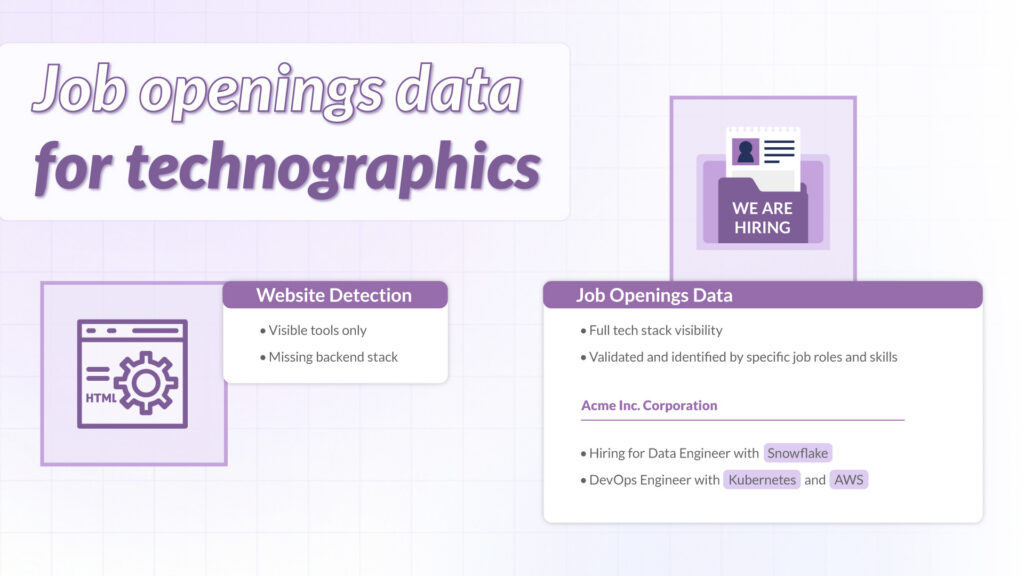
Job openings data for technographics is becoming a critical layer for understanding company tech stacks. Most technographic data providers rely on website detection, but this only shows what is visible.
As a result, teams miss important signals about what companies are actually building and adopting.
At PredictLeads, we’ve seen this limitation firsthand. Companies do not run their businesses through what is visible in HTML. Instead, they operate through infrastructure, internal tools, and systems that never appear on their website.
This is why job data plays such an important role.
For a more in-depth comparison overview of providers, see best technographic data providers for B2B targeting.
The Problem With Traditional Technographic Data
Most technographic data is based on website detection.
This includes analyzing:
- HTML
- JavaScript
- cookies
- headers
This approach works well for identifying frontend tools such as analytics or chat widgets.
However, it misses:
- backend infrastructure
- internal tools
- data stack technologies
- tools in early adoption
As a result, this creates an incomplete and often misleading view.
This is where job openings data for technographics provides a more complete and reliable perspective.
What Job Openings Data for Technographics Reveals About Company Tech Stacks
Job postings provide a direct signal of real technology usage.
They show:
- what companies are actively building
- what tools they rely on
- what skills they need right now
For example, if a company is hiring:
- “Data Engineer with Snowflake and dbt”
- “DevOps Engineer with Kubernetes and AWS”
You gain clear insight into their stack.
Unlike website detection, this data reflects real internal systems rather than surface-level signals.
How Job Openings Data for Technographics Improves Accuracy
Job openings data for technographics acts as both a validation and discovery layer.
1. Validation of existing signals
If a technology appears in both:
- website detections
- job descriptions
confidence increases significantly.
2. Discovery of hidden technologies
Many technologies never appear on websites.
However, they are clearly mentioned in job descriptions, especially:
- data infrastructure
- backend systems
- internal tooling
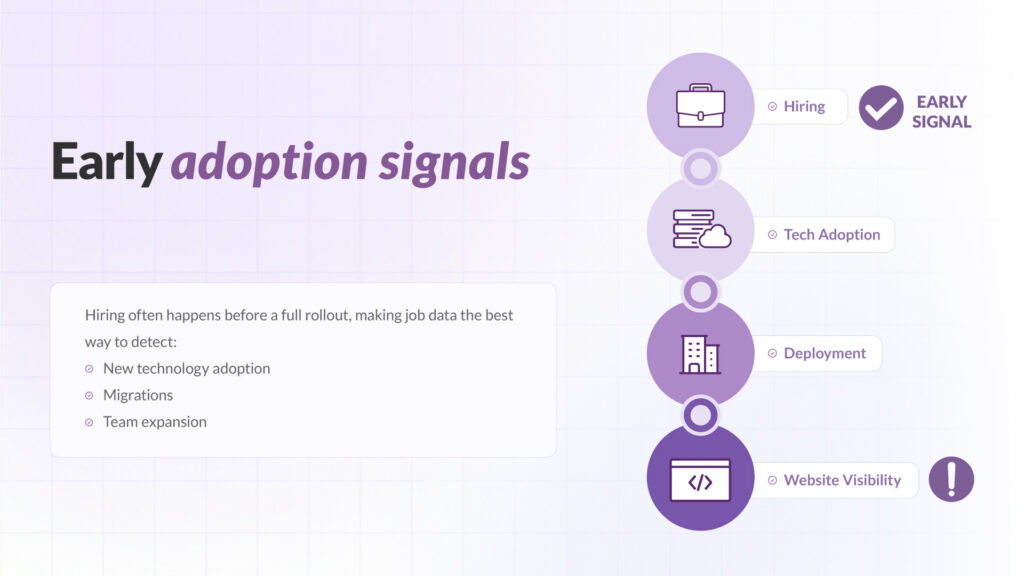
3. Early adoption signals
Companies hire before they deploy at scale.
This means job data helps you detect:
- new technology adoption
- migrations
- team expansion
before it becomes visible elsewhere.
Compared to traditional detection methods, job openings data for technographics improves both accuracy and timing of technology insights.
Why PredictLeads Job Openings Data for Technographics Stands Out
PredictLeads takes a different approach to job data.
Direct sourcing
Job openings are sourced directly from:
- company websites
- career pages
- ATS integrations
This ensures higher accuracy and freshness.
Scale and coverage
- 220M+ historical job records
- 2M+ companies covered
- ~9M active jobs at any time
- data available since 2016
At any given moment, PredictLeads tracks hiring activity across hundreds of thousands of companies.
Frequent updates
Each job is refreshed every 36 hours.
This allows near real-time visibility into hiring activity.
Rich metadata
Each record includes:
- job title
- full description
- technologies mentioned
- seniority
- location
- salary (when available)
- contract type
- O*NET classification
This makes PredictLeads job openings data for technographics highly actionable and easy to integrate.
From Static Data to Dynamic Company Intelligence
When job data is combined with other datasets, the value increases significantly.
At PredictLeads, this includes:
- technology detections
- job openings
- news events
- financing events
This allows you to move beyond static answers like:
“What technologies does this company use?”
Instead, you can answer:
“What is this company doing right now?”
You can also explore How to Choose a Technographic Data Provider (Buyer’s Guide) to understand how these datasets fit together.
Real Use Cases
Sales prospecting
Companies that are hiring have budget and momentum.
You can:
- identify active buyers
- filter by technology-specific roles
- personalize outreach using job descriptions
For practical workflows, see How to Use Technographic Data for Sales Prospecting.
Competitive intelligence
Track competitors hiring for:
- new technologies
- new markets
- new teams
Investment research
Hiring is a leading indicator of growth.
Use job data to:
- identify scaling companies
- validate investment opportunities
- detect strategic shifts
AI workflows
Job descriptions contain detailed context about:
- company priorities
- product direction
- internal structure
This makes them ideal for AI agents and automation systems.
Final Thoughts
Technographic data accuracy depends on how data is collected and validated.
Website detection alone is not enough.
Job openings data for technographics adds a critical layer by revealing real usage, validating signals, and identifying early adoption.
Without it, you are working with partial information.
With it, you gain a more complete and reliable understanding of company tech stacks.
Quick Chat?
If you’re building:
- outbound workflows
- investment models
- AI agents
- market research systems
You should be using job data.
Feel free to explore the PredictLeads Job Openings Dataset and Technology Detection Dataset.
Interested in a quick chat? Happy to help!