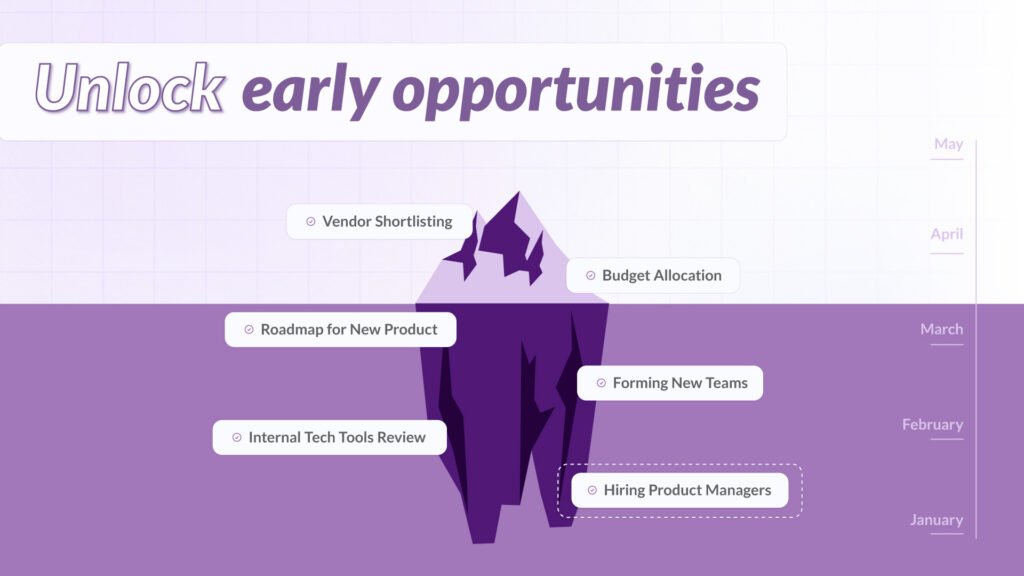
Most B2B teams discover new opportunities too late and usually after budgets are already approved, vendors are shortlisted, and internal decisions are already locked in. At that point, you’re competing on price and familiarity instead of relevance and timing.
One of the earliest and most reliable buying signals appears much sooner: when a company starts hiring Product Managers.
Product management hiring often precedes major product initiatives, tooling decisions, and external partnerships. If you can identify these signals early, you can engage accounts before buying decisions are finalized.
This guide explains how to find companies hiring Product Managers using job openings data — and how to turn that insight into actionable account prioritization for sales, marketing, and research teams.
Why hiring Product Managers is a high-intent business signal
Hiring decisions reflect strategic intent. When companies invest in product leadership, they’re signaling change — whether that’s launching new products, scaling existing platforms, or professionalizing internal processes.
Early-stage startups typically rely on founders or engineers to manage product decisions. When a company begins hiring dedicated Product Managers, it often indicates a growing or increasingly complex product surface, new product lines or feature expansion, and a shift from ad-hoc development to structured roadmapping.
For B2B vendors, this usually means upcoming investments in analytics, infrastructure, UX, experimentation, and customer feedback tools.
What Product Manager roles reveal about roadmaps and tooling
Not all Product Manager roles are the same. Job descriptions often reveal far more than just headcount growth.
They can indicate specific focus areas such as growth, platform, AI, payments, or enterprise use cases. They also reveal how product teams collaborate with design, data, and engineering, and which tools or workflows are critical to success.
Mentions of analytics platforms, experimentation frameworks, research tooling, or CI/CD processes provide strong clues about upcoming vendor needs and partnership opportunities.
Why timing matters more than targeting alone
Engaging a company while it’s still assembling its product team puts you upstream of buying decisions. At this stage, teams are defining workflows, selecting tools, and choosing long-term vendors.
Once the product organization is fully staffed and processes are set, most purchasing decisions are already locked in. Timing, in this case, becomes just as important as targeting.
A step-by-step workflow to find companies hiring Product Managers
Turning job postings into a reliable buying signal requires structure.
Start by defining which Product Manager roles actually match your ideal customer profile. Focus on relevant titles such as Product Manager, Senior PM, Group PM, or Head of Product, along with specializations like Growth, Platform, Technical, or AI. Narrowing by company type — for example, B2B SaaS versus B2C — helps eliminate noise early.
Next, refine your dataset by filtering for Product or Engineering departments, seniority levels that indicate decision-making authority, and locations aligned with your go-to-market coverage. This removes internships, duplicate postings, and roles outside your sales region.
From there, look beyond individual job listings and focus on hiring velocity. Multiple PM roles opened in a short timeframe, re-posted or expanded listings, and sudden increases in product headcount all signal urgency and internal momentum.
Context matters as well. Segment companies by growth stage and hiring pattern. Startups hiring their first Product Manager are typically formalizing product strategy, while scale-ups building multi-layered product teams are preparing for rapid growth. Enterprises hiring senior product leadership often signal new product lines or major transformations.
Finally, prioritize accounts based on role seniority and team structure. Senior hires such as Principal Product Managers or Heads of Product usually correlate with strategic initiatives and budget ownership. Companies building entire product teams at once should rank higher than those filling a single replacement role.
Aligning product hiring signals with your go-to-market motion
Once identified, product hiring signals should be mapped directly to your GTM strategy.
Sales teams can time outreach around active hiring windows. Marketing teams can tailor messaging to product expansion, platform maturity, or scaling challenges. Research teams can use hiring data to track emerging product trends across industries.
The key is treating hiring data as a trigger, not just a filter.
Using job openings data with PredictLeads
Job openings data becomes far more powerful when it’s structured, historical, and enriched.
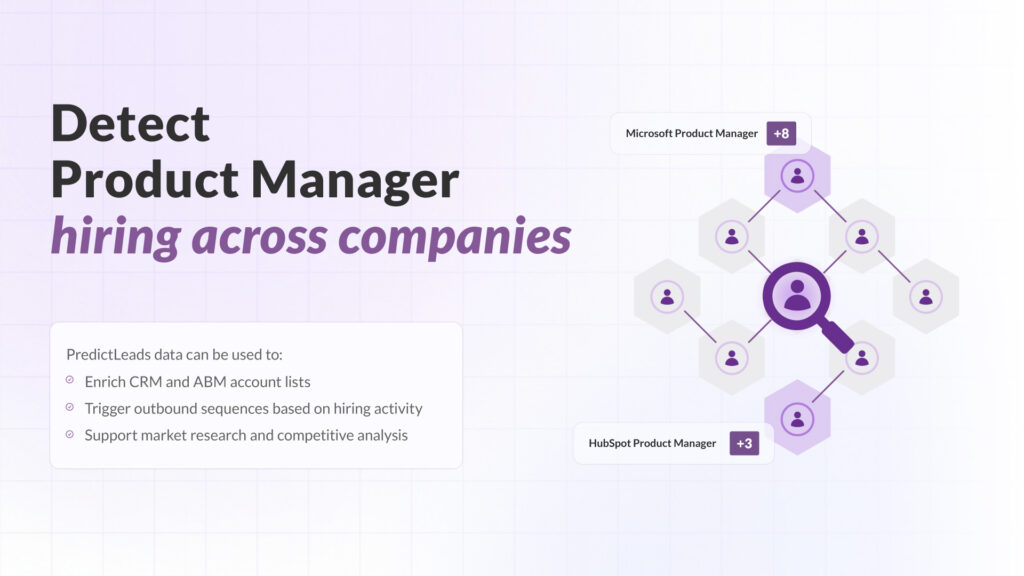
PredictLeads tracks job postings across millions of companies, making it possible to identify organizations actively hiring Product Managers without manual job board scraping. Instead of static snapshots, hiring activity can be tracked over time, allowing teams to distinguish between one-off roles and sustained investment in product teams.
When product hiring data is combined with other company-level signals — such as headcount growth, funding events, or geographic expansion — it becomes a reliable indicator of upcoming spend and operational change.
This data can be used to enrich CRM and ABM account lists, trigger outbound sequences based on hiring activity, and support market research and competitive analysis.
Common mistakes when using Product Manager hiring data
Despite its value, job openings data is often misinterpreted.
Treating all Product Manager roles as equal is a common mistake. A junior replacement hire does not carry the same weight as a new product leadership role.
Relying on single job posts without considering velocity can also lead to false signals. One listing may be outdated, paused, or experimental. Momentum is what signals real intent.
Ignoring firmographic context — such as company size, stage, and geography — makes it easy to overestimate deal potential or misread urgency.
Finally, many teams act too late. The highest-intent window is during active hiring, not months after onboarding is complete.
Turning Product Manager hiring signals into action
Companies hiring Product Managers are telling you something important: they’re investing in product.
By systematically analyzing job openings data, teams can surface high-intent accounts earlier, personalize outreach more effectively, and align go-to-market efforts with real business momentum.
When used correctly, Product Manager hiring data isn’t just a recruiting signal — it’s a strategic advantage.
About PredictLeads
PredictLeads is a company intelligence data provider used by B2B teams to detect early buying signals across millions of companies. We help sales, marketing, and research teams act on hiring, growth, and expansion data to engage accounts at the moment intent is forming.