
Category: Hiring Intent Data (Page 1 of 3)

How to Find Companies Hiring Data Engineers Using Hiring Signals and Job Data

Finding companies that are actively hiring data engineers is more than a recruiting exercise—it’s one of the strongest indicators of organizational investment in data infrastructure, analytics, and scale.

For B2B sales teams, recruiters, and data vendors, data engineer hiring represents near-term intent. These roles are typically opened when a company is building or modernizing its data stack, supporting new products, or preparing for growth.

The challenge is accuracy and timing. Job boards are noisy, information goes stale quickly, and manual searches rarely capture sustained hiring behavior. This guide outlines a data-driven approach to identifying companies hiring data engineers using structured hiring signals and job data—turning fragmented postings into actionable intelligence.


The Challenge of Identifying Companies With Active Data Engineering Needs

At first glance, finding companies hiring data engineers seems straightforward: search job boards or LinkedIn and compile results. In practice, this approach breaks down as soon as you need scale, consistency, and signal quality.

Hiring signals are dynamic and fragmented across dozens of sources. Roles open and close quickly, titles vary widely, and postings are often poorly structured. Without normalization and historical context, it’s difficult to determine which companies have real, ongoing data engineering demand versus one-off or outdated listings.

Why job boards and manual searches fail at scale

Job boards are optimized for individual job seekers—not for analyzing hiring behavior across thousands of companies. Listings are frequently duplicated across platforms, mislabeled under generic engineering roles, or left open long after positions are filled.

Manual research introduces bias and blind spots. It misses private postings, smaller job boards, and international listings, and it provides no reliable way to track hiring trends over time. At scale, this results in incomplete coverage and inconsistent targeting.

The cost of outdated or incomplete hiring information for B2B teams

For B2B sales and marketing teams, acting on stale hiring data leads to wasted outreach and missed opportunities. Contacting companies after a hiring freeze—or before a real initiative begins—reduces conversion rates and undermines credibility.

Incomplete hiring data also prevents effective prioritization. Without knowing which companies are hiring aggressively versus casually, teams are forced to treat all accounts equally instead of focusing on those with urgent, budgeted needs.


Why Data Engineer Hiring Is a High-Intent Business Signal

Data engineering roles are rarely opportunistic hires. They are typically opened in response to concrete initiatives involving data platforms, analytics pipelines, machine learning, or operational scalability.

Unlike generic software engineering roles, data engineer hiring is closely tied to infrastructure decisions and long-term investment.

What data engineering roles indicate about company priorities

When a company hires data engineers, it often signals priorities such as:

  • Building or migrating to centralized data warehouses
  • Improving data quality, reliability, and pipelines
  • Enabling analytics for decision-making across teams
  • Supporting AI, machine learning, or advanced reporting use cases

These initiatives almost always require tools, services, and vendors—making data engineer hiring a strong proxy for purchasing intent.

How hiring velocity reflects growth and infrastructure investment

Hiring velocity adds critical context. A single data engineer opening may indicate maintenance or backfill, while multiple postings over several months suggest expansion or modernization.

Sudden increases in hiring often correlate with funding rounds, product launches, market expansion, or large-scale infrastructure changes. Consistency and acceleration are usually stronger signals than isolated spikes.

Relevance for B2B sales, recruiting, and data infrastructure vendors

Different teams use these signals in different ways:

  • Recruiters identify companies with sustained demand and future hiring needs
  • Sales teams target accounts entering an active buying cycle
  • Data infrastructure vendors time outreach when budgets and urgency are highest

In all cases, data engineer hiring reduces guesswork and improves timing.


Step-by-Step Workflow to Find Companies Hiring Data Engineers

A structured workflow transforms raw job postings into reliable hiring signals. The goal is not just to find open roles, but to understand patterns, intent, and urgency at the company level.

Define data engineering roles, seniority, and scope

Start by defining what qualifies as a data engineering role. Common titles include:

  • Data Engineer
  • Analytics Engineer
  • Platform Data Engineer
  • Senior, Staff, or Principal Data Engineer

Decide whether to include adjacent roles such as machine learning engineers with heavy data infrastructure focus. Also determine which seniority levels matter—junior hires often signal team expansion, while senior hires may indicate architectural change.

Filter companies by active data engineer job openings

Next, focus only on active and recently updated job postings. Archived or stale listings introduce noise and false positives.

Company-level aggregation is critical here. One company with five concurrent data engineering openings is far more meaningful than five companies with a single outdated posting each.

Analyze hiring volume and velocity over time

Counts alone are not enough. Examine trends over time:

  • Is data engineer hiring consistent month over month?
  • Is the number of openings increasing?
  • Are new roles appearing across multiple teams?

Sustained or accelerating hiring suggests long-term investment, while one-off spikes may reflect short-term projects.

Segment companies by geography, size, and industry

Segmentation aligns hiring signals with your go-to-market strategy:

  • Geography affects compliance, data residency, and cloud choices
  • Company size influences budget and buying cycles
  • Industry reveals use-case complexity (e.g. fintech and healthcare have stricter data requirements than early-stage SaaS)

Prioritize accounts by urgency and consistency

Effective prioritization combines multiple factors:

  • Number of data engineering roles
  • Seniority of hires
  • Hiring velocity and recency
  • Cross-team hiring patterns

Companies hiring multiple senior data engineers simultaneously often have urgent, complex needs and higher willingness to engage with vendors or partners.

Validate hiring signals with complementary company activity

Hiring data is most powerful when validated against other signals such as:

  • Funding announcements
  • Cloud or data stack adoption
  • Product launches
  • Migrations or re-platforming initiatives

This context explains why a company is hiring—not just that it is.


How the Job Openings Dataset Supports This Workflow

A structured Job Openings Dataset makes this workflow repeatable and scalable. By normalizing, deduplicating, and time-stamping postings, it turns noisy job data into reliable hiring intelligence.

Detecting real-time data engineer postings at the company level

The dataset captures job postings as they appear across sources and maps them to the correct company entity. This enables near real-time visibility into which companies are actively hiring data engineers right now.

Filtering by role type, department, and seniority

Standardized role classifications allow teams to isolate true data engineering roles and separate them from generic software engineering. Seniority tags help distinguish foundational hiring from leadership or specialization hires.

Tracking hiring activity over time

Historical snapshots enable trend analysis, revealing whether hiring is accelerating, stable, or declining. This time-based view prevents misinterpretation of short-lived spikes or outdated roles.

Using hiring patterns as indicators of internal investment

When analyzed at scale, hiring patterns become proxies for internal investment. Companies increasing data engineer hiring often follow with higher spending on data platforms, tooling, and external services.


Common Mistakes When Searching for Companies Hiring Data Engineers

Even with access to job data, misinterpretation can undermine results. Avoiding common mistakes ensures hiring signals translate into meaningful action.

Relying on single postings without trend analysis

Single job postings lack context. Without historical data, it’s impossible to know whether a role represents a new initiative or routine backfill.

Confusing generic engineering roles with data-specific needs

Backend or full-stack roles do not necessarily indicate data investment. Accurate role classification is essential to avoid false assumptions.

Ignoring hiring slowdowns or freezes

A sudden drop in postings may signal budget constraints or shifting priorities. Ignoring these changes leads to mistimed outreach.

Treating hiring data as static

Hiring is dynamic. Treating job data as a static list instead of a time-based signal misses its real value: understanding momentum and change.


Conclusion: Using Hiring Signals to Identify High-Intent Companies

Companies hiring data engineers are often in the middle of transformation—building, scaling, or modernizing their data stack. When analyzed correctly, hiring signals provide one of the clearest windows into these initiatives.

Aligning hiring intelligence with B2B targeting

By integrating hiring intelligence into account selection and prioritization, B2B teams focus on companies with real, current needs. This alignment improves conversion rates, shortens sales cycles, and increases relevance.

Turning hiring signals into repeatable workflows

The key is moving from raw job postings to structured, time-based insights. With the right workflow and datasets, data engineer hiring becomes more than a list—it becomes a scalable signal for identifying high-intent companies at exactly the right moment.

Interested in finding out how PredictLeads Jobs dataset can help you out? Feel free to let us know! We’re here to help.
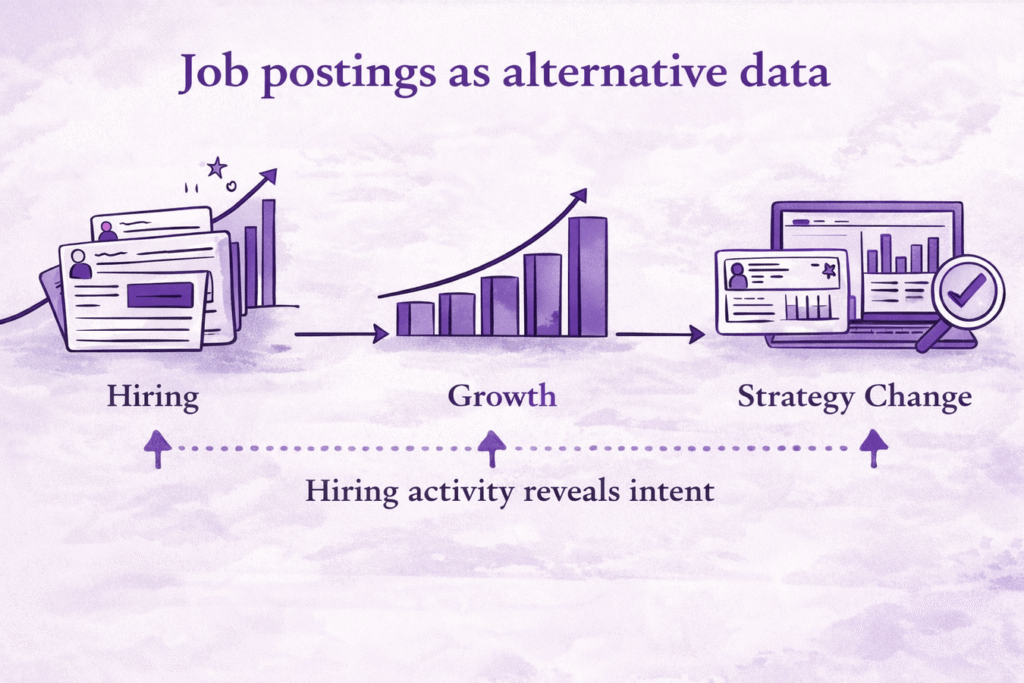

Job Postings as Alternative Data: Why Hiring Activity Reveals Real Company Intent

Estimated reading time: 4 minutes

Most company data explains what a business is, but the sad reality is that very little explains what it is changing.

Revenue ranges, headcount bands, and industry labels stay the same for long periods of time. Hiring activity does not. When a company opens roles, it signals budget approval, internal priorities, and upcoming operational work.

This is why job postings have become one of the most reliable sources of alternative data.

Job postings used as alternative data to show hiring activity, company growth, and strategy change over time
Hiring activity reveals company intent, growth patterns, and strategic change over time.

What a Jobs Dataset actually represents

Jobs Dataset explained

A Jobs Dataset collects job postings published by companies and structures them into data that can be analyzed over time.

The goal is not to help candidates find roles.
The goal is to observe company behavior.

Each posting reflects a decision that already passed internal approval: someone agreed to spend money and add capacity.

What hiring activity tells you

Job postings indicate:

  • where budget is being allocated
  • which teams are growing
  • what problems the company is trying to solve
  • how close the company is to execution

Viewed in isolation, a job posting is just a role. Viewed across time and across departments, it becomes a signal.

PredictLeads tracks hiring activity across millions of companies, allowing both current monitoring and historical comparison.


Why hiring data beats company profiles

Profiles describe. Hiring shows movement.

Firmographic data answers basic questions:

  • size
  • industry
  • location

Hiring data answers different ones:

  • which team is expanding
  • whether growth is steady or temporary
  • how priorities are shifting

A company can fit an ICP definition for years without buying anything. Hiring introduces timing.

Timing changes outcomes

A company hiring RevOps, data engineering, or security roles is in a different position than one that is not hiring at all.

That difference affects:

  • outreach relevance
  • deal likelihood
  • research accuracy

Jobs data helps decide when to engage, not just who to list.


Hiring as intent you can verify

Interest versus commitment

Some signals show curiosity. Others show action.

Reading content or searching keywords costs nothing. Opening a role costs money.

Examples:

  • Sales Ops roles point to go-to-market investment
  • Data engineering roles point to internal data work
  • DevOps roles point to scaling infrastructure
  • Security roles point to compliance pressure

Each role maps to a real internal need. That need already has funding behind it.


Why Jobs data works as a predictive signal

The value is in patterns, not posts

Single job postings are noisy. Patterns are not.

A strong Jobs Dataset allows analysis of:

  • how often roles are opened
  • which departments grow together
  • whether hiring continues or stops
  • where teams are being built

These patterns help distinguish:

  • growth from maintenance
  • short experiments from long-term plans
  • readiness to buy from internal build phases

That is why hiring data supports scoring and prioritization instead of simple enrichment.


Practical use cases for a Jobs Dataset

Sales and outbound

Jobs data helps sales teams:

  • focus on companies with active budget decisions
  • align outreach with team needs
  • avoid accounts showing no momentum

Outreach becomes event-driven instead of list-driven.

Account scoring

Hiring volume, role mix, and recency can be combined to:

  • surface expansion signals early
  • deprioritize inactive accounts
  • support objective account ranking

Market and ICP analysis

Jobs data shows:

  • which roles appear in which industries
  • how functions evolve over time
  • whether assumptions about buyers hold up in practice

This is useful for strategy, not just targeting.

Investment and research

Hiring trends often move before financial metrics.

Jobs data helps researchers:

  • spot early-stage growth
  • compare companies with similar profiles
  • monitor changes without relying on announcements

Why historical hiring data matters

Looking at hiring once tells you very little.

What matters is:

  • consistency
  • direction
  • change

Companies that hire steadily behave differently from those that hire in bursts. Declines often show up in hiring before they show up elsewhere.

PredictLeads provides historical Jobs data so trends can be measured, not guessed.


How the PredictLeads Jobs Dataset is designed

The PredictLeads Jobs Dataset is:

  • structured and machine-readable
  • accessible through API and exports
  • built for automation and analysis
  • independent of any proprietary workflow

It fits into existing data, GTM, and research systems without forcing process changes.


Conclusion

Job postings are not just recruitment noise; they are clear economic signals.

A Jobs Dataset shows:

  • where money is being spent
  • which teams are expanding
  • when companies are preparing for change

For alternative data use cases, hiring activity remains one of the earliest and most reliable indicators of company intent.

About PredictLeads

PredictLeads is a data company that tracks how companies change over time by observing real actions such as hiring, technology adoption, and company events across 100 million businesses worldwide.
It provides this data as a flexible, API-first layer that teams can use inside their existing sales, GTM, research, and investment workflows to understand timing, intent, and momentum.

Real-Time Data Personalization & How it Improves Cold Outreach

Real-Time Data Personalization isn’t a buzzword but the foundation of truly relevant cold outreach. Most sales emails today pretend to be personal, but the timing is off. The message doesn’t match what the company is doing right now, which is why responses are low even when messaging is “customized.”

This article explains how real-time job openings and real-time news events create the context that makes outbound feel natural instead of random. When outreach reflects what’s actually happening inside a company, the message doesn’t just stand out but also benefits from effective personalization based on real-time data.

To go deeper into how PredictLeads structures this data, you can explore our documentation.
PredictLeads Docs

News event data powering real-time outreach personalization

Jobs Reveal What Companies Are Building Right Now

New job openings are one of the strongest real-time signals in B2B. When a company posts a role, it tells you exactly where they’re investing:

  • A team they’re scaling
  • A capability they lack
  • A bottleneck they’re preparing to solve
  • A geography they’re entering
  • A project they’re kicking off

Instead of generic outreach (“We help companies like yours…”), Real-Time Data Personalization lets you write outreach that reflects this immediate shift.

Example:
If a company suddenly opens several engineering or ops roles in one week, you know they’re getting ready up for a buildout (even before they say anything publicly.)


News Events Explain Why Those Roles Exist

Job data shows the what while News data shows the why.

Expansion announcements, new partnerships, funding rounds, layoffs, product launches. All these events offer context for the operational changes seen in job openings, allowing for real-time data personalization.

A company expanding into a new market?
You’ll see hiring in that region.

A company signing a large enterprise customer?
Support or onboarding roles usually appear.

A company restructuring?
Reductions in one function may be paired with increased hiring in another.

News events transform cold outreach from “I hope this resonates” into “I saw what’s happening, and here’s how I can help.”

For additional context categories, see this external guide.
News Events Categories


The Advantage Comes From Combining Both Signals

Real-time data personalization gets its power from aligning both signals:

  • Jobs → operational direction
  • News → strategic explanation

Together, they give you a timeline of what’s happening inside the company, enabling a seamless connection through data-driven personalization.

Expansion → hiring spike → operational strain → perfect outreach moment.
Funding → engineering growth → new product sprints → perfect outreach moment.
Layoffs → efficiency focus → consolidation → perfect outreach moment.

This context isn’t guesswork. It’s watching a story unfold in real time.


What Outreach Sounds Like When It’s Truly Contextual

Instead of generic lines like:

“Wanted to reach out because we help companies like yours…”

You write:

Expansion + hiring
“Saw you’re expanding into Ghana and opening several Ops and Support roles. Teams usually run into X during the first 90 days… & here’s how others manage it.”

Funding + engineering growth
“With the recent funding announcement and backend hiring spike, it looks like the engineering team is preparing for new product cycles. Here’s how others speed up Y during this stage.”

Layoffs + targeted hiring
“Saw the reductions in X but continued hiring in Y. That typically signals a shift toward efficiency. Here’s what’s working in similar transitions.”

This is how personalization in real-time data works in practice.


Automating the Workflow

Implementing this doesn’t require a complex stack:

  • Fetch new jobs daily
  • Fetch relevant news events daily
  • Link them by company
  • Trigger outreach based on time proximity or categories
  • Push dynamic messaging into your outbound tool

PredictLeads’ schema is built in a relational way, so combining these signals is straightforward.


Why It Works

Personalization isn’t about writing someone’s name twice.
It’s about reflecting a company’s real-world situation with accurate data in real time.

Real-Time Data Personalization creates relevance, and relevance is what makes outreach convert.

How Hiring & Tech B2B Sales Signals Help Close More B2B Deals?

When it comes to B2B sales signals, timing and relevance win deals. But with noisy inboxes and overused tactics, how can sales teams rise above the clutter? The answer lies in real-time B2B intent signals >> specifically, insights about who companies are hiring and which technologies they use.

In this post, we’ll break down how Jobs and Technologies data can transform your outbound strategy and help you close more deals, faster with smarter B2B intent signals.

Why Static Lead Lists Fall Short

Most lead lists go stale within weeks. People change jobs. Companies pivot. Tools come and go. If you’re still relying on outdated B2B sales signals, you’re already behind.

That’s why modern sales teams are turning to dynamic lead enrichment — adding fresh, actionable intelligence about a company’s current needs, hiring trends, and technology stack.

The Power of Jobs Data: Catch Companies in Buying Mode

Open job roles are one of the strongest buying signals out there. Why?

  • New hires need tools. A company hiring for “Sales Enablement Manager” or “Revenue Operations Analyst” might be evaluating CRM tools or sales engagement platforms.
  • Growing teams have growing pains. An influx of job ads often means upcoming budget changes or workflow challenges you can help solve.
  • Titles reveal intent. Hiring for “Security Engineers”? Pitch your cybersecurity solution. Looking for “Customer Success Managers”? Perfect time to introduce your onboarding software.

By tracking job openings, you’re not guessing what a company needs but seeing it in plain sight.

Technology Insights: Your Shortcut to Relevance

Now pair that with technology usage data. Knowing a company’s tech stack gives you an unfair advantage:

  • Tailor your pitch. If a prospect uses HubSpot, don’t waste time explaining integrations — highlight how your tool plugs in seamlessly.
  • Find competitors. Selling a project management tool? Filter for companies using Jira or Asana.
  • Segment smarter. Break down your outreach by industry, company size, and the specific tools they already use.

Understanding the tech landscape means you’re not sending generic outreach but you’re showing up with context.

NOW! Let’s combine the Two: Jobs + Tech data = Smart Targeting

Here’s where things get powerful: combining Jobs and Tech data.

Imagine this:

You identify a company hiring a “Growth Marketing Lead” and see they use Segment, HubSpot, and Webflow.

You’re selling a data activation tool that plugs right into that stack.

Now you’re not just a cold email — you’re an answer to their current problem.

This type of targeting:

  • Increases reply rates
  • Shortens deal cycles
  • Positions you as a strategic partner, not a vendor

How to Start using B2B Sales Signals

You don’t need a platform — just the data. At PredictLeads, we help GTM teams enrich their lead lists with B2B intent signals such as:

  • Job Openings (titles, departments, descriptions)
  • Technology Data (tools in use, timing, frequency)

You can export enriched lists, plug them into your CRM or outreach tool, and let your sales team do what they do best — close.

It’s Not About More Leads

Outreach isn’t a numbers game anymore. It’s a relevance game. By combining B2B intent signals such as hiring signals with tech stack insights, you’re building the foundation for conversations that convert.

Because the best sales pitch? It’s the one that feels like perfect timing.

US-China Tariffs and Shopify Adoption: Signals to Watch

Trade tensions between the US and China are once again front and center — and this time, the numbers are steep, affecting hiring signals in various sectors.

  • China’s finance ministry has announced an 84% tariff on all goods imported from the US.
  • In response, the US has implemented a 104% tariff on all Chinese goods, which officially took effect today, Wednesday, April 9.

While it remains to be seen whether a last-minute deal will be struck, if these tariffs go into effect as planned, they are expected to introduce significant friction into global ecommerce, logistics, and retail operations, influencing hiring signals in these industries.

At PredictLeads, we’re looking into how this situation might influence two key areas where strategic shifts often show up first:

  • Hiring signals across ecommerce and logistics
  • Technology adoption patterns, particularly around Shopify

Shopify: A platform exposed to global flows

Shopify plays a central role in enabling international ecommerce expansion. It’s widely used by brands that rely on cross-border fulfillment and Chinese manufacturing, making it particularly exposed to the effects of rising tariffs, which also affects hiring signals for roles related to Shopify and ecommerce.

If the new trade restrictions take hold:

  • Some sellers may pause or delay global expansion efforts.
  • Others might shift their infrastructure strategy toward more localized platforms or hybrid solutions.
  • We may see slowed adoption of Shopify among brands operating from or targeting heavily affected markets.

Together with our partners in the market intelligence space, we’re keeping a close eye on the data — particularly around Shopify adoption trends and ecommerce tech stack changes — to better understand how and where these shifts might emerge.

It’s still early, but this is the moment to start watching for new hiring signals.

Hiring signals: A directional early warning

Job data has historically been one of the earliest and most reliable indicators of how companies react to market disruption, often seen in hiring signals.

Over the next several weeks, we’ll be tracking:

  • New job postings that mention Shopify, global logistics, or cross-border ecommerce
  • Changes in hiring behavior tied to international expansion roles
  • Increased focus on domestic operations, regional warehousing and job creations, and supply chain resilience

These subtle shifts in hiring priorities can offer a first glimpse into how companies are adjusting their ecommerce strategies in response to the tariffs.

For market intelligence teams: where to focus

Whether you’re analyzing ecommerce growth, tracking tech adoption, or assessing exposure to global supply chain risk, now is the time to monitor alternative data sources more closely for new signals related to hiring.

We recommend focusing on:

  • Tech stack detections — to identify the adoption slowdown at platforms like Shopify
  • Hiring data — to spot where expansion plans are being paused or redirected due to new hiring signals
  • Regional trends — to see whether companies begin shifting focus toward LATAM, Southeast Asia, or domestic-only models

These early indicators can inform broader trend analysis well before public earnings or analyst reports reveal the full picture.

Stay ahead of the shift

As of April 9, the tariffs are now in effect — and unless there’s a breakthrough soon, the ripple effects across global trade could intensify, signaling new hiring patterns.

If you’re preparing internal research, building trend reports, or want a deeper look into Shopify adoption and ecommerce hiring trends in this context, feel free to reach out. We’re happy to share additional cuts of the data or collaborate on deeper analysis.

This is a developing story, and the signals are just starting to surface.

« Older posts

© 2026 PredictLeads Blog

Theme by Anders NorenUp ↑