Category: Company (Page 1 of 3)

Job Postings as Alternative Data: Why Hiring Activity Reveals Real Company Intent

Estimated reading time: 4 minutes

Most company data explains what a business is, but the sad reality is that very little explains what it is changing.

Revenue ranges, headcount bands, and industry labels stay the same for long periods of time. Hiring activity does not. When a company opens roles, it signals budget approval, internal priorities, and upcoming operational work.

This is why job postings have become one of the most reliable sources of alternative data.

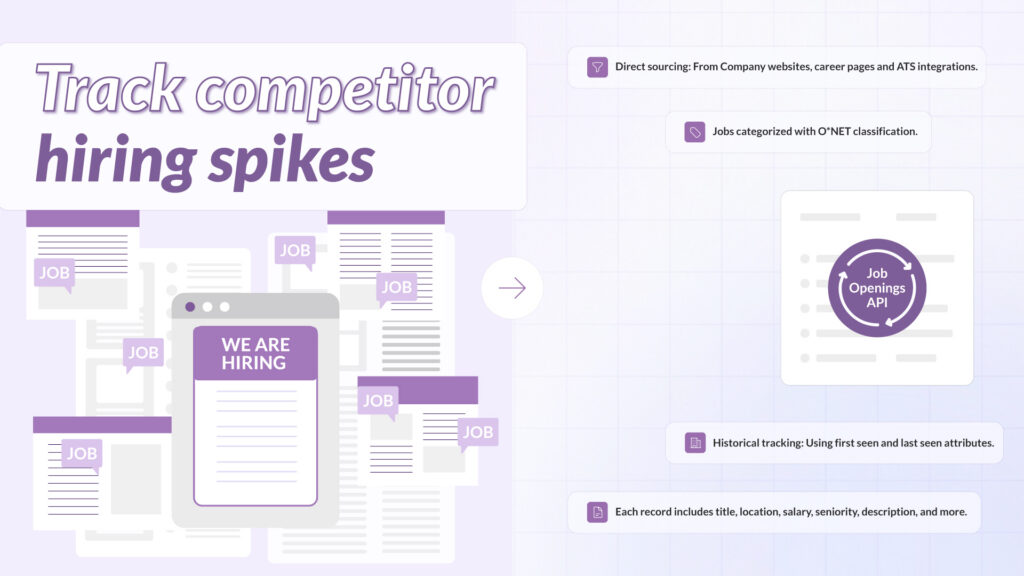
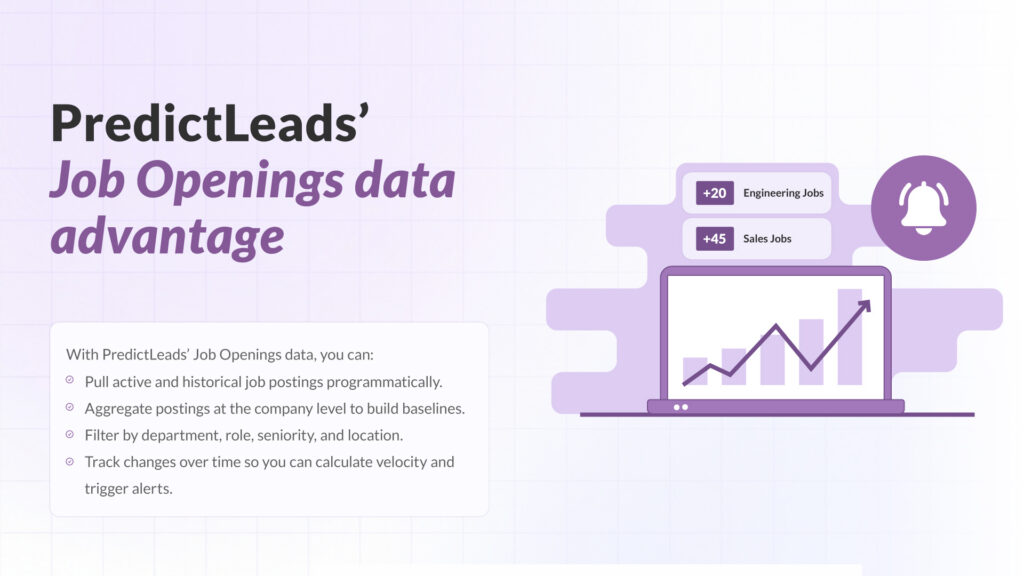
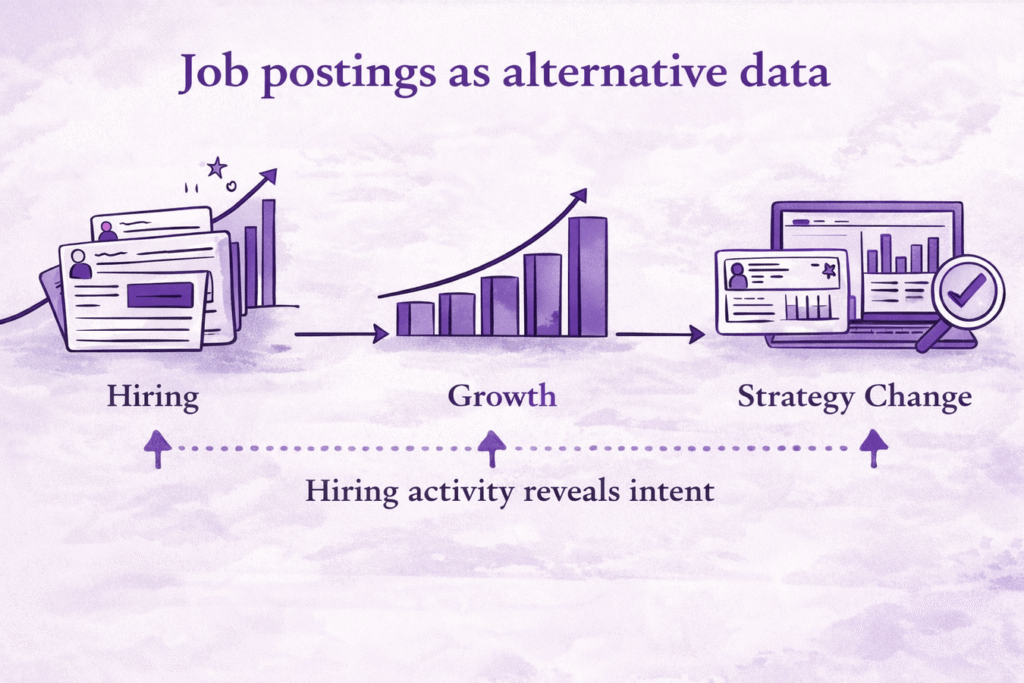
Job postings used as alternative data to show hiring activity, company growth, and strategy change over time
Hiring activity reveals company intent, growth patterns, and strategic change over time.

What a Jobs Dataset actually represents

Jobs Dataset explained

A Jobs Dataset collects job postings published by companies and structures them into data that can be analyzed over time.

The goal is not to help candidates find roles.
The goal is to observe company behavior.

Each posting reflects a decision that already passed internal approval: someone agreed to spend money and add capacity.

What hiring activity tells you

Job postings indicate:

  • where budget is being allocated
  • which teams are growing
  • what problems the company is trying to solve
  • how close the company is to execution

Viewed in isolation, a job posting is just a role. Viewed across time and across departments, it becomes a signal.

PredictLeads tracks hiring activity across millions of companies, allowing both current monitoring and historical comparison.


Why hiring data beats company profiles

Profiles describe. Hiring shows movement.

Firmographic data answers basic questions:

  • size
  • industry
  • location

Hiring data answers different ones:

  • which team is expanding
  • whether growth is steady or temporary
  • how priorities are shifting

A company can fit an ICP definition for years without buying anything. Hiring introduces timing.

Timing changes outcomes

A company hiring RevOps, data engineering, or security roles is in a different position than one that is not hiring at all.

That difference affects:

  • outreach relevance
  • deal likelihood
  • research accuracy

Jobs data helps decide when to engage, not just who to list.


Hiring as intent you can verify

Interest versus commitment

Some signals show curiosity. Others show action.

Reading content or searching keywords costs nothing. Opening a role costs money.

Examples:

  • Sales Ops roles point to go-to-market investment
  • Data engineering roles point to internal data work
  • DevOps roles point to scaling infrastructure
  • Security roles point to compliance pressure

Each role maps to a real internal need. That need already has funding behind it.


Why Jobs data works as a predictive signal

The value is in patterns, not posts

Single job postings are noisy. Patterns are not.

A strong Jobs Dataset allows analysis of:

  • how often roles are opened
  • which departments grow together
  • whether hiring continues or stops
  • where teams are being built

These patterns help distinguish:

  • growth from maintenance
  • short experiments from long-term plans
  • readiness to buy from internal build phases

That is why hiring data supports scoring and prioritization instead of simple enrichment.


Practical use cases for a Jobs Dataset

Sales and outbound

Jobs data helps sales teams:

  • focus on companies with active budget decisions
  • align outreach with team needs
  • avoid accounts showing no momentum

Outreach becomes event-driven instead of list-driven.

Account scoring

Hiring volume, role mix, and recency can be combined to:

  • surface expansion signals early
  • deprioritize inactive accounts
  • support objective account ranking

Market and ICP analysis

Jobs data shows:

  • which roles appear in which industries
  • how functions evolve over time
  • whether assumptions about buyers hold up in practice

This is useful for strategy, not just targeting.

Investment and research

Hiring trends often move before financial metrics.

Jobs data helps researchers:

  • spot early-stage growth
  • compare companies with similar profiles
  • monitor changes without relying on announcements

Why historical hiring data matters

Looking at hiring once tells you very little.

What matters is:

  • consistency
  • direction
  • change

Companies that hire steadily behave differently from those that hire in bursts. Declines often show up in hiring before they show up elsewhere.

PredictLeads provides historical Jobs data so trends can be measured, not guessed.


How the PredictLeads Jobs Dataset is designed

The PredictLeads Jobs Dataset is:

  • structured and machine-readable
  • accessible through API and exports
  • built for automation and analysis
  • independent of any proprietary workflow

It fits into existing data, GTM, and research systems without forcing process changes.


Conclusion

Job postings are not just recruitment noise; they are clear economic signals.

A Jobs Dataset shows:

  • where money is being spent
  • which teams are expanding
  • when companies are preparing for change

For alternative data use cases, hiring activity remains one of the earliest and most reliable indicators of company intent.

About PredictLeads

PredictLeads is a data company that tracks how companies change over time by observing real actions such as hiring, technology adoption, and company events across 100 million businesses worldwide.
It provides this data as a flexible, API-first layer that teams can use inside their existing sales, GTM, research, and investment workflows to understand timing, intent, and momentum.

Real-Time Data Personalization & How it Improves Cold Outreach

Real-Time Data Personalization isn’t a buzzword but the foundation of truly relevant cold outreach. Most sales emails today pretend to be personal, but the timing is off. The message doesn’t match what the company is doing right now, which is why responses are low even when messaging is “customized.”

This article explains how real-time job openings and real-time news events create the context that makes outbound feel natural instead of random. When outreach reflects what’s actually happening inside a company, the message doesn’t just stand out but also benefits from effective personalization based on real-time data.

To go deeper into how PredictLeads structures this data, you can explore our documentation.
PredictLeads Docs

News event data powering real-time outreach personalization

Jobs Reveal What Companies Are Building Right Now

New job openings are one of the strongest real-time signals in B2B. When a company posts a role, it tells you exactly where they’re investing:

  • A team they’re scaling
  • A capability they lack
  • A bottleneck they’re preparing to solve
  • A geography they’re entering
  • A project they’re kicking off

Instead of generic outreach (“We help companies like yours…”), Real-Time Data Personalization lets you write outreach that reflects this immediate shift.

Example:
If a company suddenly opens several engineering or ops roles in one week, you know they’re getting ready up for a buildout (even before they say anything publicly.)


News Events Explain Why Those Roles Exist

Job data shows the what while News data shows the why.

Expansion announcements, new partnerships, funding rounds, layoffs, product launches. All these events offer context for the operational changes seen in job openings, allowing for real-time data personalization.

A company expanding into a new market?
You’ll see hiring in that region.

A company signing a large enterprise customer?
Support or onboarding roles usually appear.

A company restructuring?
Reductions in one function may be paired with increased hiring in another.

News events transform cold outreach from “I hope this resonates” into “I saw what’s happening, and here’s how I can help.”

For additional context categories, see this external guide.
News Events Categories


The Advantage Comes From Combining Both Signals

Real-time data personalization gets its power from aligning both signals:

  • Jobs → operational direction
  • News → strategic explanation

Together, they give you a timeline of what’s happening inside the company, enabling a seamless connection through data-driven personalization.

Expansion → hiring spike → operational strain → perfect outreach moment.
Funding → engineering growth → new product sprints → perfect outreach moment.
Layoffs → efficiency focus → consolidation → perfect outreach moment.

This context isn’t guesswork. It’s watching a story unfold in real time.


What Outreach Sounds Like When It’s Truly Contextual

Instead of generic lines like:

“Wanted to reach out because we help companies like yours…”

You write:

Expansion + hiring
“Saw you’re expanding into Ghana and opening several Ops and Support roles. Teams usually run into X during the first 90 days… & here’s how others manage it.”

Funding + engineering growth
“With the recent funding announcement and backend hiring spike, it looks like the engineering team is preparing for new product cycles. Here’s how others speed up Y during this stage.”

Layoffs + targeted hiring
“Saw the reductions in X but continued hiring in Y. That typically signals a shift toward efficiency. Here’s what’s working in similar transitions.”

This is how personalization in real-time data works in practice.


Automating the Workflow

Implementing this doesn’t require a complex stack:

  • Fetch new jobs daily
  • Fetch relevant news events daily
  • Link them by company
  • Trigger outreach based on time proximity or categories
  • Push dynamic messaging into your outbound tool

PredictLeads’ schema is built in a relational way, so combining these signals is straightforward.


Why It Works

Personalization isn’t about writing someone’s name twice.
It’s about reflecting a company’s real-world situation with accurate data in real time.

Real-Time Data Personalization creates relevance, and relevance is what makes outreach convert.

How to Choose a Historical Data Provider?

Choosing a historical data provider comes down to coverage, timestamp fidelity, lifecycle tracking, provenance, and licensing fit. PredictLeads provides time-stamped company signals such as Job Openings, Technology Detections, News Events, Financing Events, and Vendor/Partner/Investor Connections. Each record includes granular first_seen, last_seen, found_at, and published_at fields, along with rich categories. The data is delivered through APIs, FlatFiles and webhooks, which makes it easy to build reproducible backtests, ICP models, and RevOps playbooks.


Why a “historical” view matters (and what it is not)

If you’re evaluating historical data for B2B go‑to‑market, investing, or partnerships, your goal isn’t tick‑by‑tick market feeds. It’s who did what, when, and for how long. E.g., when a company started hiring for a role, when a technology first appeared on their site, when a partnership was announced, or when a funding round was published. That requires:

  • Event‑level timestamps that support causal analysis (e.g., jobs spike → outreach → meeting → opportunity).
  • Lifecycle states so you can see what’s active now and what existed in the past (avoid survivorship bias).
  • Provenance so every signal is explainable and defensible (source URLs, categories, and context).

For GTM decisions, event recency and duration usually matter more than intraday speed. If you can align a first_seen_at with an action you took, you can attribute lift.


The evaluation framework

1) Coverage & provenance

Ask: Which signals and geographies are covered? Can I inspect source URLs and confidence? Are categories normalized?

PredictLeads coverage (examples):

  • Job Openings: titles, categories (incl. O*NET mapping), location, salary fields, first_seen_at/last_seen_at, active/closed flags.
  • Technology Detections: tech name, version where available, first_seen/last_seen, subpage context, optional behind‑firewall hints.
  • News Events: normalized categories (e.g., acquisitions, partnerships, launches, headcount, expansions, awards), found_at, linked article URL.
  • Financing Events: amounts, round types, investors, first_seen_at.
  • Connections: normalized relationship types (vendor, partner, integration, investor, parent, rebranding, published_in, badge, other).

2) Timestamp fidelity & auditability

History is useful only if you can trust when things happened. Prefer datasets with event‑level timestamps (e.g., first_seen_at, last_seen_at, found_at, published_at) and clear rules for “active,” “closed,” and “deleted.” Distinguish source publish time from discovery time for honest backtests.

3) Granularity & lifecycle tracking

Look for record lifecycle: created → updated → closed/deleted. For hiring, you’ll want active/closed and last_seen_at to infer fill times; for tech adoption, you want first_seen and last_seen to understand churn and stickiness.

4) Normalization & enrichment

Categories unlock use cases: job families (Sales vs Eng), O*NET for role families, news event categories, connection types, and financing round types. Normalization reduces your downstream modeling effort and boosts precision.

5) Delivery & operational fit

API, webhooks or flat files. Prefer JSON/REST with clear pagination, idempotent endpoints, rate‑limit headers, and meta.count. For batch, support for incremental windows (e.g., found_at_from), and stable IDs.

Clarify whether you can: use data in internal models, trigger outreach, share derived analytics, or redistribute subsets. Ensure the license reflects your actual workflows.


How PredictLeads maps to the checklist

Job Openings

  • Fields: title, categories, onet_code, location_city/country, salary_low_usd/salary_high_usd, first_seen_at, last_seen_at, active_only, not_closed.
  • Uses: hiring intent, geo expansion, seniority mix, comp banding, time‑to‑fill.

Technology Detections

  • Fields: technology_name, subpage, confidence_score, first_seen, last_seen.
  • Uses: tech adoption, competitive intel, ecosystem scoring.

News & Financing Events

  • Fields: category (partners_with, launches, acquires, increases_headcount_by, expands_offices_to/in, raises_funding), found_at, published_at, amount, round_type.
  • Uses: intent, timing outreach, portfolio scouting.

Connections (vendor/partner/investor)

  • Fields: relationship_type (vendor, partner, integration, investor, parent, rebranding, published_in, badge, other), source_url, first_seen_at.
  • Uses: partner ecosystem maps, channel strategy, integration‑led growth.

Why this matters: With continuous first_seen/last_seen and strong categories, you can write reproducible rules like: Companies with ≥3 new engineering roles in the last 14 days AND a newly detected HubSpot integration → high‑priority outreach.


Example playbooks

1) Hiring momentum filter

  1. Pull last 90 days of engineering jobs for a domain list with active_only=true.
  2. Aggregate by domain/week; keep domains with ≥5 new roles/week and salary_low_usd ≥ X.
  3. Join with Technology Detections (e.g., Salesforce, HubSpot, Snowflake) for stack fit.

Outcome: A short‑list of fast‑growing, ICP‑fit accounts with concrete talking points.

2) Partner ecosystem map

  1. Query Connections for relationship_type in [vendor, partner, integration].
  2. Rank vendors by breadth and first_seen_at recency.
  3. Enrich with News Events for fresh announcements to personalize outreach.

Outcome: Find co‑sell angles and integration‑led ABM plays.

3) Expansion alerts

  1. Listen to News Events for expands_offices_to/in or increases_headcount_by.
  2. Cross‑check Job Openings spikes in those geos.
  3. Route accounts to reps by territory; trigger sequences with geo‑specific messaging.

Outcome: Time outreach to moments of budget and urgency.


Common traps (and how PredictLeads addresses them)

  • Survivorship bias: Only looking at what’s live today hides closed roles and churned tech. PredictLeads tracks historical states and last_seen timestamps.
  • Opaque provenance: Without source_url, confidence, and page context, you can’t justify a signal. PredictLeads links back to sources and captures context.
  • Schema drift & rework: Hand‑built normalizers break. PredictLeads ships normalized categories (job families, news types, relationship types) to cut integration time.

Implementation blueprint (90‑minute setup)

  1. Pick signals: Start with Jobs + Tech + News for your ICP.
  2. Define windows: e.g., found_at_from last 30/90 days; keep active_only where applicable.
  3. Build joins: Domain key across signals; keep first_seen/last_seen fields in your warehouse.
  4. Score rules: Combine recency (days since first_seen), volume (event count over 7 or 14 days), and context (technology stack fit or partner relevance).
  5. Route & measure: Push scored accounts to CRM, track meetings/opps sourced.

Conclusion

Historical data that drives revenue must be explainable, time-stamped, and normalized. PredictLeads focuses on the company‑level events that matter. Look for who’s hiring, adopting tech, partnering, raising, launching, and changing their site. Such timestamps and lifecycle states you need to trust your models and take action.

Ready to see your history‑powered pipeline?
• Explore the API docs: https://docs.predictleads.com/guide
• Ask us for a sample: https://predictleads.com/#demo


About PredictLeads

PredictLeads indexes 98M+ companies and delivers normalized, time‑stamped signals to help GTM and investment teams find and act on buying windows. We provide APIs, webhooks, and flat files; therefore, you can wire signals directly into your workflows.

How Consultants Can Use PredictLeads’ Key Customers Dataset for Competitive Advantage

In the consulting world, understanding a client’s ecosystem is everything. Whether you’re advising on growth strategy, market positioning, or partnership opportunities, your recommendations are only as good as the data behind them. That’s where PredictLeads’ Key Customers Dataset comes in – providing an unparalleled window into the companies your clients rely on and the ones relying on them.

What Is the Key Customers Dataset?

The Key Customers Dataset identifies which companies are customers of which. It surfaces business relationships – for example, which firms use HubSpot, AWS, or Snowflake – based on verified digital evidence such as logos, case studies, testimonials, job posts, or partner listings.

Each record helps you see:

  • Who buys from whom
  • The type and depth of the relationship
  • When the connection was first detected or last updated

This dataset connects millions of companies globally, revealing commercial dependencies that often go unnoticed in traditional research.

Logos of companies using PredictLeads data, including Dealroom, Clay, and FactSet.

Why It Matters for Consulting Firms

Consultants thrive on context. Understanding a client’s customer and partner landscape allows for sharper insights, faster audits, and more targeted recommendations. Here are some specific consulting use cases:

1. Market Mapping & Competitive Benchmarking

By analyzing the customers of your client and their competitors, you can identify:

  • Which verticals or regions your client underperforms in
  • The industries that competitors dominate
  • Emerging players gaining traction with shared customers

For instance, if your client competes with HubSpot, you could analyze thousands of its key customers to uncover underserved segments or new partnership opportunities.

2. M&A Target Screening

When evaluating acquisition targets, consultants can quickly assess:

  • Overlap or synergy between customer bases
  • Potential cross-sell opportunities
  • Concentration risk (e.g., 70% of revenue tied to one customer cluster)

This reduces manual research and brings data-driven precision to strategic decision-making.

3. Customer Retention & Expansion Planning

For growth-focused consulting, understanding a client’s current customers (and who else they buy from) enables tailored expansion strategies.
Example: If a SaaS client’s customers also use 3–4 competing platforms, that’s a signal to strengthen retention tactics or upsell integrations.

4. Partner & Ecosystem Strategy

Advisors helping clients build alliances or reseller programs can identify:

  • Which companies have overlapping customer ecosystems
  • Where indirect partnerships already exist through shared clients
  • Which verticals offer the strongest growth potential

Example: Turning Data into Strategy

Imagine a consulting firm advising a cybersecurity company. Using PredictLeads’ Key Customers Dataset, the consultant identifies that most of their top customers are also working with AWS and Snowflake … suggesting an opportunity to develop integrations or co-marketing campaigns within those ecosystems.

In another case, the dataset could reveal that a client’s competitor just signed multiple fintech customers in Southeast Asia, hinting at regional momentum worth investigating.


Why PredictLeads?

PredictLeads doesn’t just collect data but it maps business relationships across millions of verified signals.
The Key Customers Dataset integrates seamlessly with other PredictLeads datasets (e.g., Job Openings, Technologies, or News Events), allowing consultants to layer insights:

  • Who are a company’s biggest customers?
  • What technologies do they use?
  • Are they hiring for new markets or functions?

Together, these datasets paint a holistic picture of where your client stands – and where they can move next.


Final Thoughts

For consulting firms, the Key Customers Dataset transforms relationship intelligence into strategic foresight. Instead of relying on assumptions or fragmented public data, consultants can now map entire customer ecosystems, quantify competitive positions, and identify actionable growth paths – all with data that’s refreshed continuously.

How PredictLeads Company Data powers modern Sales Intelligence & Data Enrichment

In today’s markets, having the right data at the right time can make or break a sales, marketing, or investment strategy. PredictLeads is a company data provider specializing in fresh, structured, and highly targeted company intelligence. Instead of offering another platform with a limited interface, PredictLeads delivers APIs, FlatFiles, and webhooks that plug directly into your existing systems offering top notch data enrichment services.

With some 100 million company profiles indexed and datasets covering everything from hiring signals to funding events, PredictLeads empowers teams to enrich their CRM, identify opportunities earlier, and personalize outreach with precision.

Why Data Enrichment Matters in 2025

Sales and marketing teams face an overload of static data that quickly becomes outdated. Investors, revenue teams, and growth leaders need real-time insights that signal change. That’s where data enrichment becomes critical.

Instead of relying only on traditional firmographics, modern teams use dynamic signals such as:

  • Job Openings for hiring for new roles signals company growth.
  • Technology Adoption used for monitoring tech stacks reveals buying intent and churn risks.
  • Financing Events showcasing funding rounds highlight momentum and expansion.
  • News Events such as acquisitions, partnerships, or product launches used to trigger new opportunities.

PredictLeads captures these signals at scale, allowing businesses to focus on accounts that are actually moving.

Turning Signals Into Opportunities

1. Companies Dataset

A global index of over 100 million companies, including firmographics, domain data, and organizational details. This forms the backbone for data enrichment and targeting.

2. Job Openings Dataset

Hiring trends reveal where companies are investing resources. Whether a SaaS company expanding its sales team or a fintech startup hiring engineers, job ads are a leading growth indicator.

3. News Events Dataset

Structured data on press releases, announcements, and media coverage – including M&A, partnerships, IPOs, and product launches. Perfect for timely outreach and market tracking.

4. Financing Events Dataset

Information on venture rounds, seed investments, and growth funding to help VCs and sales teams spot emerging opportunities before they hit mainstream databases.

5. Technologies Dataset

Understand which tools a company is adopting or replacing. Tech stack data is invaluable for competitive positioning and outbound targeting.

6. Website Evolution & Github Dataset

Track how websites evolve and which companies are actively pushing code. These niche signals are particularly useful for technical sales and product intelligence.

How PredictLeads Company Data Fits Into Your Stack

PredictLeads doesn’t lock users into a rigid interface. Instead, it integrates seamlessly with:

  • HubSpot & Salesforce – enrich leads and accounts with dynamic signals.
  • n8n, Zapier, Make.com, Polytomic – automate data flows without writing custom code.
  • Google Sheets & CRMs – Provides tools to convert exports into CSVs for quick experimentation and reporting.

Example Workflows using Company Data

  • Sales Prospecting: Find companies hiring for “Head of Marketing” roles → feed into CRM → trigger personalized outreach.
  • VC Scouting: Identify startups that just raised a Series A and are expanding their engineering team.
  • Competitive Monitoring: Get alerts when a competitor’s customer adds or drops a specific technology.

Case Examples with Data Enrichment

  • A SaaS company used the Job Openings dataset to find prospects expanding their marketing teams. By aligning outreach with hiring signals, they almost doubled response rates.
  • A venture capital firm leveraged Financing Events and News Events to track AI startups raising early-stage rounds for identifying opportunities before competitors.
  • A data marketplace partner integrated PredictLeads’ APIs to resell enriched company data profiles to their client base, generating recurring revenue.

Frequently Asked Questions

What is PredictLeads?
PredictLeads is a sales intelligence data provider offering APIs and datasets on companies, job openings, news events, funding, and technologies.

How does PredictLeads enrich company data?
By layering fresh signals (hiring, news, funding, technologies) on top of firmographics, PredictLeads helps teams prioritize the right accounts.

What makes PredictLeads different from Clearbit, Apollo, or ZoomInfo?
Unlike platforms that lock data behind a UI, PredictLeads provides direct APIs, FlatFiles and Webhooks  making it easy to integrate into any workflow.

Can PredictLeads integrate with HubSpot or Salesforce?
Yes. PredictLeads data can be enriched directly into CRMs via APIs, n8n, Zapier, or reverse ETL tools.

Who uses PredictLeads Data Enrichment Services?
Sales teams, venture capital firms, marketing leaders, data marketplaces, and anyone needing up-to-date company intelligence.

Conclusion

The future of GTM and investment workflows is signal-driven. Static databases no longer cut it and companies need real-time enrichment that reflects actual market movements.

PredictLeads delivers exactly that: fresh datasets, flexible APIs, and seamless integrations. Whether you’re a sales leader targeting enterprise accounts, a VC scouting your next investment, or a marketplace reselling enriched company data, PredictLeads gives you the edge.

Feel free to let us know if you have any questions! We’re here to help.

Want to know how BBQ and company data are related – find out “here.

Want to learn how to leverage PredictLeads via Polytomic?

The Billion-Dollar Clues Hiding in The Right Blend of Company Data

In 2012, Stripe was just a little payments API that almost nobody outside of Silicon Valley had heard of.
By 2021, it was worth $95 billion.

The uncomfortable truth is the signals that Stripe was going to be huge were visible years before the big headlines hit. Most people just weren’t looking for that crucial early-stage investment signals (or didn’t know where to look).

That’s the edge today’s smartest investors are chasing: finding billion-dollar companies before they look like billion-dollar companies. And it starts with something almost no one talks about. The right blend of News and Connections data.

The Secret’s in the Signals

At PredictLeads, we monitor more than 20 million news sources and close to 100 million companies worldwide, capturing early-stage investment signals in a company’s journey. Spaning from funding rounds and product launches to strategic partnerships, hiring surges, and market expansions.

But we don’t stop at just the news.

Our Connections dataset maps the business relationships that reveal how a company is truly positioning itself in the market – from product integrations and investor ties to vendor agreements and partnerships with industry leaders. This is done by scaning company websites for partner and customer logos, using our image recognition system to match each logo to a verified domain. We also analyze case study pages, testimonials, and “Our Customers” sections to uncover customers, partners, vendors, and investors that often go unreported in press releases or traditional news.

Each connection is a signal of strategic intent: integrations hint at ecosystem alignment, investor relationships point to future funding potential, and vendor or partner deals often precede market entry or expansion. When combined with our other datasets, these connections turn scattered updates into a clear, data-backed narrative of growth — and within that narrative is where the next unicorn often emerges.

The Pattern Every Investor Dreams Of

Picture this:
January > a startup raises a modest $8M Series A.
February > they integrate with Stripe’s API.
March > our company data shows a vendor relationship with Shopify.
April > they expand into London and start hiring engineers at double the previous rate.

If you’re only reading headlines, you’ll miss the story.
If you’re tracking news events and company connections in real time, you’ll see it months before the rest of the market and you’ll be in the room when the deal is still hot.

Why Public Headlines Are Too Late

By the time TechCrunch reports a $100M Series C, the race is already crowded and you’re not ahead of the game, you’re simply keeping pace with everyone else.

To spot opportunities earlier, you need to look where others aren’t. News data reveals unannounced or smaller funding rounds — early startup investment signals that indicates momentum gain. Connections data uncovers the strategic moves behind that momentum, from product integrations and new partnerships to key customer wins and vendor relationships.

Overlay these signals, and you will not wait for the news — you’ll see them coming. The result is an early warning system for hypergrowth, giving you a competitive edge long before the headlines hit.

The Future of Investment Intelligence

In the next five years, the biggest wins in venture won’t go to the investors with the most meetings — they’ll go to the ones who can see conviction in the data before the rest of the market believes it.

The edge won’t come from chasing every funding headline, but from quietly tracking the early indicators of momentum: a new integration with a market leader, a sudden hiring surge in engineering, an unexpected expansion into a high-growth region.

When you can spot these early-stage investment signals as they happen — and connect them into a bigger story — you stop reacting to the market and start anticipating it. Finding the next unicorn and its startup investment signals isn’t about luck; it’s about reading the signals early enough to act, while the opportunity is still invisible to everyone else.

If you’re ready to see what those whispers sound like, let’s talk.

How Hiring & Tech B2B Sales Signals Help Close More B2B Deals?

When it comes to B2B sales signals, timing and relevance win deals. But with noisy inboxes and overused tactics, how can sales teams rise above the clutter? The answer lies in real-time B2B intent signals >> specifically, insights about who companies are hiring and which technologies they use.

In this post, we’ll break down how Jobs and Technologies data can transform your outbound strategy and help you close more deals, faster with smarter B2B intent signals.

Why Static Lead Lists Fall Short

Most lead lists go stale within weeks. People change jobs. Companies pivot. Tools come and go. If you’re still relying on outdated B2B sales signals, you’re already behind.

That’s why modern sales teams are turning to dynamic lead enrichment — adding fresh, actionable intelligence about a company’s current needs, hiring trends, and technology stack.

The Power of Jobs Data: Catch Companies in Buying Mode

Open job roles are one of the strongest buying signals out there. Why?

  • New hires need tools. A company hiring for “Sales Enablement Manager” or “Revenue Operations Analyst” might be evaluating CRM tools or sales engagement platforms.
  • Growing teams have growing pains. An influx of job ads often means upcoming budget changes or workflow challenges you can help solve.
  • Titles reveal intent. Hiring for “Security Engineers”? Pitch your cybersecurity solution. Looking for “Customer Success Managers”? Perfect time to introduce your onboarding software.

By tracking job openings, you’re not guessing what a company needs but seeing it in plain sight.

Technology Insights: Your Shortcut to Relevance

Now pair that with technology usage data. Knowing a company’s tech stack gives you an unfair advantage:

  • Tailor your pitch. If a prospect uses HubSpot, don’t waste time explaining integrations — highlight how your tool plugs in seamlessly.
  • Find competitors. Selling a project management tool? Filter for companies using Jira or Asana.
  • Segment smarter. Break down your outreach by industry, company size, and the specific tools they already use.

Understanding the tech landscape means you’re not sending generic outreach but you’re showing up with context.

NOW! Let’s combine the Two: Jobs + Tech data = Smart Targeting

Here’s where things get powerful: combining Jobs and Tech data.

Imagine this:

You identify a company hiring a “Growth Marketing Lead” and see they use Segment, HubSpot, and Webflow.

You’re selling a data activation tool that plugs right into that stack.

Now you’re not just a cold email — you’re an answer to their current problem.

This type of targeting:

  • Increases reply rates
  • Shortens deal cycles
  • Positions you as a strategic partner, not a vendor

How to Start using B2B Sales Signals

You don’t need a platform — just the data. At PredictLeads, we help GTM teams enrich their lead lists with B2B intent signals such as:

  • Job Openings (titles, departments, descriptions)
  • Technology Data (tools in use, timing, frequency)

You can export enriched lists, plug them into your CRM or outreach tool, and let your sales team do what they do best — close.

It’s Not About More Leads

Outreach isn’t a numbers game anymore. It’s a relevance game. By combining B2B intent signals such as hiring signals with tech stack insights, you’re building the foundation for conversations that convert.

Because the best sales pitch? It’s the one that feels like perfect timing.

What Summer BBQs Can Teach Us About Reading B2B Buying Signals

It’s a Saturday in mid-July and you’ve been invited to four different BBQs.

You’re walking through a quiet suburban neighborhood, sunglasses on, sandals flapping. The sun is relentless, the scent of grilled meat hangs in the air… and you’re on a mission. 🥩🧑‍🍳

The first house?
You catch a whiff of burnt tofu and hear someone ask if the kombucha is homemade.

Hard pass.

You keep moving.

A few steps down, you hear music (real music) and spot a lineup of Ford Raptors and a 96 Chefy parked out front. There’s laughter behind a wooden fence, and you catch sight of a green ceramic grill puffing steady smoke, with a line forming around the buffet table.

You don’t need to ask for a menu.
You already know:

This is the one worth joining.

You skip the silent lawns and low-energy gatherings and you:
1. Read the signals.
2. Follow the smoke.
3. Choose wisely.

🎯 In B2B Sales and Investing, the Same Rules Apply

Some companies signal quality before you even step in the door.
Their websites, partners, and public presence give off subtle (and measurable) signs:

  • Logos of well-known brands appear on their sites.
  • Integrations and partnerships get highlighted.
  • Case studies and testimonials drop recognizable names.
  • All of it is smoke – but in this case, smoke that matters.

It’s all smoke! But in this case – it means something.

In B2B such smoke isn’t always obvious. That’s why we built the Connections Dataset at PredictLeads – to read the grill smoke signals at scale.

🔍 Why Logos Matter and Why They’re Hard to Track

To gain credibility, B2B startups often put logos of companies they work with directly on their websites. These show up under sections like:

  • “Our Customers”
  • “Trusted by”
  • “Partners”
  • “Who we work with”
  • Testimonials or Case Study pages

The challenge?
Most of these logos are not backlinked. There’s no easy text trail or hyperlink to follow. A Google search won’t help. Scraping doesn’t cut it.

So we built something smarter.

Logo Recognition Meets Entity Mapping

Our system uses image recognition to detect logos on company websites. Then we match those logos to verified domain names and legal entities.

This enables us to connect:

  • Which company is claiming a relationship
  • Who the other party is (vendor, partner, customer, etc.)
  • Where and how that connection is represented

We don’t just scan the homepage. We parse through case study sections, customer lists, footers, header navs, press pages (anywhere companies hint at collaboration).

Each relationship is then categorized:

  • “vendor” → “Company A is a vendor to Company B”
  • “partner” → “Company A collaborates with Company B”
  • “integration” → “Company A integrates with Company B”
  • “investor”, “published_in”, “parent”, “rebranding” (and more)

We even timestamp when we first and last saw the connection. That means you can prioritize based on recency and relationship type.

🧾 Example: Invoicy → Salesforce

Let’s say a small fintech startup called Invoicy includes a line on their “Customers” page that says:

“Trusted by finance teams at companies like Salesforce, Rippling, and Brex.”

There are no backlinks. Just static logos and a sentence tucked beneath a testimonial.

Our system scans the page, detects the Salesforce logo, maps it to the domain salesforce.com, and parses the surrounding text.

The language >“trusted by finance teams”< suggests that Invoicy is a vendor to Salesforce, likely providing tooling for invoicing, reconciliation, or internal financial workflows.

That gets recorded as:

  • category: “vendor”
  • source_url: the exact URL of the “Customers” page
  • first_seen_at: when the connection was first detected
  • last_seen_at: when it was last confirmed

For a company like Invoicy, being able to show they’re used by a giant like Salesforce is a huge trust signal and even more so when made searchable and machine-readable.

Now sales teams, investors, and analysts can factor that credibility directly into targeting models, scoring frameworks, or due diligence … without ever scraping a webpage by hand.

🔥 What This Means for You

For GTM teams:
Use vendor and partner relationships to qualify and prioritize leads.
If your ICP already sells to Snowflake, Notion, or Google – that’s your BBQ. Bring your best pitch.

For investors:
Track which startups are gaining traction with known buyers.
Logos and partnerships are sometimes more honest than press releases.

For growth teams:
Score accounts based on who trusts them.
If they’ve passed another company’s procurement process, they’re likely enterprise-ready.

🛠️ The Grill is Hot so Start Reading the Signals!

You wouldn’t walk into a BBQ blind. You look for smoke, listen for music, and trust the signs.

The same goes for B2B:

Who they work with tells you who they are.

And PredictLeads helps you see that across millions of companies in real time.

Want a quick walkthrough or test run of the Connections Dataset?
Explore the PredictLeads API

How AI Sales Agents Are Transforming B2B Prospecting and How PredictLeads Steps In

Over the last 18 months, AI agents have gone from experimental prototypes to everyday tools transforming how go-to-market (GTM) teams work. The emergence of AI sales agents has revolutionized traditional methods. Today, AI sales agents can automate lead qualification, personalize outreach, prioritize accounts, and enrich CRMs — at a scale humans simply can’t match.

But here’s the catch: AI is only as good as the data you feed it.
Even the most advanced agent can’t create meaningful output without real-time, event-based company intelligence. AI sales agents benefit greatly from data-driven insights, and that’s exactly where PredictLeads comes in.


What Is PredictLeads?

PredictLeads is a data provider built for modern GTM, sales, marketing, and investment teams. Our infrastructure tracks 92M+ companies globally and provides dynamic signals that go far beyond static firmographics, crucial for AI sales agents.

We capture:

Instead of manually compiling lists, you can plug into our API or webhooks to enrich leads, monitor accounts, and score opportunities in real-time. This is where AI sales agents truly shine.


Why AI Agents Need Event-Based Company Data

Here’s the truth: most AI agents are bottlenecked by poor context.

Whether you’re building in LangChain, AutoGPT, OpenAgents, Pipedream, n8n, or Zapier, many agents still rely on outdated CRMs or static CSVs. That means they lack the situational awareness needed to act intelligently. AI sales agents that have access to real-time data perform best.

PredictLeads changes that. By feeding your AI with real-time hiring, funding, technology, and partnership signals, you create agents that don’t just automate tasks — they anticipate market shifts.


Example: An AI SDR Agent

Imagine this workflow:

  1. AI monitors 10,000 target accounts.
  2. Detects when a company hires a Sales Enablement Manager or adopts Outreach.io.
  3. Generates a personalized intro email mentioning the hiring signal and tech stack.
  4. Pushes the draft to an SDR’s inbox or LinkedIn sequence.

This isn’t theoretical. Teams are already building these automations with PredictLeads + AI agents, exemplifying the true potential of AI sales agents.


Top Use Cases for PredictLeads in AI Workflowsads

Use CaseDatasetAI Output
Outbound AutomationJob Openings + TechnologiesPersonalized emails or LinkedIn messages
Account ScoringNews Events + FundingDynamic ICP fit scoring
CRM EnrichmentCompanies + Website EvolutionAuto-filled account descriptions & tags
Market MappingConnections + Tech DetectionsRelationship graphs and industry maps
Timing SignalsJob ads + Product LaunchesPredictive lead routing and prioritization

Built for AI-First AI Sales Agents Workflows

Our API-first architecture gives AI agents exactly what they need:

  • JSON responses and simple endpoints
  • Daily refreshed datasets
  • Filters by title, tech, domain, industry, revenue, geography
  • Works seamlessly in Pipedream, n8n, Make.com, Zapier, Retool, Hex, or your data warehouse

No login UI. No bloated dashboards. Just raw, real-time signals delivered at scale — the way AI expects them.


Why This Matters in 2025

AI sales agents are getting smarter and more autonomous every month. But autonomy without context is just automation.

By pairing AI sales agents with PredictLeads’ event-based company intelligence, GTM teams gain:

  • Faster awareness of shifts in buyer behavior
  • Sharper targeting based on real-world company events
  • Smarter automation that adapts as markets move

The future isn’t about replacing sales teams with bots. It’s about enabling them with AI sales agents that understand companies as they evolve.


Final Thoughts

At PredictLeads, we believe the next wave of GTM efficiency will come from AI sales agents powered by live market signals.

If you’re building AI tools that need to know what companies are doing — not just who they are — we should talk.

How 🟣PredictLeads + Pipedream🟢 Help Founders Score and Reach Out to Leads with Relevant, Timely Signals

Most companies already have a massive list of leads covering some tens of thousands of domains, contacts, or accounts collected from various sources. So sometimes – the problem isn’t finding leads – is knowing when and why to reach out. 

That’s where PredictLeads comes in

Our API lets you ping domains in your lead list and enrich each company with fresh, real-time signals like hiring activity, new partnership, funding rounds, or changes in their tech stack. These signals help you score leads and create meaningful, personalized outreach triggers so your sales team can contact prospects at the exact right moment. 

By integrating PredictLeads data with Pipedream, your engineering team can now build fully automated workflows that: 

  • Enrich leads as they come in
  • Automatically score and prioritize based on recent business events 
  • Trigger personalized email sequences or alerts to sales reps 
  • Do all this without costly manual data processing or building complex pipelines
PredictLeads logo above a headline asking 'What do you want to automate with PredictLeads?' followed by a subtext describing AI agent deployment with over 2,500 connected apps

Why This Matters 🤔

Many founders tell us: “We have a huge lead list, but our outreach is not working. We don t know who to call first or what message to send.” 

The truth is that generic outreach is too old or irrelevant and doing that leads to wasted time and budget. But if you can layer in contextual, timely data like “This company just raised $5M“, or “They started hiring SDRs last week” suddenly your outreach becomes relevant, compelling and timely.

How the PredictLeads + Pipedream Workflow Works

  1. Upload or connect your lead list of thousands of company domain names. 
  2. Use PredictLeads API via Pipedream to ping each domain and enrich it with signals such as recent funding, hiring, new partnerhips or tech adoption.
  3. Pipedream picks up this data and runs workflows to:
    • Score each lead based on your criteria
    • Create or update records in your CRM 
    • Send tailored outreach messages via email or LinkedIn 
    • Alert sales reps in Slack or other tools 
  4. Sales teams receive prioritized leads with a strong reason to reach out making outreach timely, efficient, and high impact.

Example Use Case: Outreach After Funding or Partnership & Hiring Events

Your company has a list of 30,000 leads collected from marketing and old data vendors but it’s unclear which leads are hot right now.

You set up PredictLeads API to check these domains daily and flag those who: 

  • Raised a funding round in the past month 
  • Recently hired sales or marketing roles 
  • Started using new technologies relevant to your product 
  • Formed a partnership with a F500 company (signaling buying power)

Whenever a lead matches your triggers, Pipedream runs your workflow scoring that lead higher, sending a personalized email sequence referencing their recent event, and notifying your sales team to act fast.

List of popular PredictLeads API actions with options to get technologies, look up companies by domain, retrieve companies by technology, and access news events by domain each with links to documentation and a 'Try It' button

Why Use PredictLeads + Pipedream Together?

  • Low cost & no heavy engineering to get automated
  • Real-time enrichment without building your own data pipelines. 
  • Personalize outreach at scale to reach to the right people with the right message at the right time. 
  • Create flexible workflows integrated with any CRM, marketing platform, or communication tool via Pipedream extensive connectors.

If you already have a lead database stop wondering who to call next, know when to call & get started with PredictLeads + Pipedream now, and unlock 100 free API credits to experiment.

PredictLeads and Pipedream logos above an illustration of two stylized hands forming a handshake, symbolizing integration and partnership between the platforms
« Older posts

© 2026 PredictLeads Blog

Theme by Anders NorenUp ↑